Words By
MORGAN SLIFF
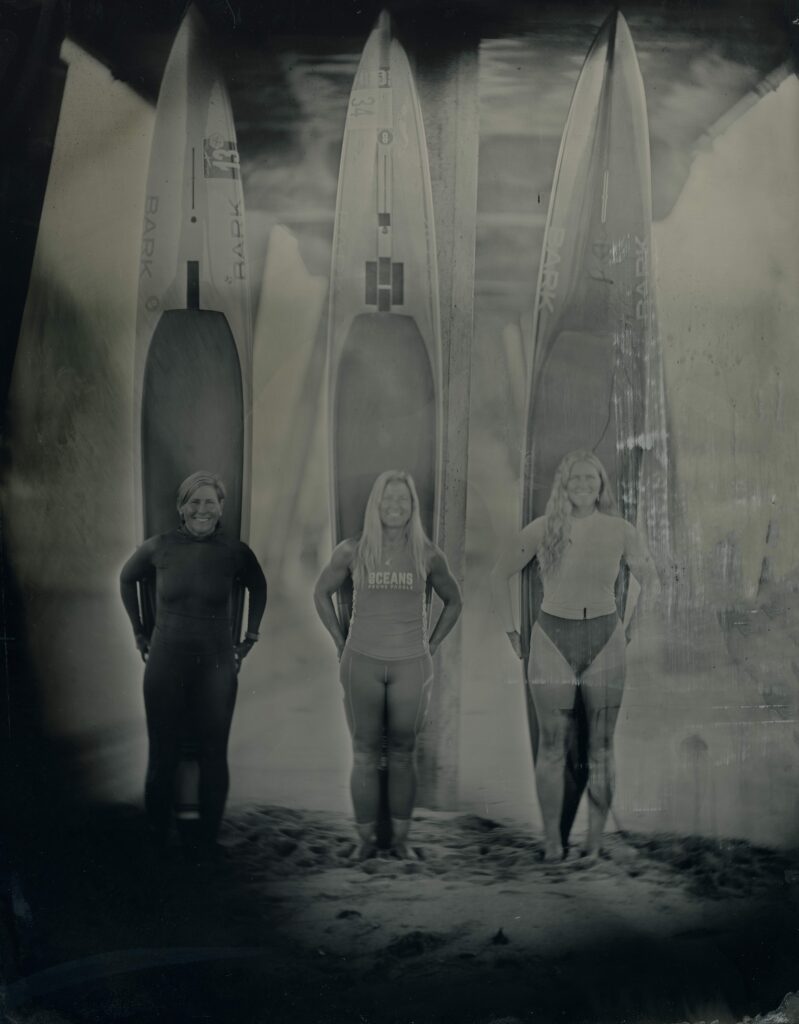
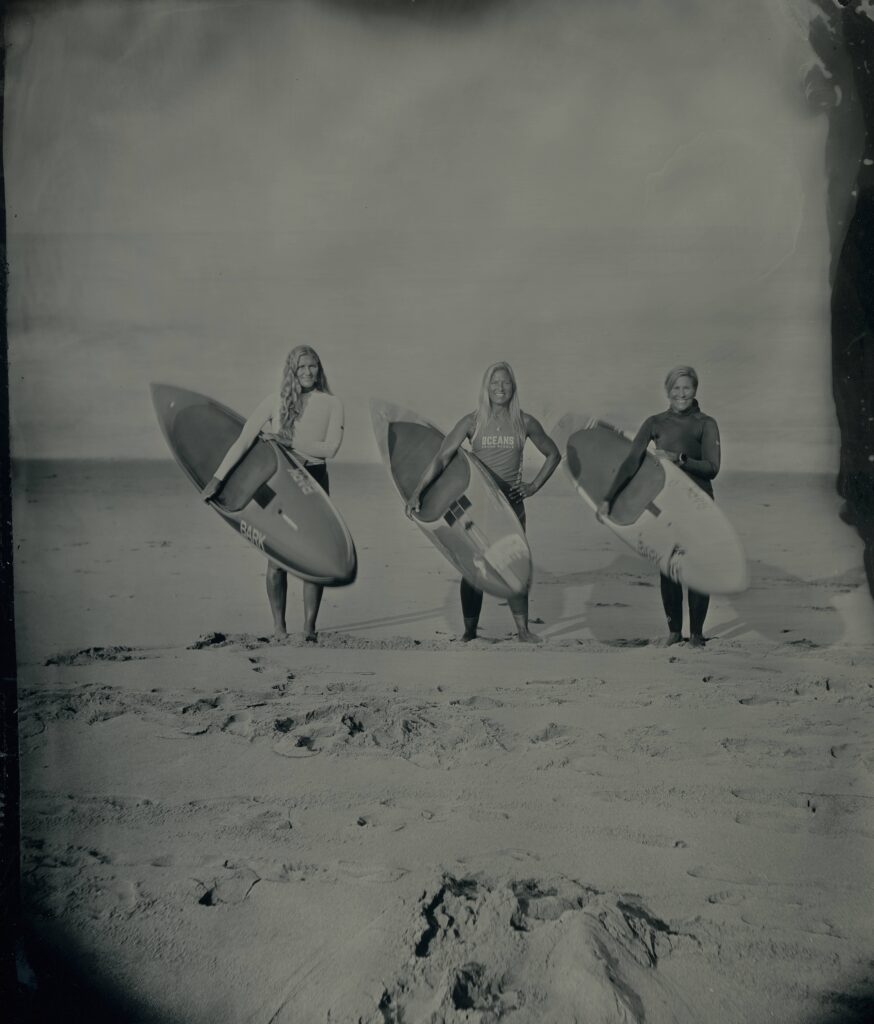
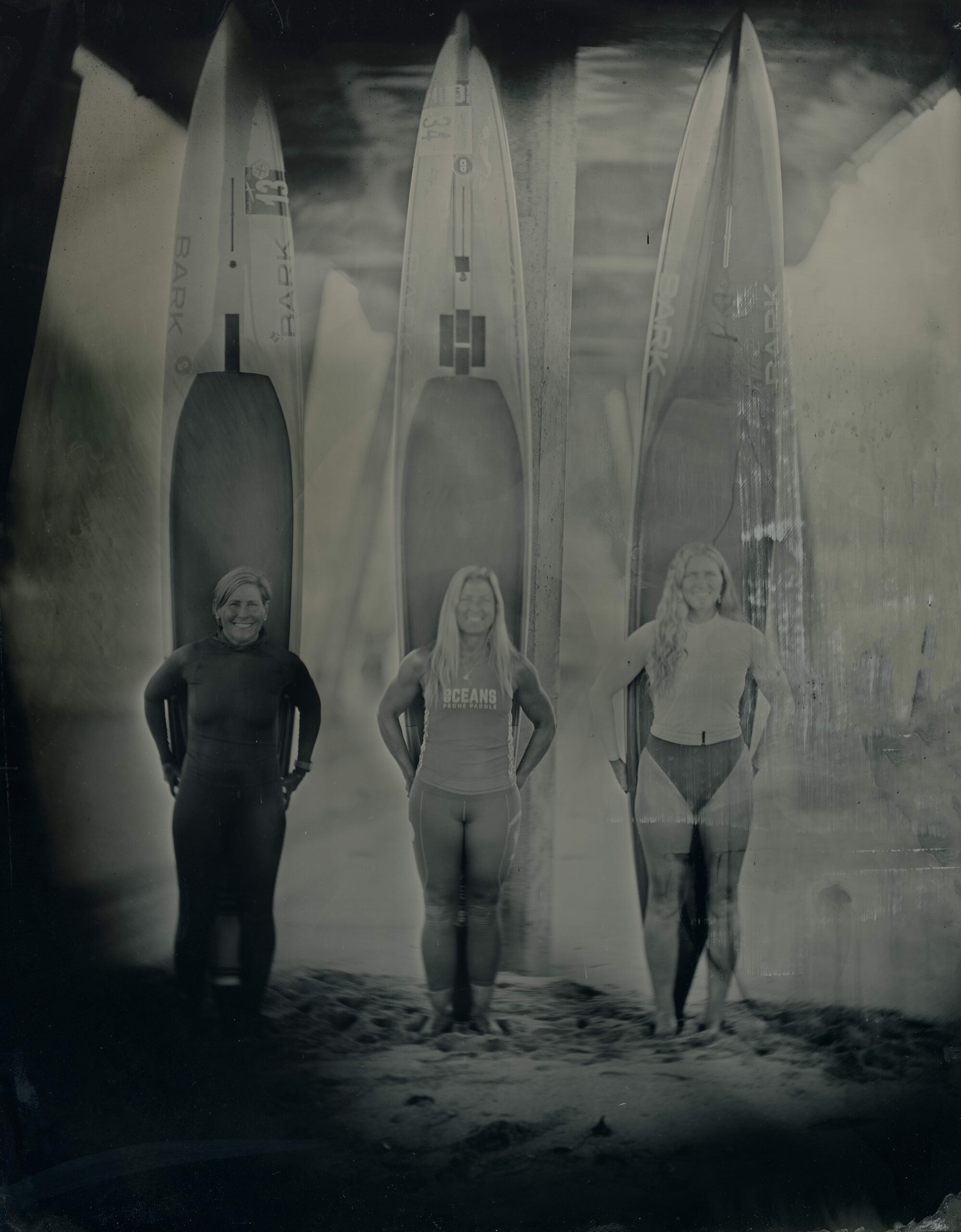
Emily Bark, DJ Wilson, and Amy Dantzler. The 48th Catalina Classic, a paddleboard race from the Isthmus Cover on Catalina Island to the Manhattan Beach Pier on August 24.
Photos By
VANIA ZASK
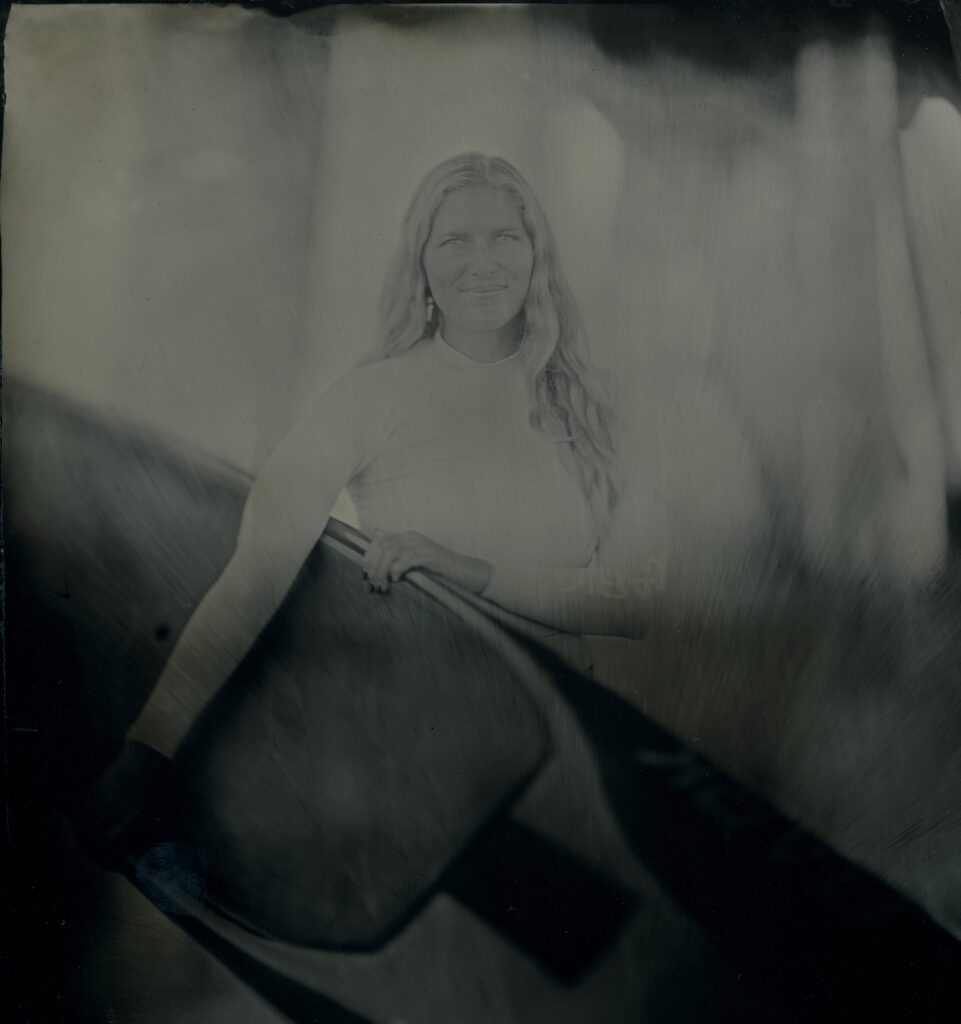
These photos were shot using wet plate photography on aluminum (tintypes) with a Toyo 8×10 camera and a Dallmeyer lens from the 1880s. For more work by Vania Zask, see Instagram @surfmartian
Paddle in the blood: Bark upholds a family legacy
Emily Bark, 26, has been on the beach for every single Catalina Classic since she was born.
In her younger years, she’d watch her dad, Joe, paddle in, and the beach volunteers would hand young Bark the ceremonial lei to place around his neck. “I remember my dad coming in, so tired, and he’d pick me up and would be so excited to see us,” she says.
Now, the youngest of four Barks is on the other side, her dad helming her escort boat and her family waiting on the beach to welcome her home, as she takes on her 5th race.
Long-distance races, and time spent in and near the ocean, are a natural extension of the Bark family’s legacy. While cousins, grandparents, and friends regularly flocked beaches along the coast, summers for Bark and her immediate family were immersed in the Catalina Channel and the historic race. Jack Bark, eldest brother, is set to race in his 14th Classic this year, and all four Bark kids have cemented standings in the 32-mile feat. Her father, Joe Bark, renowned paddleboard shaper, and a legendary waterman, has paddled more than anyone in the race’s immense history, clocking 38 official crossings – 1,216 miles, longer than the combined coastal distance, 1,202 miles, of California and Oregon.
Emily’s maiden crossing was a 22-mile journey from Catalina to San Pedro, completed on Father’s Day when she was in the 8th grade. Jo Ambrosi, seasoned women’s paddler and her mentor that summer, paddled beside Bark the whole way. “[Jo] was [paddling] next to me,” she says, “and my dad was on the boat, and it was the coolest moment of finally crossing a channel for the first time.”
Paddling is a thread that runs through every part of the Bark family’s life, and Emily’s art captures the connection. She drew early inspiration from the Catalina Classic posters adorning her dad’s shop wall, and created her own hand painted and digital designs that blend coastal elements with a nostalgic aesthetic. She brings that same artistry to her surfboards, shaping and painting them by hand. And now, she has designed the very race posters that she used to admire on her dad’s shop wall.
The cadence of the sport was constant. Even long paddles were a normal way Emily moved through the world.
“I was just out there doing it, and typically it would be all the adults and me,” she says. “So it never really felt like racing. It just felt like doing it for fun.”
But last year, Bark shifted from a more easygoing approach to more focused, deliberate training. With that refinement came speed. The 2024 Classic featured the narrowest first place finish in the race’s history, with Liz Hunter, a multiple-year women’s winner and renowned San Diego paddler, finishing behind a victorious Bark by just one second.
“I felt like I had some energy, and so I picked up the pace a little at the end,” Bark says. “She’s so fast, and she was really moving — it was such an honor to race against her.”
What is unique in this competition is that the prize is the finish itself. And so camaraderie reverberates from the start.
“When you’re racing, it’s hard not to think about the people that are next to you,” Bark says. “Every woman on that start line is going to be happy for however you do. It’s a really cool community.”
Last summer, Bark, her brother and a few friends started the South Bay Paddle Club after casual paddles, wanting to get more people in the water. What began as a small crew has grown to 10 to 20 paddlers — most of them her age — meeting for morning R10 runs or evening forays that end with a cold beverage. For Bark, it’s a shift from years spent on the water with her family’s friends to building her own community of peers, including more women. More and more women are competing in the Classic every year, and Emily is intent on seeing that side of the sport keep expanding.
“It would be so exciting to see the race get to 50 women,” she says.
Special words and tokens help carry Emily through each race. Last year, at the bow of her board, she fastened a photograph — her late grandmother, a pillar of her upbringing, and her family at the finish from one of her dad’s races.
“Something very meaningful about these races,” she says, “is the people who are either alongside you at the start, in the water with you, or that are waiting for you at the finish.”
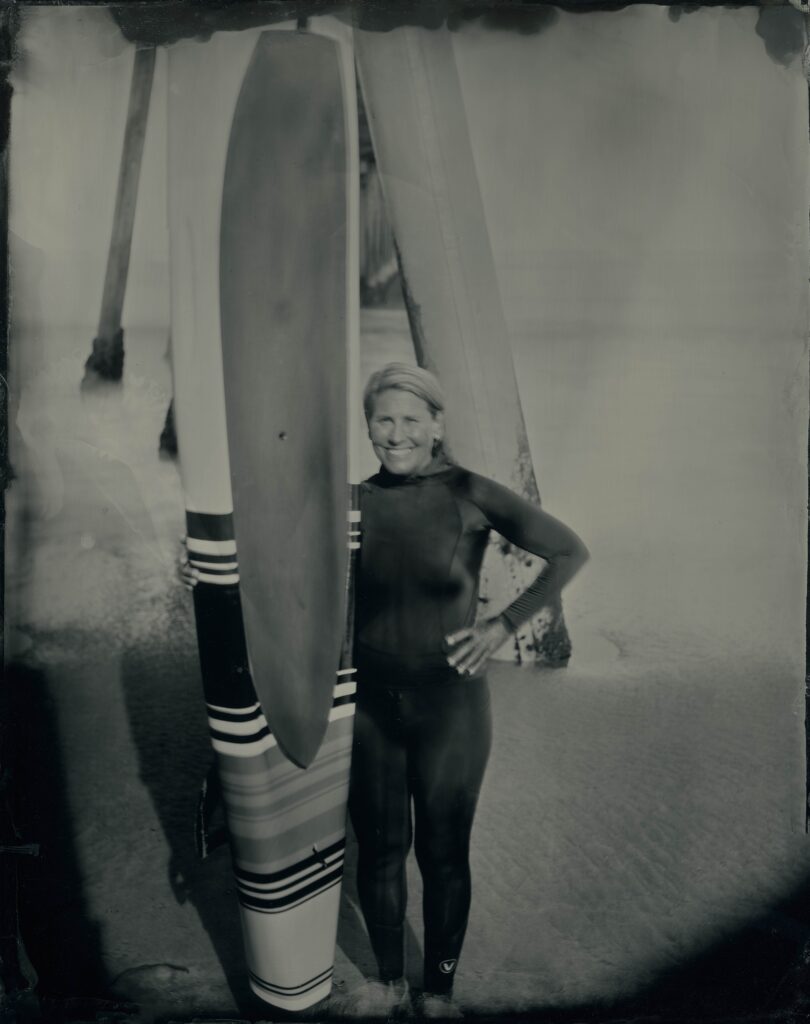
The Crossing: Long distance swimmer Amy Dantzler takes on the Classic
Amy Dantzler is no stranger to the Catalina Channel. Before she ever even touched a paddleboard, she swam across it in the middle of the night.
A swimmer since she was 5, Dantzler, 61, competed in pools throughout her high school and college years until extending her reach in the open ocean – a wilder, unformulated terrain. Training under Penny Dean, an accomplished swimmer who holds records like the 50-mile double Catalina, Dantzler began with local pier-to-pier races and advanced to long crossings like the 9.5-mile swim from Lanai to Maui in Hawaii. In 2014, she joined a record-setting five-person Catalina Channel relay with a time of 6 hours and 57 minutes. In 2018, her open-water journey took her international, where she swam from Asia to Europe on the current-backed waters of the Bosphorus, placing third in an electric finish that felt like an Olympic reception in Istanbul, Turkey.
When she and fellow swimmer Jake Glick decided in 2020 to train for a 20 mile solo Catalina Channel crossing — her longest effort yet — it made for many a late-night. The event starts around 11 p.m. or midnight to account for current, wind and boat traffic logistics.
“We trained at night because we wanted to get comfortable with night swimming, so we would swim at 2:30 a.m.,” Dantzler says.
Dantzler had never imagined she’d be open to night swimming. But when she tried it, she loved it.
After months of training, she and her swimming partner received an unfortunate message after a 10-mile swim. “We got out of the water to an email saying that they had canceled the season because of the pandemic,” she recalls. So she prepared for another year, spending time north on a record-setting circumnavigation of Anacapa Island, a chain of islets with dramatic sea arches off the Ventura coast. After the most demanding chapter of her swimming career, she completed her solo feat in September, 2021 in 9 hours and 42 minutes.
Just two weeks after her crossing, Max First, 5-time Catalina Classic winner, nudged Dantzler toward paddling. For someone who’d spent over 50 years defining herself as a swimmer, the thought of starting from scratch in a new ocean sport — and in her late fifties — could have been intimidating. But Dantzler saw it as another adventure.
Dantzler heard rumblings of mysterious paddle guru, “DJ,” that she should seek out. She didn’t know if DJ Wilson was a man or a woman. When they met, they clicked — endurance-apt women close in age. But climbing onto a stock paddleboard — a 12-foot craft far bulkier than a swim cap — the first time, she was thrown.
“This thing wasn’t what I thought,” she says. “It’s tippy. It’s harder than I imagined.”
She persisted, and after a few lessons and training paddles, Dantzler found her balance. DJ, logging her 17th consecutive Catalina Classic this year, did not take long to pull Amy into the ranks.
“We started paddling together initially,” Dantzler says. “And then the next thing I know, I’m doing the Catalina Classic.”
For Dantzler, the draw to endurance events goes beyond completing the course. The structure of training, setting goals, and the pursuit itself, is part of the reward.
This year will be Amy’s 3rd Classic and 4th long paddle race, coming directly off a two-person Molokai relay with DJ — 33 miles through the tempestuous Channel of Bones. Her first 32-mile Classic proved an initiation: 2023 was a notoriously merciless year, with many exhausted paddlers clawing in past the 9-hour cutoff mark. Dantzler achieved a finish at 8 hours and 38 minutes, in the middle of the women’s pack. But last year she clocked 6 hours and 26 minutes, 4th place in the women’s and just 14 minutes behind the winner. Be it an easy year or brutal grind, whatever the ranking, she keeps the race rooted in fun.
Dantzler is a rare breed in that she does not knee paddle. While switching from prone to knees can relieve tired shoulders and necks – and often lends speed – she stays the course flat. She claims she is not fast, but she’s known to lock into metronomic pace and hold firm, true to her swim roots.
“I’ve always been one gear,” she says. “In the mile, or every 50 or 100, I’d have the exact same time.”
Dantzler continues to raise her game as a paddler, but has not left her beloved swim community behind – she is widening her net. And in paddling, there’s a unique connection across generations, with more young paddlers joining the fold.
“People have been very welcoming,” she says. “I saw someone get in on a paddleboard, and I thought she was one of the young women that I already knew, but I’d never met her. We paddled together for 11 miles, talking and training for the same race. That’s the cool thing about it.
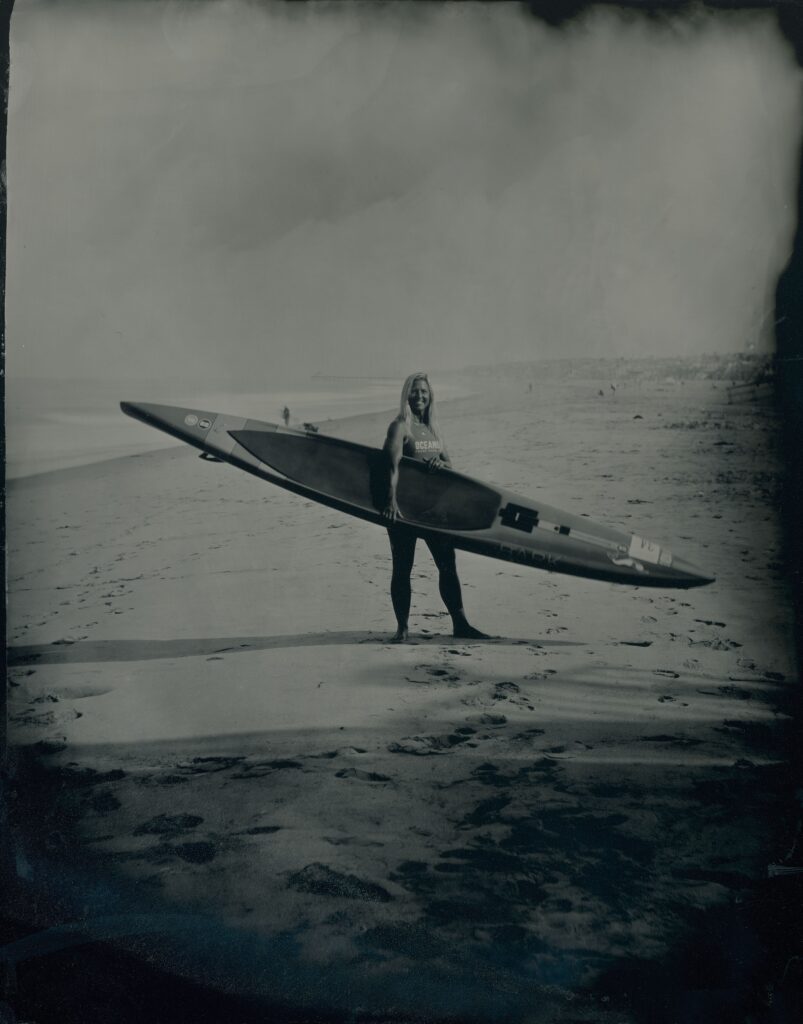
Legend of the channel: The staying power of DJ Wilson
Last year, after Donna Jo “DJ” Wilson’s 16th consecutive Catalina Classic paddleboard race – 17th if you count an unofficial Covid-year crossing — she announced that it would be her last.
“During the race there was a deep hurt in my arms,” she says. “Like something was wrong.”
She finished the race in pain, but in the coming weeks and months she started to feel better. So she kept paddling.
Wilson, a longtime endurance athlete who cycled and swam, found paddling after lobbying Joe Bark, the world’s most acclaimed paddleboard shaper, to let her swim in his 3-mile paddle race in 2000. He turned her down, but handed her a Bark board instead. She won the race.
The allure came quickly. Wilson realized that with a paddleboard, she could cover more water, perch higher, and talk to people. Months later, she got a brand-new Bark board for Christmas. She took out that same day in harrowing surf, sitting nearly an hour past the surf line before finding a narrow window to scratch in.
Though she and paddling fell into lockstep, it once was unlikely DJ could ever finish one 32-mile race. After a severe back injury in early years and a spondylolisthesis diagnosis, a doctor wanted to do surgery. He told her, “I don’t know how you’re walking.” But DJ, a longtime pediatric physical therapist, forewent surgery, and she credits paddling as some of the rehabilitation her back needed. “It’s like I have this paddle belt around my body keeping me strong. My back feels great.”
As Wilson continued to build strength in the water, she also began building a current of women around the sport. In 2006, she founded the South Bay Mermaids, a women’s paddle group where not everyone was training for long races, but they were having a great time.
“You got these wonderful women who love the ocean,” Wilson says. “We’re all like-minded, and we had so much fun training together and getting better and being excited.”
Before 2007, the year DJ first entered the Catalina Classic, there had been no more than three women on the startlist since the race was officially founded in 1982. In her first year, her paddle group helped to nearly quadruple the record for most women entries, and this years’ race will see the largest number of women participants in the sport’s history.
“To see it growing means everything to me,” she says. “Women are good at this sport. Women have endurance, women have balance, women have fire and competition. We’re built for this.”
In 2023, one of the toughest years on record due to tumultuous conditions, the LA times described the historic paddle race as “32 miles of torture.” To most, it’s an otherworldly feat to sweep past more than a marathon of water with your hands. But to DJ, there are no low points. She knows our capabilities far surpass what we think we can do. “I know I can do anything for five more minutes.” And she’s helped many to lean into their unknown borders and have fun doing it.
While the Mermaids still exist in looser congregation, DJ and her partner Kurt, whom she met paddling in 2015, have been running training via Oceans Prone paddle since shortly after they met. With paddleboards difficult to lug and cost-prohibitive, they provide boards to paddlers and get people excited about training, racing and being out on the water. That passion for getting women – and anyone – in the water is a driving force for DJ, who, in her 20 years as a pediatric physical therapist, has worked and paddled with countless kids. Some of those children are now adults, and she still takes them out for paddles.
In this year’s Classic, more young women are starting, and she’s excited for them to experience the feeling of getting closer to the pier, hearing the horn blaze, and emotional embraces from friends and family on the beach — the feelings only a finisher knows. A two-time winner, she’s relaxed herself on the competitive angle. Her focus is on the joy of the effort itself.
“There’s just nothing like doing something so hard for yourself, by yourself, with your arms, that people think is crazy,” she says.
She has already completed more Classics than any other woman in the history of the race. Her goal is to complete 20. But for Wilson, one of her whys isn’t hers alone — it’s shaped by the kids she’s helped over the years — some of whom have passed.
“I paddle for all these kids that I know can’t ever do this,” she says. “So I’m going to give it my all.”