
A SOUTH BAY
ORIGINAL TAKES
HER PLACE ON
THE WALK OF FAME
by Mike Purpus
Laurie Wilson: Hermosa’s Fearless Goofy-Footer
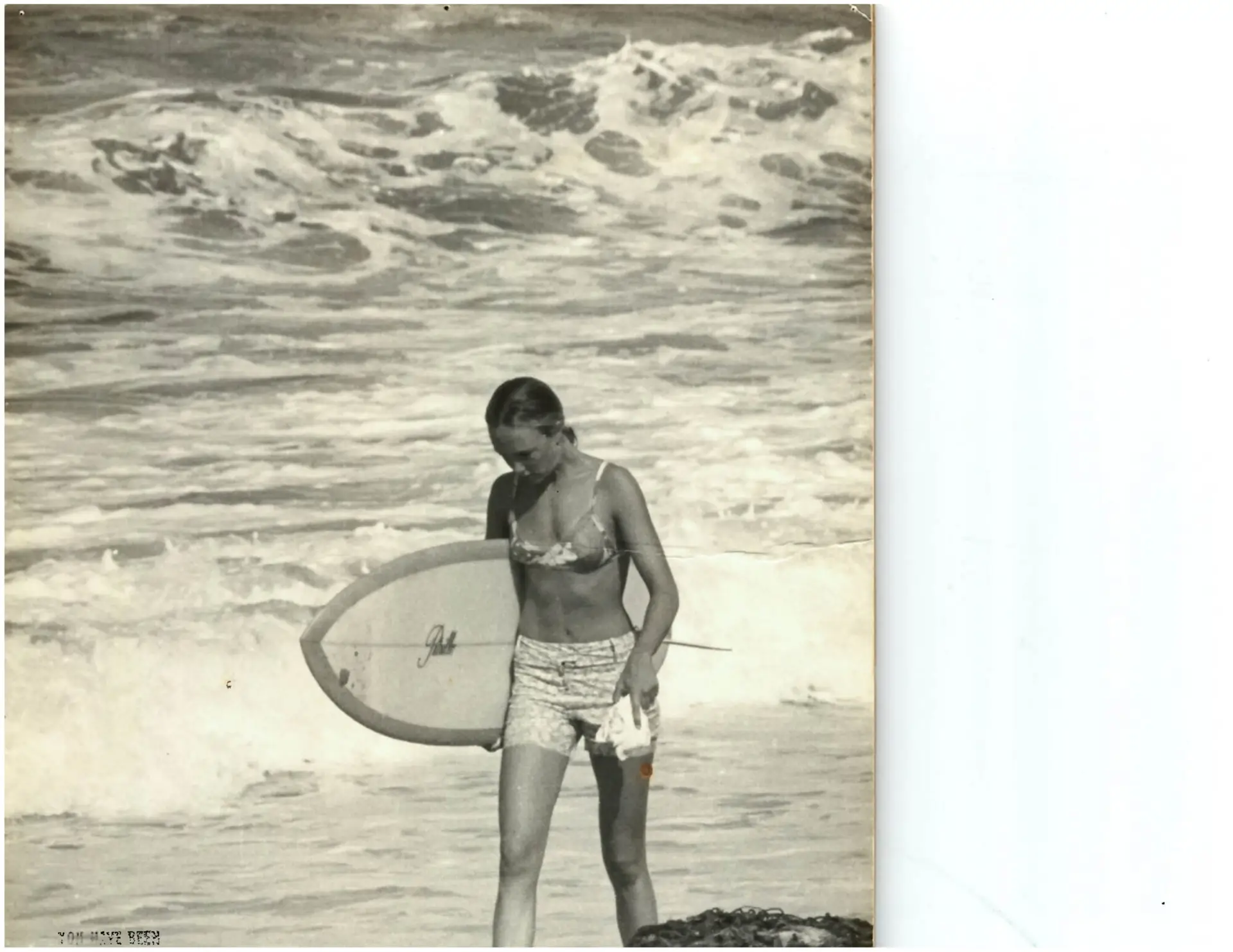
She was tall, tan, and blond, a goofy-footer with fire in her surfing — a mean backside off the lip, threading fast rights with the kind of aggression that turned heads in an era when girls were expected to cruise the curl and look pretty doing it. Laurie Wilson didn’t cruise anything. She attacked.
On April 25th, Laurie Wilson gets her plaque on the Hermosa Beach Surfers Walk of Fame, and anyone who ever watched her tear apart the pier break will tell you it’s overdue.
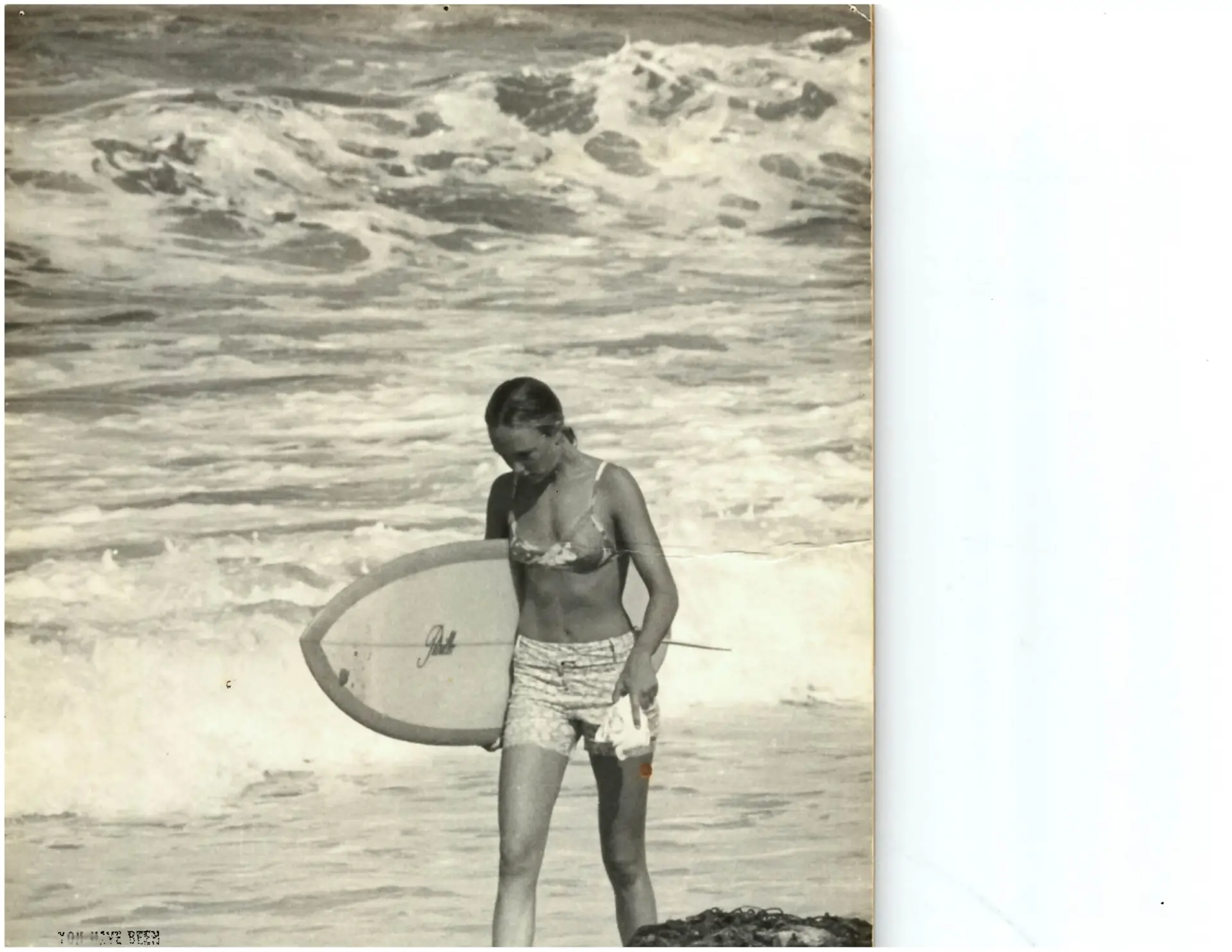
Growing up ten feet from the sand at 8th Street in Hermosa Beach, surfing wasn’t a choice so much as an inheritance. Her parents bodysurfed every day. Her older brother Jeff was already out in the water, and by age ten, Laurie was planted at the water’s edge, waiting for him to wipe out so she could sprint down and retrieve his board.
“I would sit at the water’s edge waiting for Jeff to wipe out,” she recalls with a grin. “I ran down retrieving his surfboard and paddling it back out.”
Eventually Jeff started shoving her into waves on his 9-foot Cidello. A few years later, she was catching them on her own.
Jeff’s crew — Jim Cuberly, Bill Lacy, Alfred Laws, Mike Stevenson, and John Baker — kept an eye on her and, whether they knew it or not, helped shape the surfer she’d become.
“They were all good surfers that inspired my aggressive style,” Laurie says.
The South Bay women’s lineup in the mid-’60s was thin. Josette Legadaire, Margo Scotten, and Judy Carillo were the standouts. Linda Benson and Candy Woodward — both honored today on the Hermosa Walk of Fame alongside Josette — were winning contests up and down the coast. But Laurie was watching someone else.
“They were good surfers,” she says, “but they had a pull-in-the-curl, cruise style. I wanted to surf like the hot guys — attacking the lip, shooting down the line.”
Her inspiration came from the surfers who congregated around Dru Harrison’s beach house at 15th Street, where Hermosa’s finest stashed their boards under the deck and paddled out at first light.
“I remember one hot, four-foot day,” Laurie says. “The north side of the Hermosa Pier was perfect. The best surfers were running down to the water from Dru’s house with a cup of coffee in their hand.”
The names reading off the lineup that morning sounded like California surfing royalty: Donald Takayama, David Nuuhiwa, Tiger Makin, Eddie Underwood, and Steve and Chris Schlickenmeyer.
“Those were the best surfers on the coast,” she says. “It was as good as surfing gets.”
The only footnote to the legend of Dru’s house: one summer night, thirty surfboards disappeared from under that deck — vanished into the South Bay night.
By fifteen, Laurie had entered the Western Surfing Association circuit, the proving ground that ran from San Diego all the way up to Santa Cruz. The WSA ran three divisions — Single A, Double A, and Triple A — and the top thirty surfers in Triple A were considered the best in the country. Magazines covered the events. Cameras rolled. Sponsors watched.
Laurie moved up the ladder fast.
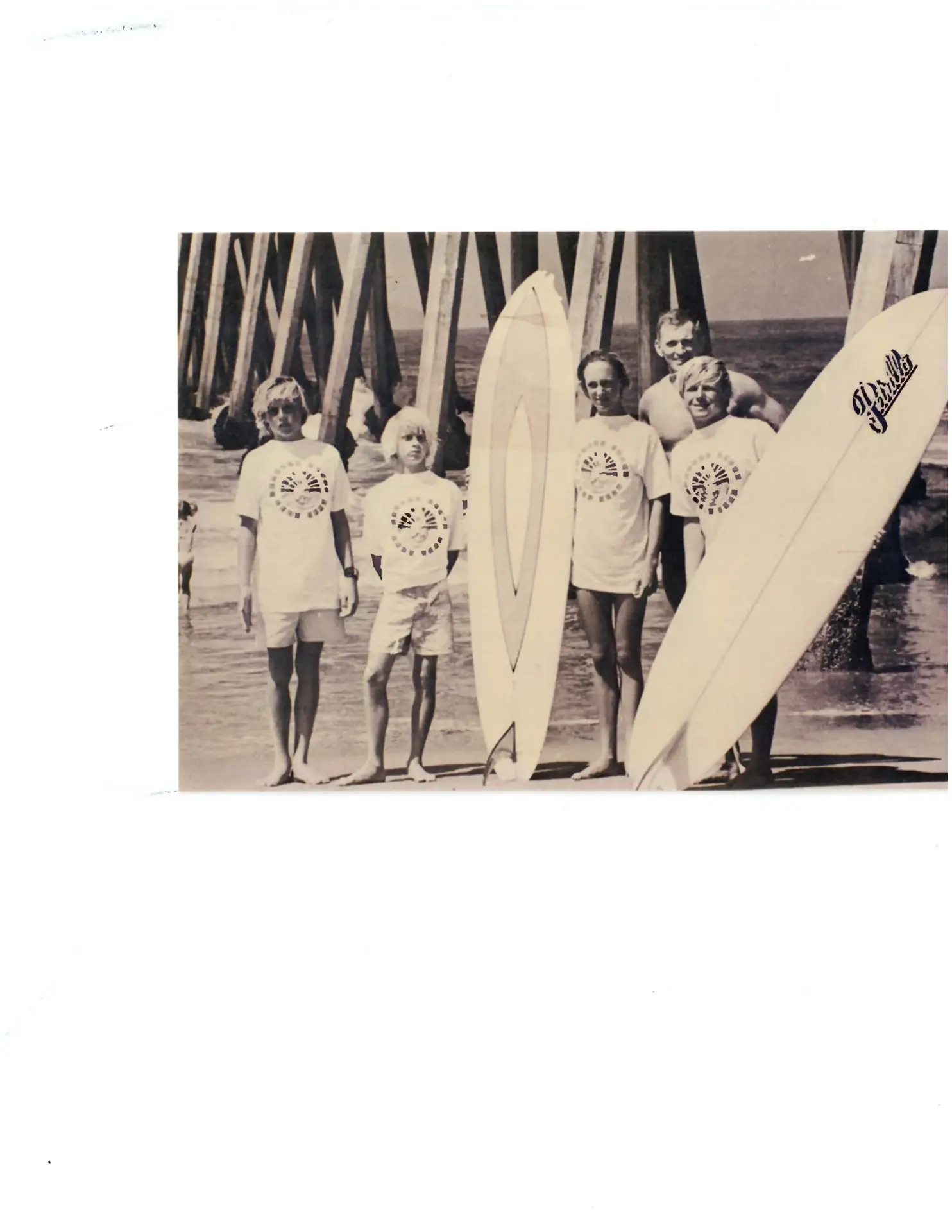
She landed free boards from Petrillo and wetsuits from Sea Suits, and she, Mark McMillen, Paul Mooney, Chris Barrows, and Mike Purpus were soon cutting through lineups on matching 6’6” boards painted in blazing red, yellow, and orange — hot-looking surfboards that got plenty of attention.
The crown jewel of South Bay surf competition was the Hermosa Beach Surfing Championship, held as part of the Lifeguard Invitational Surf Festival — a sprawling event that brought lifeguards from around the world to compete in swimming, paddling, and dory races alongside the international surfing championships at the pier.
In 1972, Laurie won the women’s division.
“It’s the only surfing trophy I still have,” she says.
No coming-of-age South Bay surf story is complete without a Trestles run, and Laurie’s is a classic.
This was the mid-’60s, when sneaking onto the Camp Pendleton Marine Base to surf the perfect right-hand point break at San Clemente was both a rite of passage and technically illegal.
The Marines patrolled the trails. They confiscated boards. They’d make you come back with your parents and sign a contract promising a ninety-dollar fine for the next offense. They hid in the bushes waiting for someone to lose a board in the shorebreak — long before the days of leashes.
Laurie lost hers.
The Marines grabbed it.
She turned to me screaming to get it back. I wouldn’t confront the Marines because I didn’t want to lose my brand-new board. Every surfer in the water watched the drama unfold. The Marines marched Laurie back to the boundary and eventually returned her board.
“Laurie was mad at me,” Purpus recalls, “but everyone laughed all the way home.”
By the early ’70s, Laurie and the Hermosa crew were a legitimate force in California surfing. But women’s surfing was still fighting for respect. The sellout surf movie nights at Pier Avenue Junior High were almost exclusively male affairs, and the culture hadn’t yet fully opened its arms to female surfers.
The WSA was fading.
Laurie found another wave to ride.
At Redondo Union High School she’d picked up basketball, and she was good — good enough to earn a grant to play at University of California, Santa Barbara and eventually a spot in the first women’s professional basketball league.
“My coach got me into The World Basketball League,” she says.
In 1978, she signed with the Minneapolis Fillies.
“Basketball was a lot of fun and I was getting paid just to play.”
The league folded after one season in 1979, and Laurie came back to what she’d always known — the ocean.
She drifted north to Santa Cruz from 1983 to 1988, worked a long career with FedEx, kept boards in Hawaii where she still returns at least twice a year, and never stopped surfing whenever the waves and her schedule aligned.
When Laurie Wilson looks back at Hermosa Beach in the late ’60s, what she sees is a place and moment that can’t be recreated.
The best shapers in the world were building boards here. The best surfers in the world were riding them here.
“It was surfing’s best era,” she says, “and I was part of it.”
On April 25th, her plaque goes up on the Walk of Fame — a long overdue honor for a goofy-footer who surfed like the hot guys, because she was one of them.
Mike Purpus is a South Bay surf legend, former WSA competitor, and longtime chronicler of Hermosa Beach surf culture.