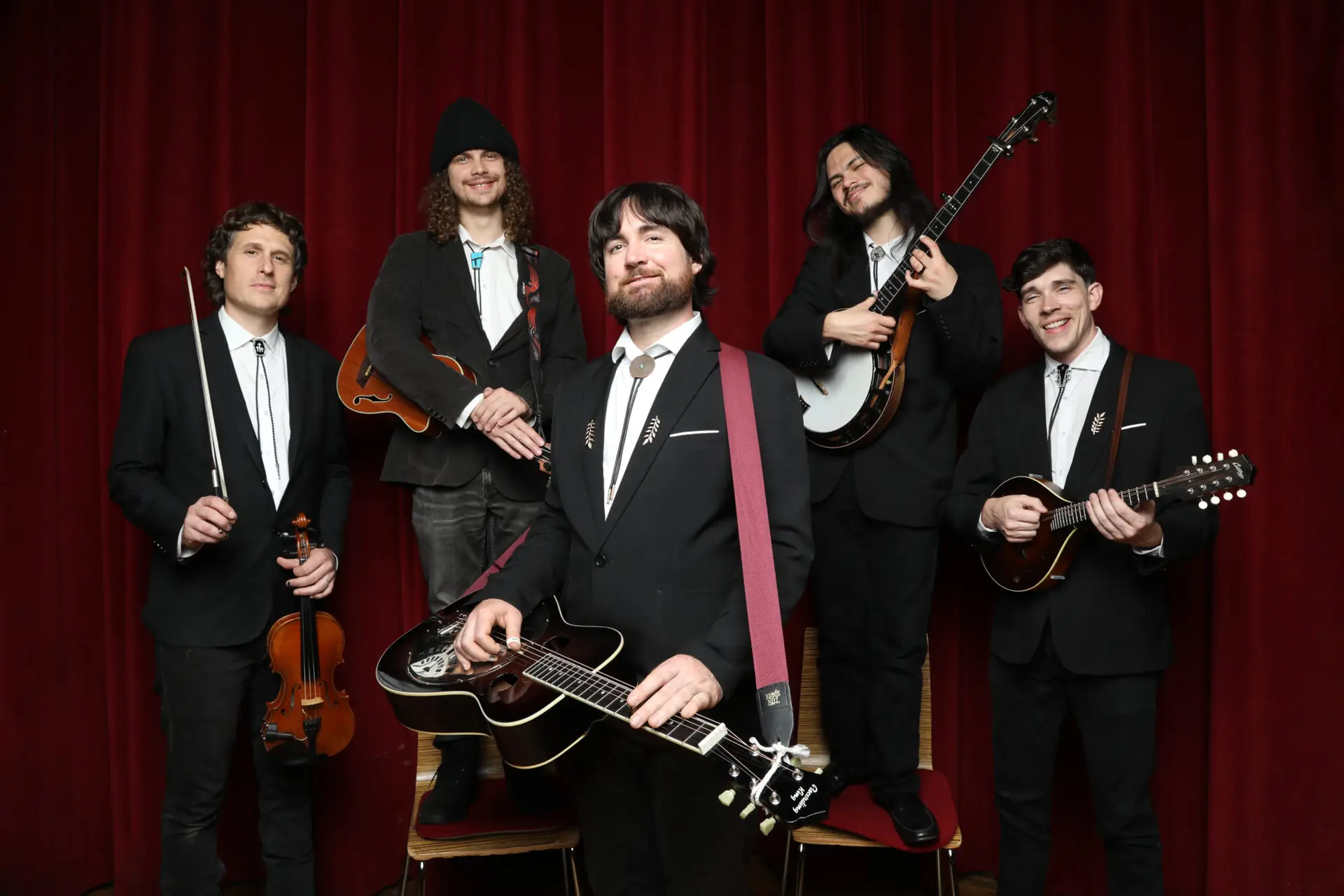
Kenny Feinstein doesn’t wait for the world to come to him. The boundless bandleader of The Water Tower String Band has spent the better part of his life walking up to strangers — at freeway off-ramps, street corners, car windows rolled down at red lights — and playing music right in their faces.
Equal amounts spunk and punk, Feinstein herds his bandmates the way a cattle dog works a field: constant motion, no stragglers, always moving toward the next watering hole. It’s a manifesto as much as a lifestyle, and it has taken Water Tower from the rain-soaked off-ramps of Portland to The Vans Warped Tour, to opening night for The Lumineers, to sharing a stage with 311’s Nick Hexum — one converted stranger at a time.
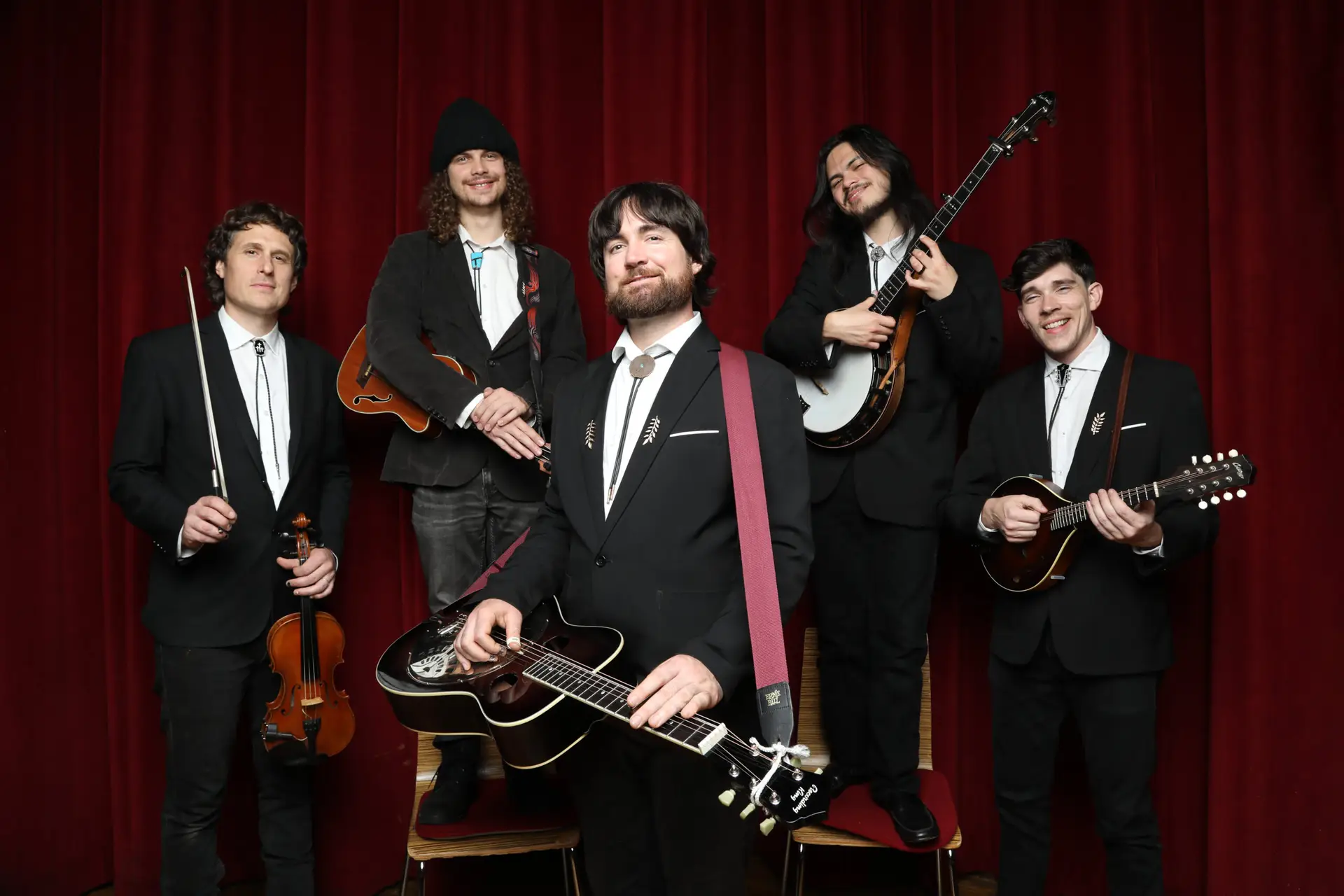
The band’s current lineup snapped into place by accident and fate colliding in Hermosa Beach. Banjo player Jesse Blue Eads showed up to his regular busking spot at Pier Plaza one afternoon to find Feinstein, Tommy Drinkard and company already picking at his post up. Jesse, surprised and impressed, didn’t wait for an invitation. He just joined in, and The Water Tower String Band has been complete ever since.
Feinstein came to bluegrass the way a lot of people find the thing that changes their life — sideways, at sixteen. He was playing in punk bands, running through Blink-182 and Offspring covers, when a friend dragged him to a square dance headlined by Foghorn String Band. He sat at the bandstand for three hours and barely moved.
“Everything made sense,” he said. “I fell in love with the sound of the fiddle, and the mandolin, the banjo, the guitar, and the bass that night. My whole life turned around.”
What hooked him wasn’t just the sound but the history underneath it — the collision of Gaelic fiddle tunes that crossed the Atlantic from Scotland and Ireland, meeting the African musical traditions carried on slave ships: the gourd banjo, specific melodies, rhythms that fused with European forms and became old-time dance music. Then Bill Monroe arrived in the 1930s, stirred in jazz, blues and country, and bluegrass was born — performance music carved from the bones of something older and wilder.
The punk-to-bluegrass pipeline is not as strange as it sounds.
“It’s fast, it’s in your face, and it’s just telling it like it is with three chords,” Feinstein said. “One of my favorite punk bands, Global Threat, had the motto: three chords, blood, sweat, no rewards. That’s so punk rock, but it’s so bluegrass too.”
His life’s mission has been bringing those two worlds together. Strip the distortion off a Ramones song, a Misfits song, a Blink track, and what you’re left with is a bluegrass song. He’s sure of it, and Water Tower has spent years proving it.
The band came up the hard way, traveling the high lonesome road to where they are now. Feinstein started busking at twelve. By eighteen the band was working. By twenty-one they were touring the world. They moved from Portland to Los Angeles not despite the traffic but because of it.
“We’re probably some of the only people who moved to LA for the traffic,” he laughed. “There’s good traffic here.”
The cops in Portland kept ticketing them. The rain shut them down six months a year. In LA, he said, the cops tip them.
The off-ramp became their laboratory. Feinstein kept notebooks — actual notebooks — cataloging which exits paid and which ones didn’t. Artesia: $150 in an hour. Seal Beach: a cop’s finger wag. They worked five hours a day, seven days a week, testing new material one car window at a time. A good set of lights buys you thirty seconds with five cars in a row. Try a line, watch the reaction, change a word, shift the melody, and when the money starts coming in, you’ve got a song. It is the most honest A&R process in the music business.
“When a song starts to pay up, that’s how we know it’s a good song,” Feinstein said.
Their unlikely breakthrough onto social media came during the pandemic, when off-ramps were suddenly unavailable for the first time in the band’s history. They took what they did in traffic and started streaming it. It worked because it wasn’t a performance — it was documentation. Years of action developed face-to-face with strangers translated naturally to the lights and cameras.
The underground railroad that guides their touring life came from Gil Landry of Old Crow Medicine Show, who spread out a hand-drawn map of the best busking spots across America during an early encounter in North Carolina — alleyways in New Mexico, a specific block in San Francisco — enough waypoints to connect four shows across 3,000 miles and keep the band fed in between.
Old Crow are heroes to Feinstein; they were discovered busking outside a drugstore when Doc Watson’s daughter heard them and called her father down. Doc Watson booked them at MerleFest on the spot. Water Tower took that story as instruction.
Old Crow’s Ketch Secor has mentored Feinstein on the road, and the band has since collaborated with Willie Watson on several songs. True ambassadors, Water Tower were the first bluegrass band to play Warped Tour. They got invited back.
Punk legend Don Bowles of the Germs produced their debut record, a concept album about Feinstein’s journey from Portland to LA through addiction and back — a seven-year project that drew on Sparklehorse, Elliott Smith and the Velvet Underground, its artwork a deliberate riff on Lou Reed’s Transformer. It arrived in 2020, and it sounds like nothing else in bluegrass. That’s the point.
Water Tower will bring all of it — the off-ramp philosophy, the punk attitude, the old-time reverence, the sheer physical joy of live music played close — to the BeachLife Festival in May. Find them, get close, and don’t be surprised if Kenny Feinstein walks straight up to you and fiddles in your face. That’s the whole idea.
Water Tower played BeachLife May 2. Photo by Michael Scott Evans.