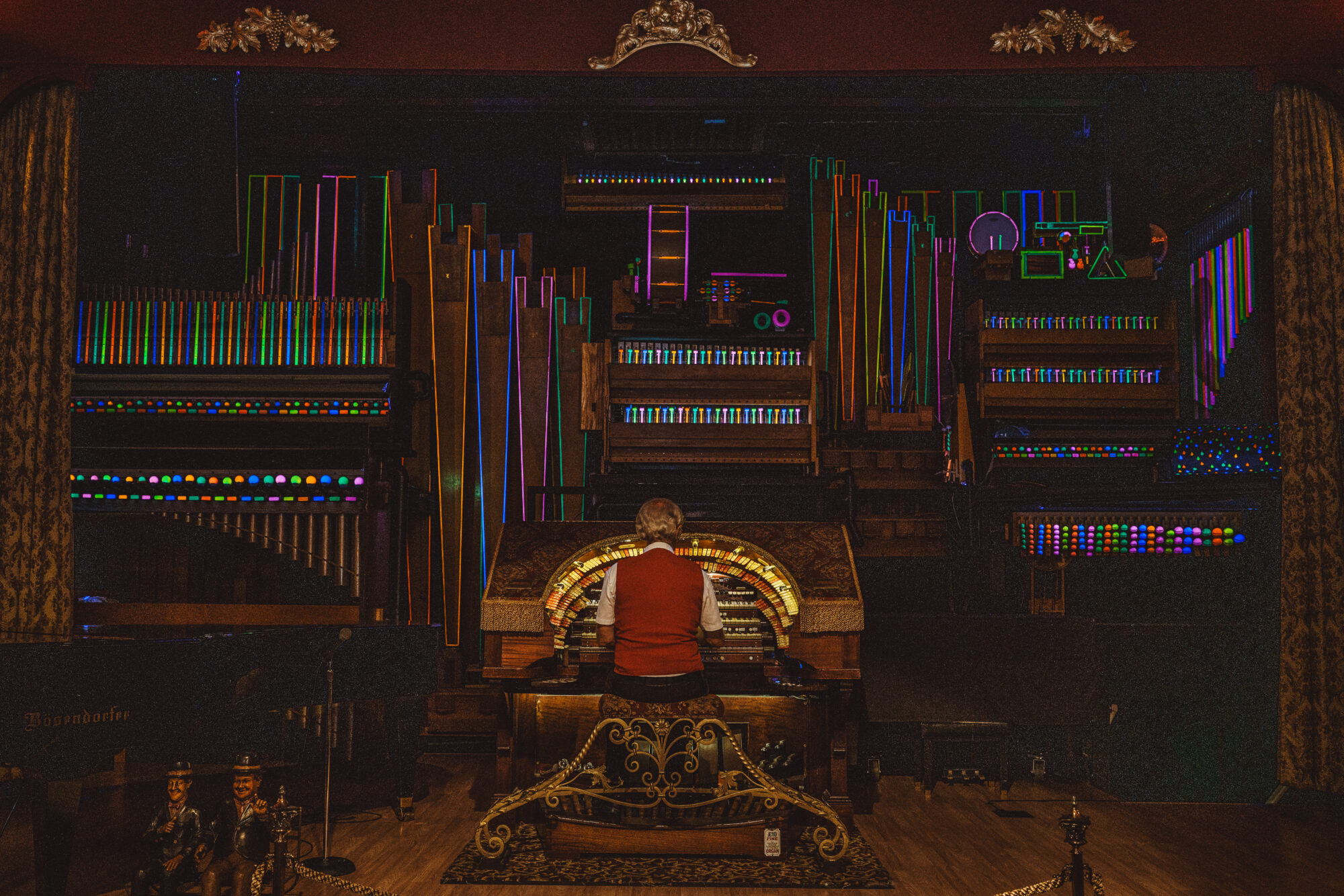
Old Town Music Hall’s crown jewel, the Mighty Wurlitzer Theatre Pipe Organ.
Words By
JEFF VINCENT
Images By
JESSIE LEE CEDERBLOM
There’s a hidden gem in the South Bay, glowing in plain sight. Those who know: have been. But too often, even just a block away at El Segundo Brewing Company on any given weekend, someone’s sipping a Standard Crude with no idea that it’s waiting just around the corner. Or maybe they’ve some foggy notion that the place exists, but haven’t made a point of actually going and aren’t really sure exactly what it’s all about.
It’s a house of magic. A living relic, and breathing museum. A cultural sanctuary, beating with the pulse of yesteryear’s celluloid heroes and villains. It is… your proverbial passport to a different time.
The first time I ever went to the Old Town Music Hall, some 15 years ago, it was an October showing, when the lobby is laden with monsters and filled with frights, a few ghouls have reserved seating in the back rows, and the stage is littered with a festive fall foliage of skeletons, jack-o’-lanterns, spiderwebs, witches, and the like. As a later arrival (predating assigned seating along with online ticket sales), I was situated as close to the screen as anyone in the audience can be. But someone was about to sit closer…
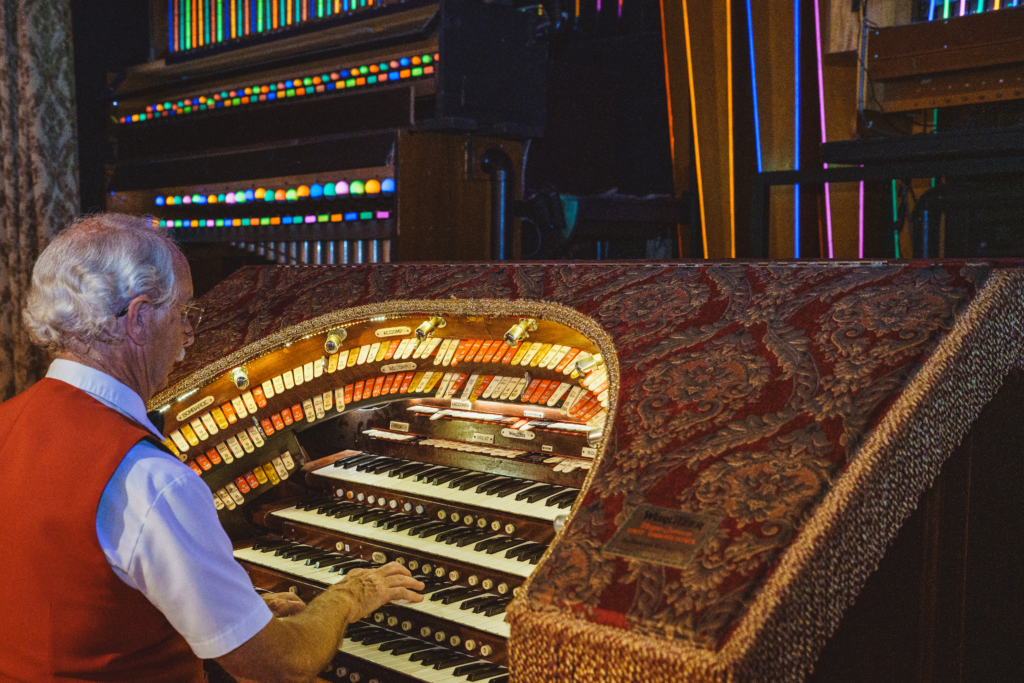
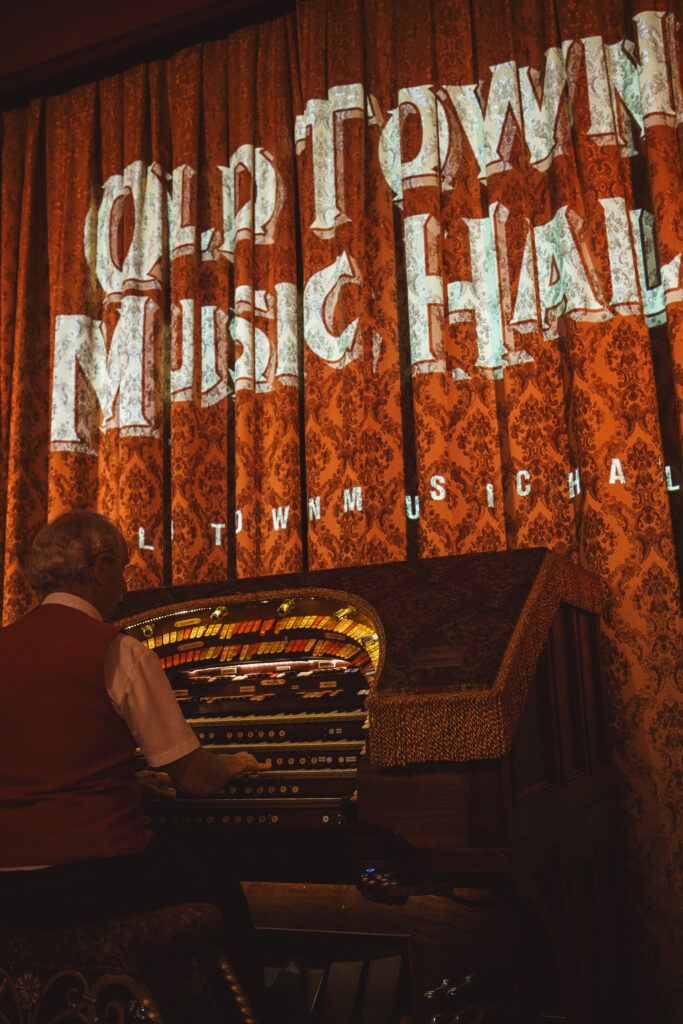
Stirling Yearian manning the controls.
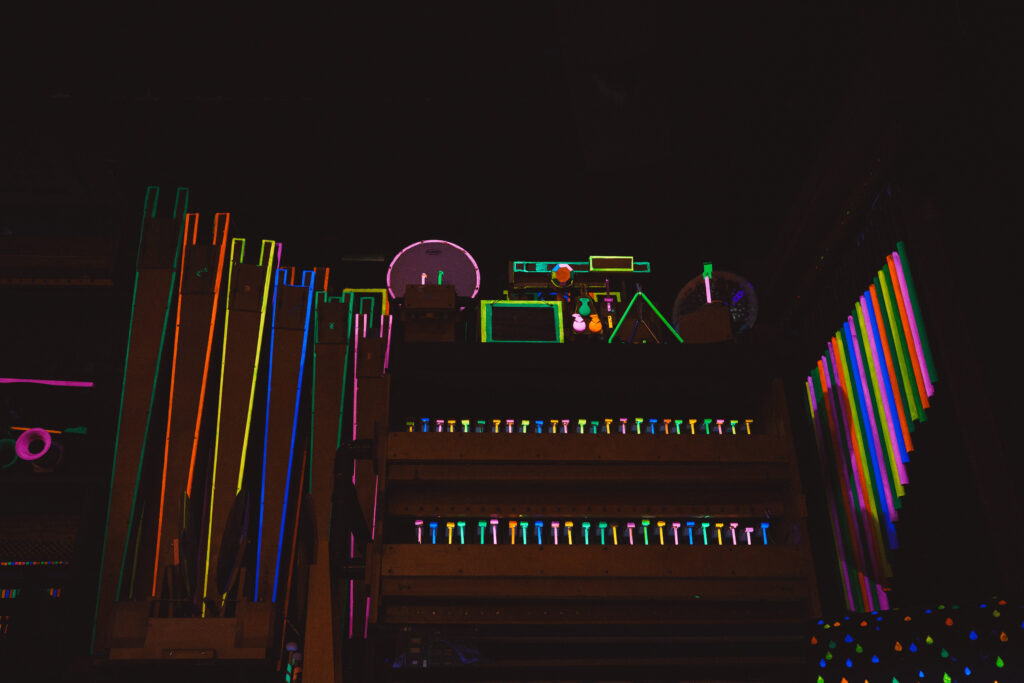
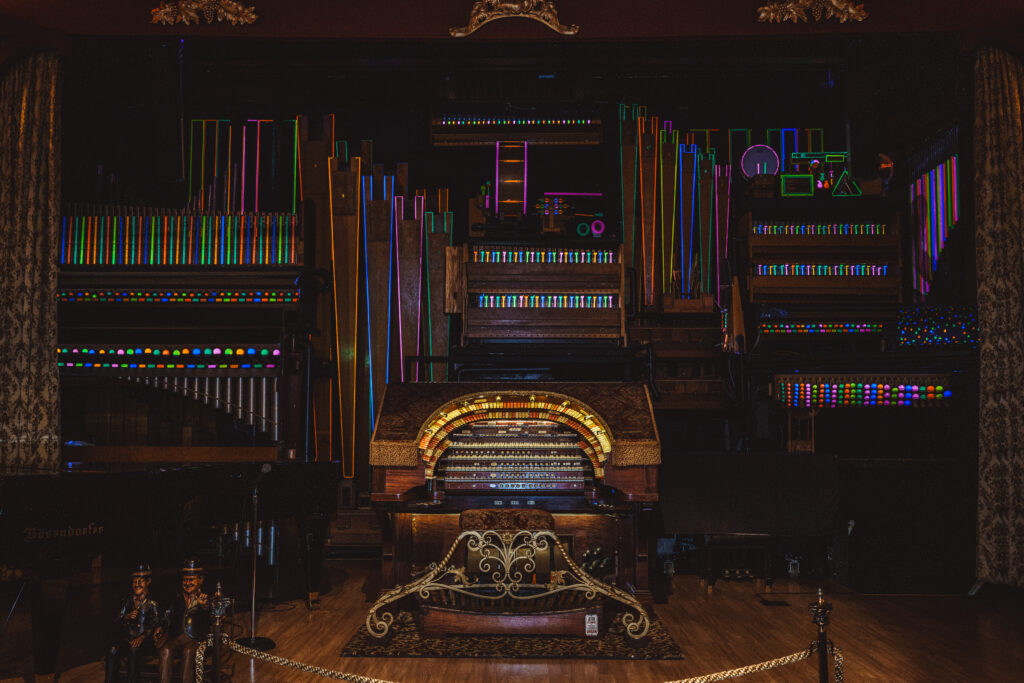
A wizened elder came rolling down the aisle on a Rascal or Lark scooter, and up a little ramp to an ornate bench upon the stage, where he slid over to take his place upon the throne before what appeared to be the controls of a Martian spaceship. As the curtains drew open, they didn’t unveil a screen; but a literal labyrinth of pipes and percussive instruments towering up to the ceiling, all aglow in bright, multicolored blacklight paint. A breathy atmosphere radiated into the room, as the wizard of the keys began to play.
Transfixed and utterly mind-blown, my front row view revealed an elegant master of ceremonies who seemed to tinker and toil with the ease of at least twenty fingers and five legs over four keyboards, 260 switches and tabs, an array of controls, and even a foot-operated floor board of wooden piano keys. I’d officially been initiated to Old Town, and what a night out at the movies was like a century ago, when a live human provided the sound for silent film. And to think, that once upon a time this maniacal machination of mankind was somehow more convenient and expedient than just inventing film with sound.
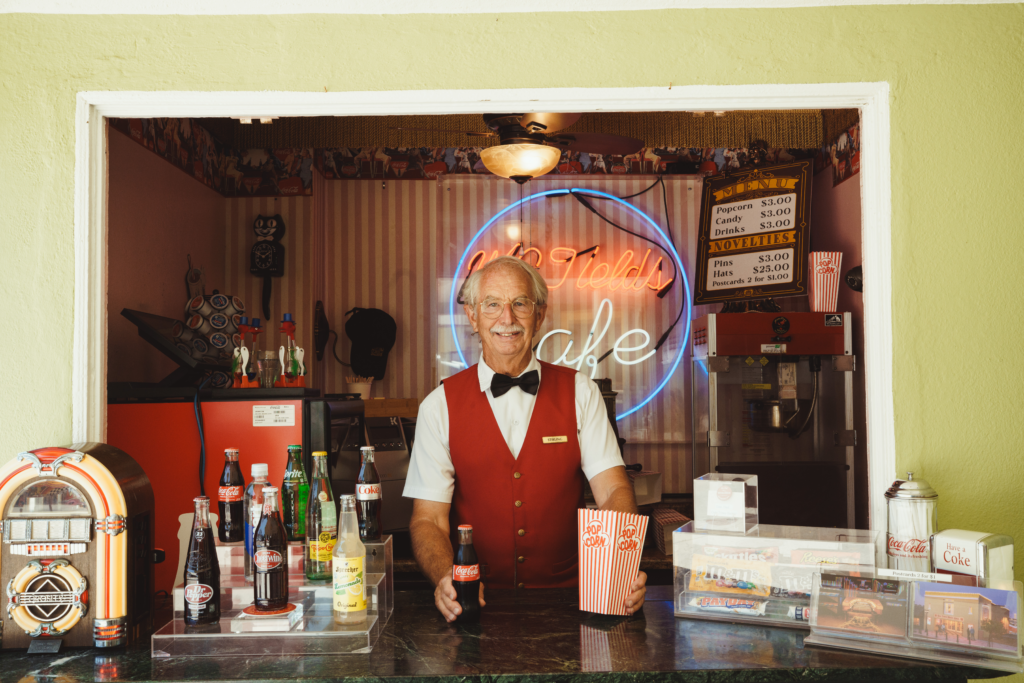
Old Town’s snack bar keeps it affordable.
THE SOUND OF SILENCE
In an age when 30 minutes of overstimulating previews constitutes a coveted movie-going experience not to be missed all on its own, it might be difficult to imagine a time when newfangled still photos ushered in the quiet dawn of motion pictures. When films first appeared in the late 1800s, decades before most homes in the United States would even have electricity, they were without sound. In the early 1900s, theatre organs replaced expensive live pit orchestras to provide musical and aural accompaniment for movies. Traditional church organs were initially relied upon; but by 1910, English engineer Robert Hope-Jones and the Cincinnati-born, New York-based Rudolph Wurlitzer Company (founded by German immigrant Franz Rudolph Wurlitzer) collaborated to create what they called the Unit Orchestra, allowing a sole organist to become a one-man orchestra. Old Town Music Hall is home to such an artifact.
The crown jewel of the Old Town Music Hall is a Mighty Wurlitzer Theatre Pipe Organ, built in 1925. Not only is it a stunning marvel to behold visually, but it places all the sounds of a full orchestra, including percussion, at the fingertips and foot stomps of its operator, along with cinematic sound effects such as sirens, train whistles, thunderclaps, and horse hooves, not to mention some of those more exotic leanings like xylophones, marimbas, or chimes. This gorgeous monster boasts more than a staggering 2,600 pieces, with the largest pipes standing at a menacing 16 feet tall, while the smallest are just the size of a pencil. And the whole dang thing is entirely acoustic—powered by wind generated from a 10-horsepower electric blower, with a low voltage system operating electromagnets that open valves to admit air into all the pipes. Maniacal. And to make it an even rarer breed, talkie films (moving pictures with sound/dialogue) were introduced by 1927!
I’ve been in the belly of the beast, literally—I was taken on a tour of its inner workings. And it’s like being inside an excited dragon who’s furiously huffing and puffing about a hobbit trying to steal his gold.
It was Bill Field on that fantastical-feeling fall night of my initiation, taming the beast while manning the console of the Mighty Wurlitzer, as he had every weekend since 1968 when he and Bill Coffman injected new marrow into the sturdy bones of this early 1920s edifice.
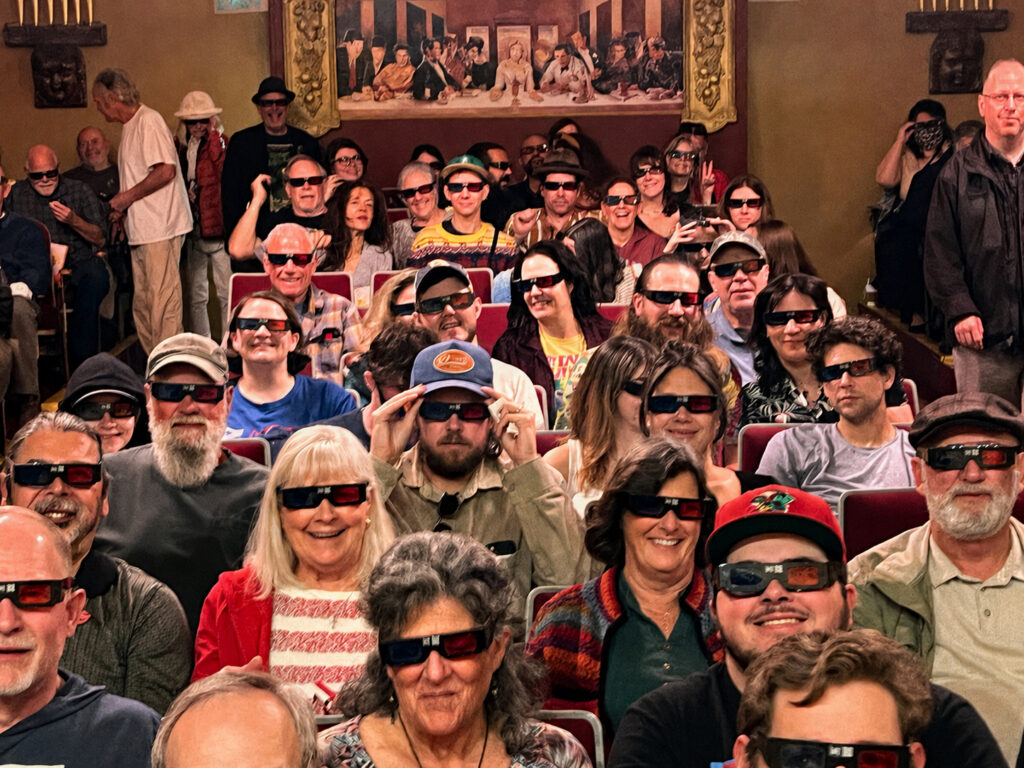
Every year, Old Town usually shows a couple 3-D sci-fi flicks from the 1950s. (Photo courtesy of Old Town Music Hall)
NEW RELIC IN AN OLD TOWN
Peering through some of the smoky haze of the building’s history, it sounds like an early wood frame theatre existed around 1912, survived a fire in 1919, and was condemned in 1920. Then, the El Segundo Theatre or State Theatre opened in 1921 (it’s hard to say which was first, as it bounced back and forth between names over the years). At any rate, it was erected to host live entertainment for the employees of the Standard Oil Refinery and was soon fitted for motion picture viewing, functioning as such into the mid-1930s until it went dark for a few years; eventually reopening as the El Segundo Theatre in 1944, returning to the State Theatre in 1951, abandoned in the early ’50s. In the 1960s, two musicians, Bill Field and Bill Coffman (the “Two Bills”), acquired the Mighty Wurlitzer organ pipes from the Fox West Coast Theatre in Long Beach, and the console to operate them from the Paramount Theatre in downtown Los Angeles. And in 1968, they established the Old Town Music Hall that we know and love today.
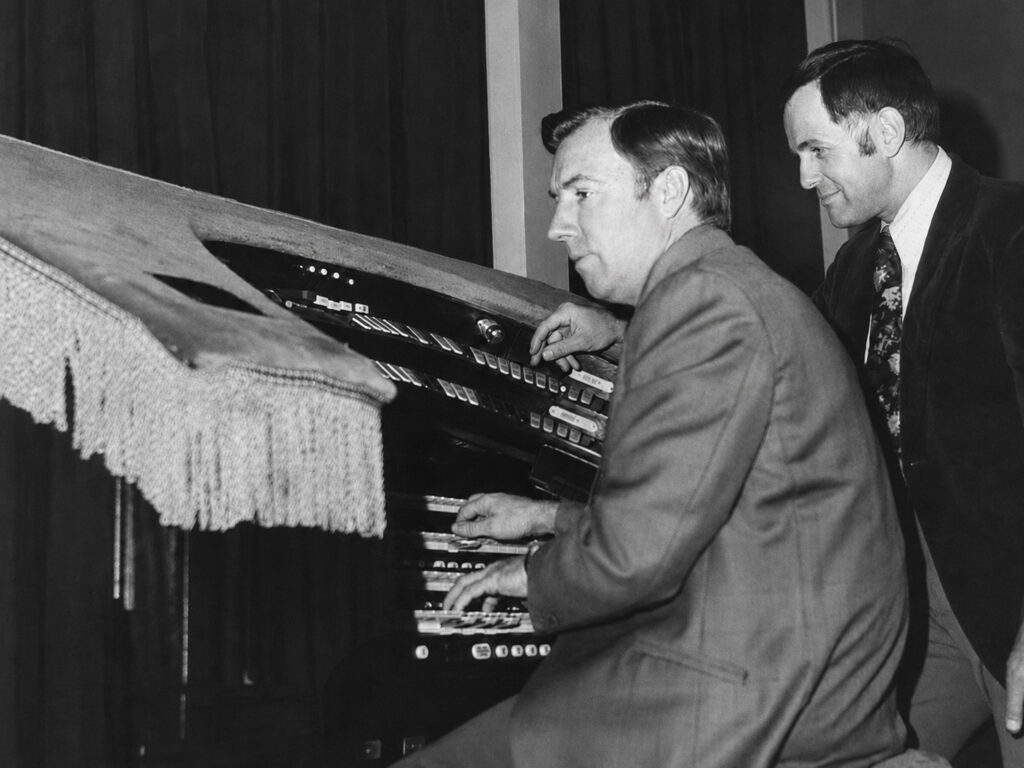
Old Town’s founders, “the Two Bills.” Bill Coffman (seated), Bill Field (standing). (Photo probably from the 1970s, courtesy of Old Town Music Hall)
Under the impassioned leadership of the Two Bills, Old Town became a volunteer-run vibrant house of classic film (with a principled focus on showing only pictures released between about 1921-1956), as well as ragtime, jazz, and pipe organ concerts. The format was: a performance on the Mighty Wurlitzer (just to show off what this puppy could do), which culminated in an old fashioned audience singalong and was followed by a cartoon or featurette; then, an intermission, and, lastly, the main show of the feature film itself. If the feature was a silent film accompanied by a live human playing the Mighty Wurlitzer throughout, then the featurette would typically be a talkie like an Abbott and Costello short. In reverse, if the main feature was a talkie picture, then the featurette would usually be a silent accompanied by the Wurlitzer, something like a Laurel & Hardy short.
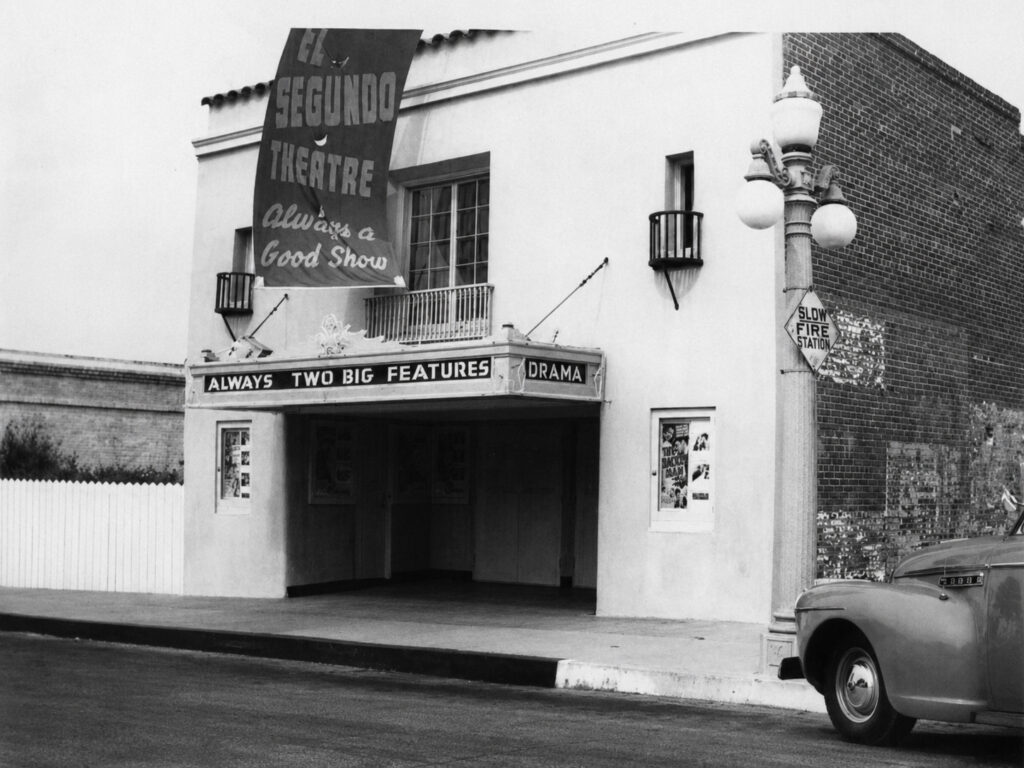
Old Town Music Hall in the 1940s, when it was the El Segundo Theatre. (Photo courtesy of Old Town Music Hall)
It was definitely a much fuller night out to the movies, just like it used to be in the olden days, when folks probably dressed up in suits and dresses for the occasion. To this day, it’s still the same format at Old Town, singalong and all. And it’s not uncommon that screenings will be presented/introduced by some member of the local film or entertainment intelligentsia—whether a film historian, author, stand-up comedian, filmmaker, museum board member, etc.
One of the only things that’s changed since 1968 occurred in just the last few years, which was the decision to expand the breadth of their film selection; while keeping it classic. They loosened their stance just enough to allow iconic flicks from the ’60s, ’70s, ’80s, and even up into the 2000s to grace their screen.
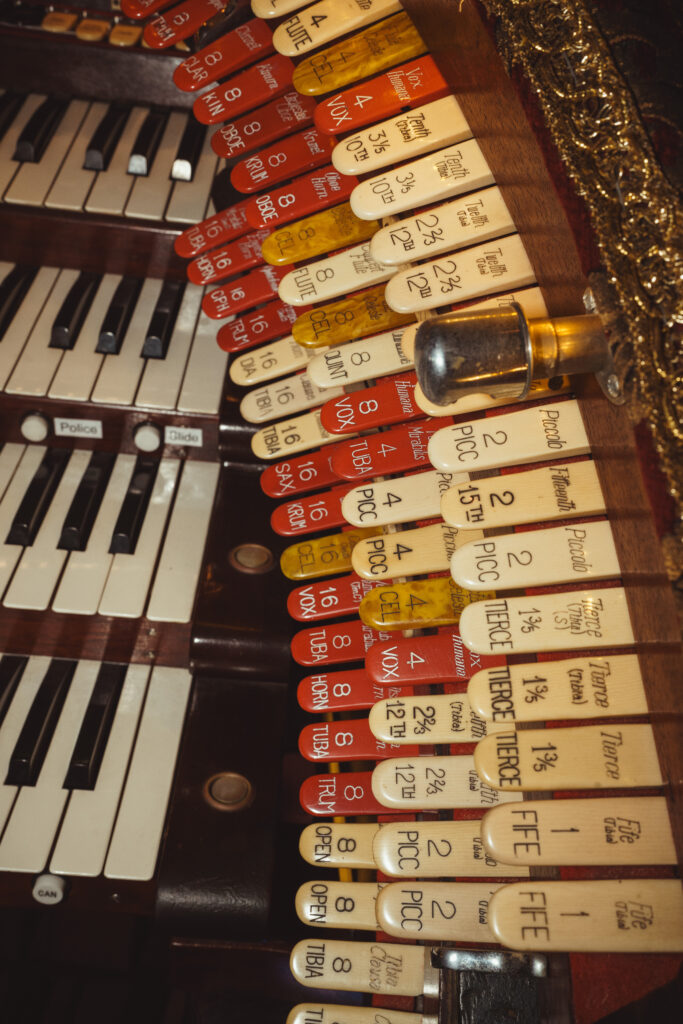
A maniacal machination of mankind indeed.
So, naturally, we took my best friend’s 10-year-old boy to see “Halloween” (1978) for his first time last October! Covering his eyes at the (in)appropriate moments, of course. Though, he was pretty entertained by seeing Michael Myers appear up on the stage and walk amongst the audience, just standing and staring at people.
A few other examples of what might appear in modern Old Town’s repertoire throughout the calendar year include “Psycho” (1960), “The Good, the Bad and the Ugly” (1966), “Grease” (1978), “Xanadu” (1980), “Who Framed Roger Rabbit” (1988), “National Lampoon’s Christmas Vacation” (1989), “L.A. Confidential” (1997), “Shaun Of The Dead” (2004), and “Wall-E” (2008). Though, to be sure, the predominant regular day to day weekend is still chock-full of ultra classics and deep cuts from the 1920s-50s.
About the only other change at Old Town after all these years is who you see behind the hundred million keys of the Mighty Wurlitzer. By now, the founders have left us. Bill Coffman in 2001, Bill Field in 2020. But their vision remains intact. The theatre looks the same as it did in 1968, aside from some upgraded seats, which are aesthetically true to form, yet much more comfortable to fit your posterior form. Ultimately, the heartbeat of the Two Bills maintains a thriving rhythm under the stewardship of its incredible volunteers.
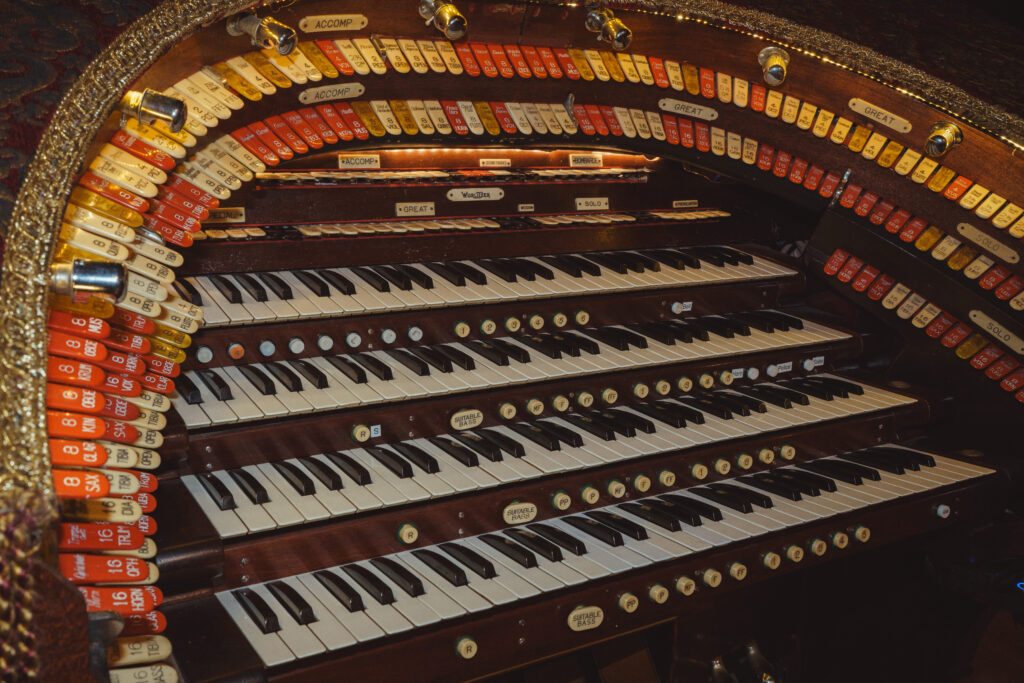
ENTER THE PALACE OF PASSION, BUT BEWARE THE RED VEST!
One such devotee is current President and CEO James Moll, whose mother and stepfather had actually met at Old Town.
“Although I’ve been involved with the theatre in one way or another since I was 11 years old, spending much of my teen years playing ragtime piano on stage before movies, my official board member position didn’t begin until after the passing of Bill Field in 2020,” James says. “In fact, when I was at USC Film School (after I was accepted because of an introduction the Two Bills made for me to meet the head of the film school) the Two Bills allowed me to shoot one of my student films in the W.C. Field’s Cafe restaurant next door—which was a wonderful buffet restaurant that operated as part of the theatre in the 1980s.”
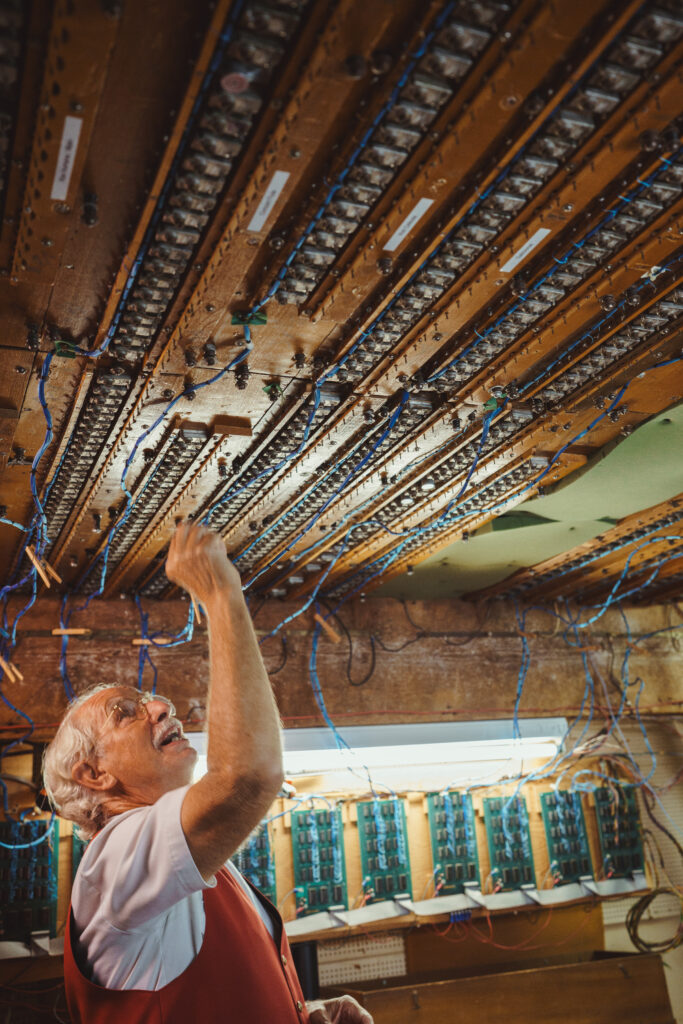
The neon sign from that cafe, named after Old Town founder Bill Field (birth name William Charles Field), not the actor/comedian W.C. Fields, now hangs in the snack bar at Old Town; unassuming and modest, like James himself, who waited tables at the restaurant during high school, long before he’d go on to become an award-winning documentary filmmaker with an Oscar, two Emmys, and a Grammy under his belt. He is also the Founding Executive Director of the USC Shoah Foundation, which he established for Steven Spielberg, that records, preserves, and shares audio-visual testimonies of Holocaust survivors.
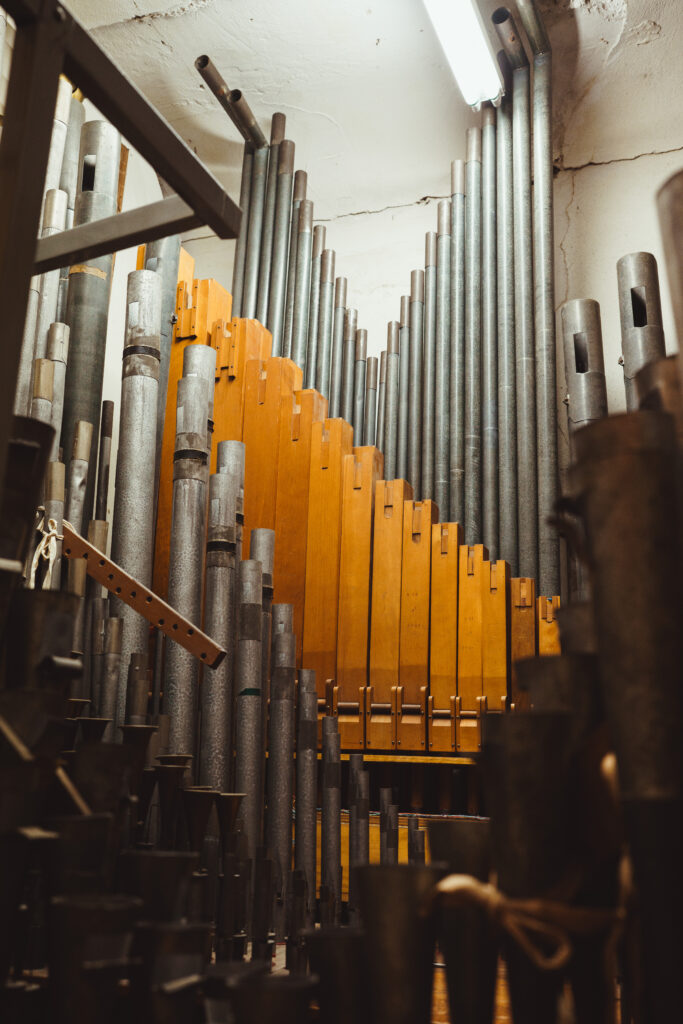
Of the Two Bills, I never got to meet Bill Coffman. But Bill Field was always available for conversation, always sitting out front before and after shows, or lingering upon the organ bench, exuding the kindest approachability while chatting it up with his guests, his admirers, his friends of the arts. And if Field set the tone for the warmth that his theatre would represent, there couldn’t have been a more appropriate successor than James.
A tender piece of James’s spirit is occupied by Old Town, and the theatre itself is a piece of his family. The gentle joy and care with which he treats his guests, as he bounces around, donning his red usher’s vest, is only matched by his obvious love and reverence for the very building and all the memories it holds. If a magic lives there, he’s our Albus Dumbledore.
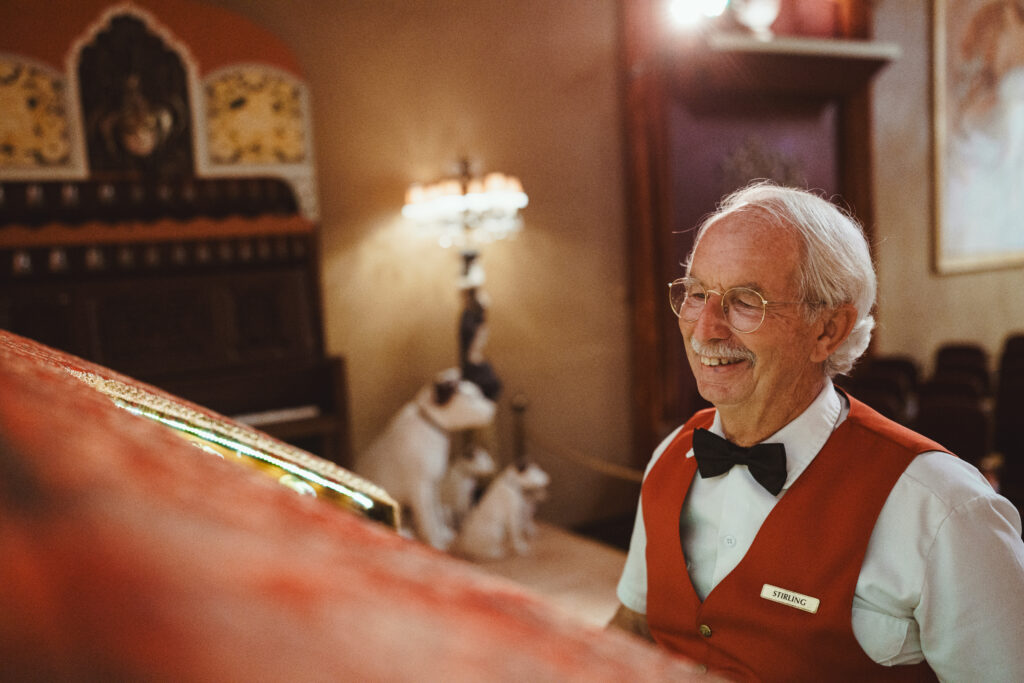
Old Town’s enchanting personality has a tendency to captivate and ultimately capture many of its volunteers. Like lovesick moths to a flame, they’re drawn to the theatre from a compulsive place of passion, only to be gleefully devoured. They don’t need to be there, their lives don’t depend on it; but they can’t help themselves, and wouldn’t have it any other way. The current Executive Director and occasional organist was one such captive. You’ll see Stirling Yearian in a black bowtie and his official red usher’s vest while greeting guests out front of the theatre. He’s a gentle soul, whose soft, yet piercing bespectacled eyes betray a glint of mischief above his white moustache. And I daresay he missed his calling as a comedian, since he’s a retired maintenance mechanic and operations engineer of a chemical plant.
He and his wife Vicki, who hustles the snack bar (with her wonderful homemade healthy popcorn waiting alongside sparkly and Smart Water, as well as more traditional moviegoing goodies and candies), drive 160 miles roundtrip to volunteer every weekend at Old Town. But it didn’t start that way.
I’ve known Stirling’s face at Old Town for a long time, but began to wonder if it was always as one of the crew. It seemed to me in my mind that it was only in the last 5 years or so that he and Vicki began appearing out front in their red vests; yet, in a manner that seemed as if they’d always been there, or like maybe I missed something, the film skipped a frame, time melded together like Milk Duds upon my brain. Well, it turns out that Stirling first discovered the theatre well over a decade ago, around the same time as myself.
“I saw a little flyer, and it mentioned something about a small theatre in El Segundo that had a pipe organ in it,” he recalls. “And I thought, ‘Well, maybe I’ll go check that place out.’ It’s a long drive all the way out here, and I guess I kind of had that feeling that I see in people’s faces the first time they walk into the theatre. I just walked into this place and fell in love with it. Sat in the very front row so I could watch Bill Field play the Wurlitzer, and just sat there, just amazed at the magic that was coming out of that instrument.”
“It kind of drew me in, and we would come to shows maybe about once a month, just because it was such a long drive. Well, plus I was working back then too… And then when I retired, I started coming more often and told my wife well I’d really like to volunteer here. We would kind of hang out and help clean up and all that, and before we knew it, they stuck red vests on us and put us to work, and [we’ve] been enjoying our weekends here ever since.”
So there you have it, for years on end we were fellow faces in the crowd; then, all of a sudden, one day he’s greeting me on the way in before taking his place behind the Mighty Wurlitzer. The red vest got ’em. As it’s gotten others…
“We had a new volunteer just started last weekend,” says Stirling. “Jen was a regular customer, we’d always see her all the time in the audience, and I kind of joked around with her… I said, ‘You come here often enough, we’re going to put a red vest on you and put you to work’—that’s how they trapped my wife and I to come here to volunteer too. She’s having a blast here, so much fun.”
A STIRLING PERFORMANCE
Still, I can’t get over that 160-mile roundtrip drive to volunteer every weekend.
“I think it helps to be a little bit crazy,” says Stirling.
But what kind of crazy does he mean? In addition to his duties as Executive Director, which he assures me includes sweeping floors, unplugging toilets, and polishing chrome in the bathrooms so that everything looks perfect for the guests, he also fills in on the Mighty Wurlitzer when Official House Organist Randy Woltz takes time off.
“I’m a theatre organ enthusiast,” says Stirling, who’s also a long-time member of the American Theatre Organ Society. “I love the Wurlitzer here, and it’s certainly worth the drive for me… And more importantly, it’s more worth the drive to me to see so many happy people when we come to the theatre… everybody’s just smiling and so happy to be here… then hearing all the comments, especially [from] first-timers that have never been here before… It’s fun to watch people walk into the theatre the very first time, the look on their face when they go around the corner from the lobby into the house and see the giant chandeliers and the paintings; it’s like they’re instantly transported back in time, to a happy place.”
Stirling enjoys the films at Old Town, of course; but his true passion is the Wurlitzer.
“If the Wurlitzer wasn’t here… I’d probably be either taking up bowling or drinking for the weekends,” he says. In case you hadn’t caught on to his wry wit and humor just yet.
During years of admiring Bill Field’s craft behind the keys, a third eye for Stirling would’ve come in handy for the films themselves, since his God-given peepers were usually glued to Bill’s hands and feet, studiously absorbing what he was doing.
“A lot of what I play here is just self-taught, or from sitting in the front row watching Bill Field play. Before we had assigned seating, my wife and I would get here—we tried to be the first ones at the ticket booth, because I’d always ask my wife, ‘I want to sit in A9,’ because that’s the best view of Bill playing the Wurlitzer. So I’d always sit in the very front row.”
He would often chat it up with Bill in the lobby before showtime. Eventually, Bill began inviting him and his wife out to dinner after the shows, treating them like part of the family, which is how Stirling came to better get to know the other volunteers.
“And it’s kind of funny, because—well, one of the other volunteers knew that I sort of knew how to play the organ,” Stirling said. “So after one of the movies, my wife and I were hanging around, and so the other volunteer asked if I wanted to try playing the Wurlitzer… So I tinkered around a little bit with it, and Bill was up in the office up here, and he’s yelling, ‘Turn it off!’ Well, the organ uses a lot of electricity with the blowers. Bill said, ‘Turn it off! Turn it off!’ And then the other volunteer said, ‘Well, Stirling’s playing.’ ‘Oh, no, that’s okay. Let him play, let him play.’”
“It’s very intimidating. Sitting at that thing, you’re like at the controls of a 747, there’s so many buttons and switches on it. There’s a big keyboard we play with our feet, and then four manuals [standalone keyboards] we play with our four hands, and then 200 and some odd different colored switches up there that turn on different sets of pipes.”
Fondly, I told Stirling that I’ve seen him play.
“And you came back? Good!” he immediately fired back. “I figure if I can’t be good, at least be fun and be loud. Add lots of extra xylophone and car horns and sirens.”
PHANTOM OF THE MUSIC HALL
Another Old Town familiar is Official House Organist Randy Woltz. As an Associate of the American Guild of Organists, who’s a graduate of the Film Scoring program at USC, with a master’s degree in Organ Performance, Randy is also the mild-mannered, witty-humored maestro who introduces October films while sporting a Phantom or Dracula cape before busting into some serious Wurlitzer.
Randy’s command of the stage wouldn’t come into focus until after COVID, though he’d been performing on it off and on for twenty years with various bands and singers. On occasion, Bill Field would let him play a couple tunes on the organ, but it wasn’t until after Bill’s passing in 2020, and when the pandemic had relaxed enough for everything to begin reopening—as James was looking for organists—that Woltz became our main man.
“I’m the one that’s expected to be there every weekend unless there is a guest organist or live band,” says Randy. With regard to the opening performances on the Mighty Wurlitzer, he says, “I try to come up with a different medley every weekend—sometimes three different ones to match the various films. It could be a violent gangster film, then a Disney cartoon, then, on Sunday, a Western. Each medley is about five or six minutes long. If we are showing a film that has music in it, I will try to play some of that, which requires research. I have to look through my library, or buy music online, or transcribe something from a recording if there is no printed music. It keeps me on my toes!”
Personally, I remember feeling that Randy was a comfortable transition into a new era of Old Town, and he seemed to quickly become mighty comfortable on the Wurlitzer himself.
“It is so much fun! It was a bit alien to me at first because I was classically trained on church-type instruments. But now I have endless joy in creating beautiful music with all the different sounds available on a theatre organ. When I am playing a silent film, I get into the emotion of the scene just as if I was in the movie. If it is a love scene, or chase, or suspense, I try to really pump that up so the audience is getting the full impact of the movie like the films of today with full orchestra scores. It’s interesting to think that 100 years later theatre organists are still playing for silent films—and many of these films are beautifully restored, so the audience is seeing them in their full glory.”
REAL TIME TIME CAPSULE
I’m not the only one who continues to come back. A young face I’ve seen there just about every time I’ve ever been belongs to Krysta Olson, who discovered Old Town somewhere in the early 2000s. And she fell in love.
“Growing up, I was always kind of a shy and quiet kid,” she says. “So discovering silent movies really blew my mind. Suddenly, there was an entire world where people told these amazing, emotional stories without ever saying a word. Chaplin, Keaton, and Harry Langdon were my favorites. And growing up, I totally fell in love with 1920s fashion and furniture, it was all so beautiful and elegant… The moment you step inside the Old Town Music Hall, it’s like walking into the ’20s. You don’t just lose yourself in the movie, the entire trip is part of the experience. Sometimes even walking up the theater there would be someone playing ragtime music on the piano.”
She captures it perfectly. The moment you walk into Old Town, you step into a time capsule. A time capsule that, instead of pulling anything out of, you put yourself in, and experience its contents in real time—the real time that they were frozen in, during the real time that you’re living. Leaving the theatre can be a harsh return to reality; though, you do leave lighter and happier, giddy but relaxed, like your soul’s had a nice massage.
Krysta’s first contribution to the time capsule was actually during one of their live music concerts.
“Janet Klein & Her Parlor Boys. If you haven’t seen them, I highly recommend it!” she says. “She sings dirty songs from the ’20s and ’30s—it’s all really suggestive… Stuff like, ‘You can put your banana in my basket, boy.’ And somehow it feels way dirtier than a lot of current stuff.”
“People from the theatre also talked about the Wurlitzer organ, how they found it and installed it, and it was just so amazing. After that I went back for the movies, and I was hooked. When there are so many distractions everywhere, and everything moves so fast, taking the time to sit down and completely lose yourself in a film is unlike anything else. The Old Town Music Hall takes it another step further. Going is so special… Sneaking off to go there has always felt almost like a guilty pleasure, something I treat myself to. It’s so nostalgic and beautiful, it makes me feel all tingly and happy… like instant endorphins! I especially love going in October for all the horror films. It’s honestly hard not to fall in love.”
I myself am also a big fan of the theatre’s October festivities. But they also tend to shuttle in some late September sci-fi. Sitting by myself for “The Day The Earth Stood Still” (1951) was just what the doctor ordered a decade ago, but these days Old Town tends to do a 3-D day for their pre-Spooktober sci-fi screenings. Most people probably wouldn’t know that the 1950s were the heyday for 3-D movies (with flicks like “Creature From The Black Lagoon” in 1954), but a couple years back, they showed “Robot Monster” (1953), which was without a doubt one of the most fun movie-going experiences I and a group of us have ever had in our lives. And, of course, the Robot Monster himself was waiting to greet us on the sidewalk and take pictures after the show.
NO NOVELTIES IN OLD TOWN
If you consider the vastness of history contained within the walls of Old Town… From WWI to Roaring Twenties, flappers, prohibition, and a Great Depression. WWII, Korea, Vietnam, nukes, 9/11, and a handful of genocides. Civil Rights, assassinations, moon landings, hippies! Television, VCRs, DVDs, colored TV! Cell phones, video games, computers, TiVo, artificial intelligence. Insurrection and autocracy. Too many Middle Eastern, Eastern European, and African wars and conflicts to count. It’s quite remarkable how little has changed at the Music Hall. Some would even call it special.
“What makes Old Town Music Hall so special is that there’s really nothing quite like it,” says James Moll. “It’s like time traveling, to step into a venue that looks almost exactly today as it did when it first opened in 1968; and it takes you back even further to the earliest days of cinema. And the programming format is the same as when The Two Bills first opened… the idea of starting every show with music on the Mighty Wurlitzer and an old fashioned singalong—like it was done 100 years ago! And, of course, the Mighty Wurlitzer is in the spotlight multiple times per month, accompanying silent films, just like it was built to do. For anyone interested in experiencing a silent film as they were originally meant to be seen, there’s no experience more rewarding than a visit to Old Town Music Hall.”
It’s no novelty at Old Town. The Mighty Wurlitzer is no gimmicky bell and whistle (even with its bells and whistles). This Music Hall is a preservation house, run by passionate volunteers, archivists, curators, and accomplished, credentialed professionals.
“There is no other place on Earth like Old Town Music Hall!” says Randy Woltz. “Really, it is quite unique. It survives on a wonderful family of volunteers who are there every weekend, and sometimes during the week, to make sure everything is working properly. Also, the legacy of continuing the dream of its founders Bill Field and Bill Coffman, who would be thrilled to see their theatre playing to capacity audiences.”
We’re lucky that such a precious and rare gemstone has survived in our own backyard. Only a few hundred fully functioning theatre organs still exist today. And Old Town Music Hall is one of the only theatres in the United States that provides regularly scheduled silent films accompanied by live theatre pipe organ. Where you can take the kids to see an oldie like “The Wizard Of Oz” and introduce them to it in a whole new way. Where you can take your mom to see her favorite movie, “Wuthering Heights” (yes, my mom). Take dad to see Bela Lugosi slay his iconic role as the first-ever Dracula. Take grandma to revisit the gangsters, musicals, or silents of her childhood. Maybe slip out for a solo expedition to experience the Mighty Wurlitzer in its full flex with “Nosferatu” or “The Phantom Of The Opera.”
“Old Town Music Hall gives people a chance to time travel back in time, and to see what it was like to see a movie 100 years ago,” says Stirling Yearian. “It’s such an honor to be part of this place and carry on its legacy into the future.”
Visit Old Town Music Hall online at OldTownMusicHall.org to view their Film & Concert Calendar and to purchase tickets for upcoming shows, or drop by the theatre to grab either in person. Stay up to date with current happenings on their Instagram page, because even an old town’s got new tricks.