
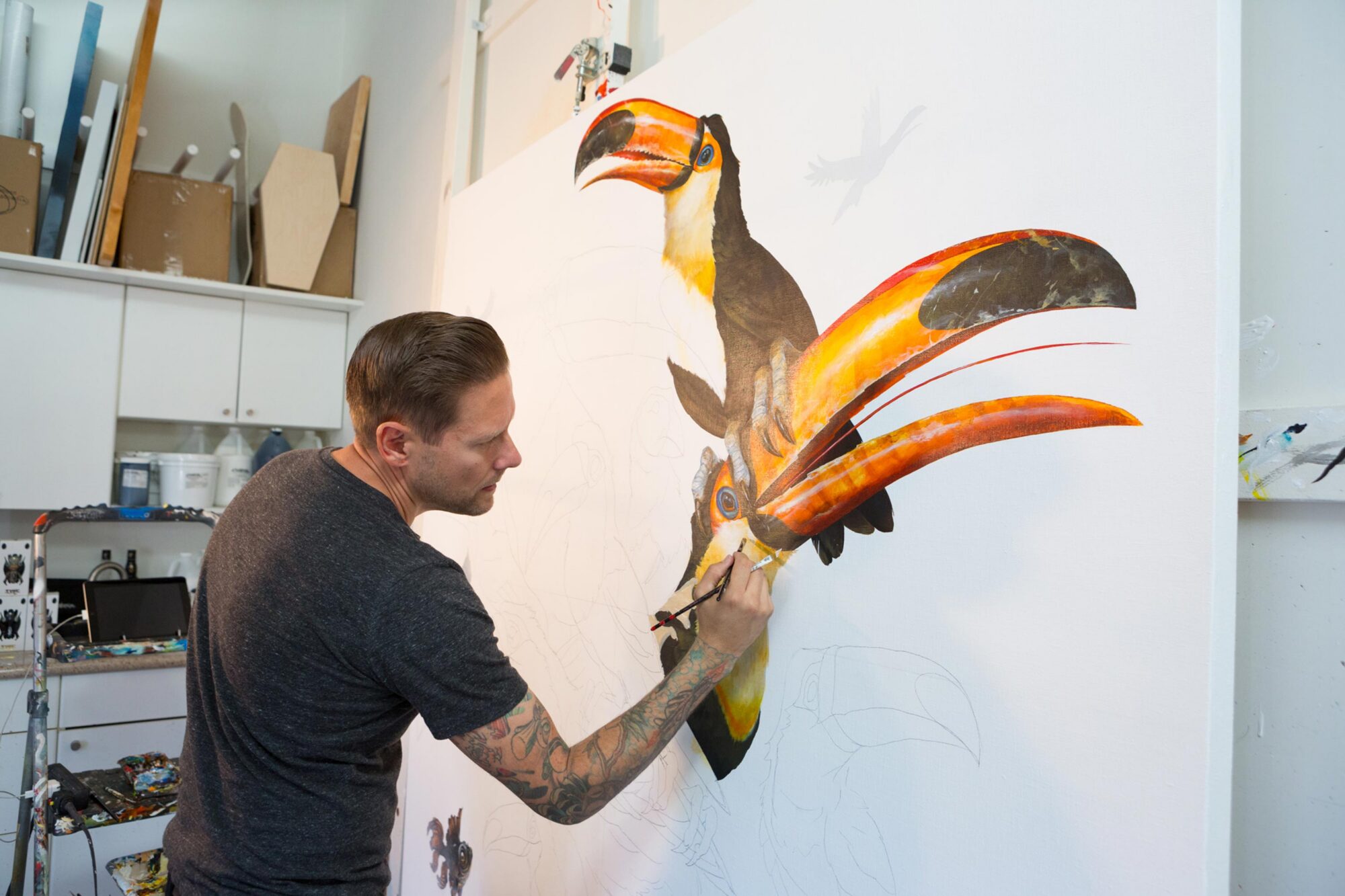
ARTIST GREG SIMKINS IS AN INTERNATIONALLY RENOWNED MAKER OF WORLDS. BUT HIS WORK IS DRAWN FROM THE FANTASTICAL REALMS OF THE SOUTH BAY
Words By
RACHEL REEVES
Photos By
BRENT BROZA
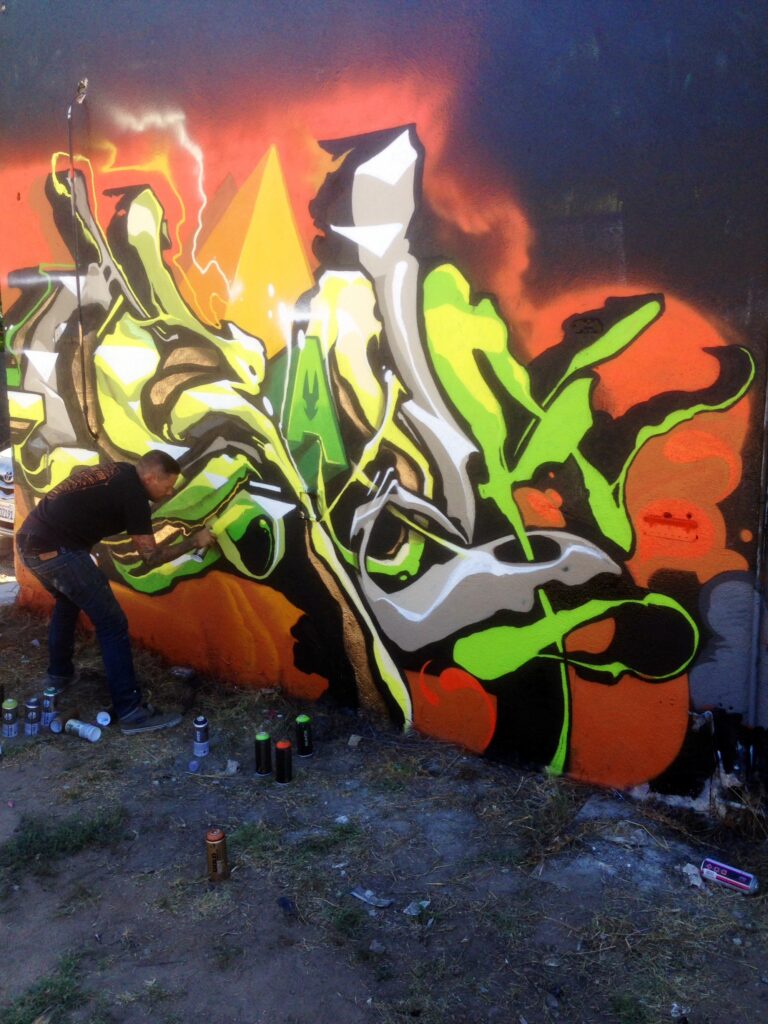
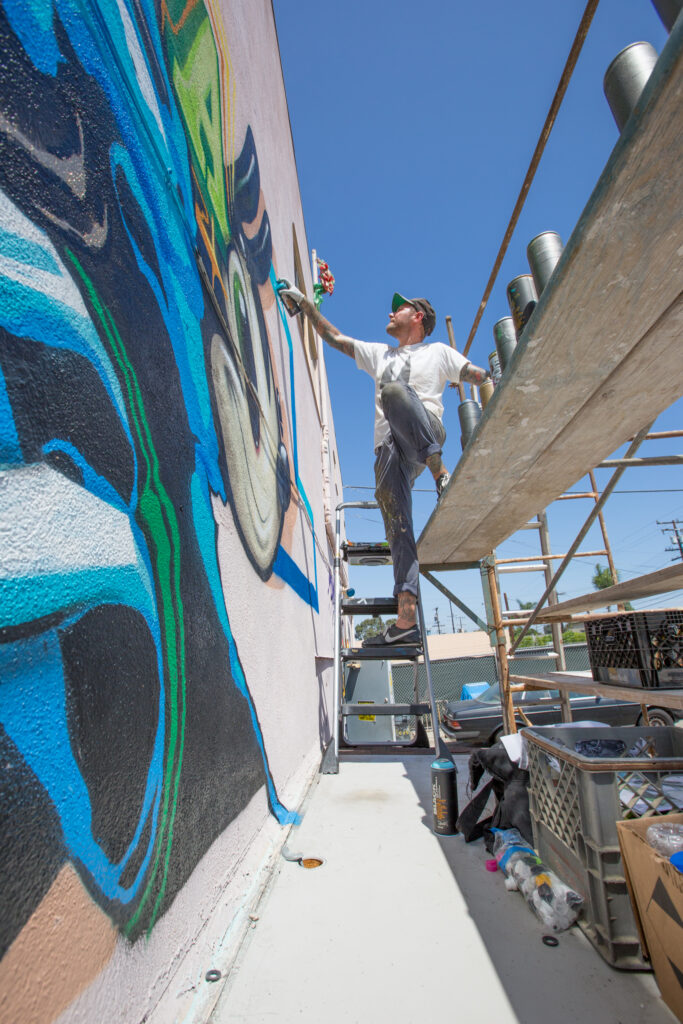
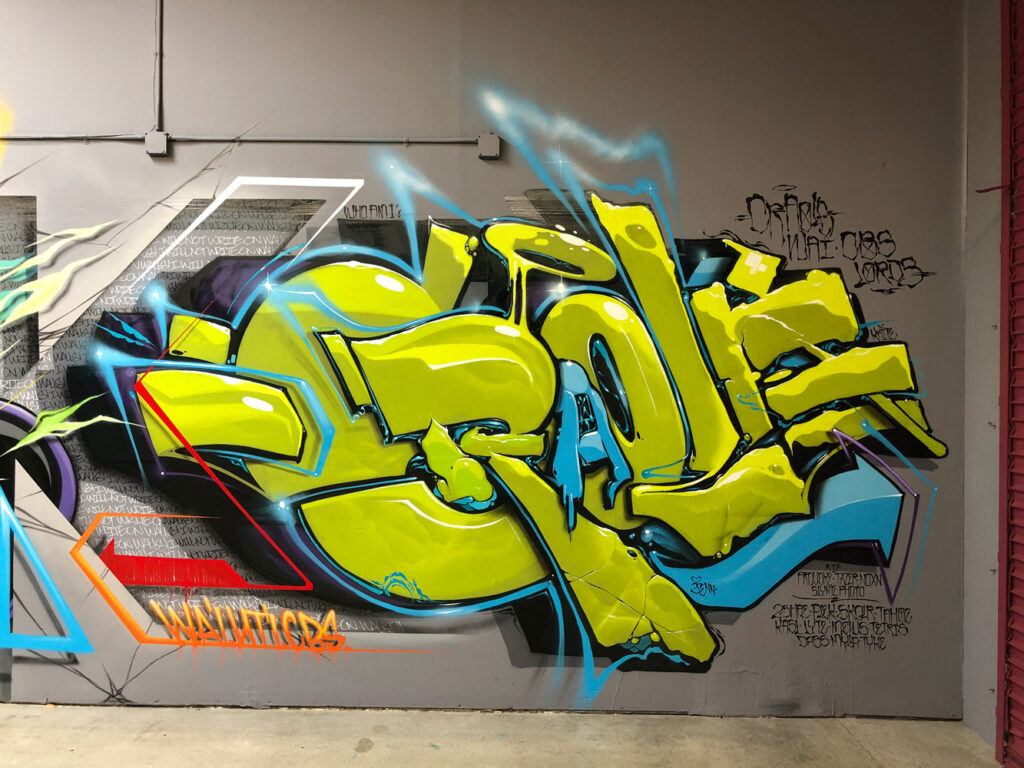
Greg Simkins, the artist internationally known as CRAOLA, lives two blocks from the house he grew up in. Down the street are his middle school, his high school, and the concrete drainage channel where, at sixteen, he squeezed through a locked gate with a backpack full of spray paint from his dad’s garage and tagged his first wall.
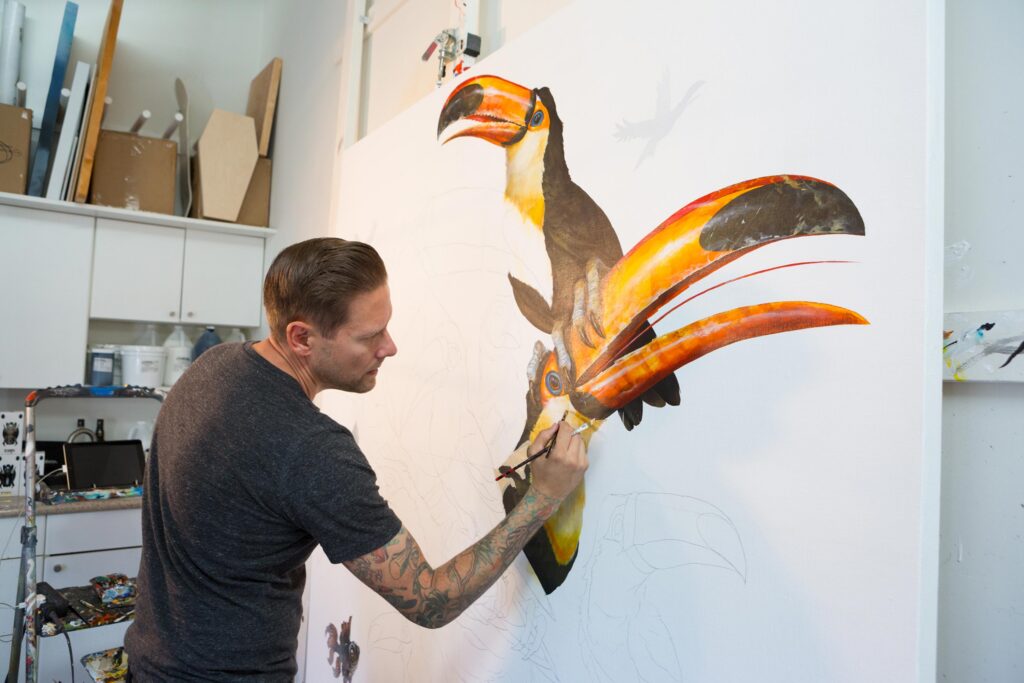
That was 1992, before the sold-out gallery shows, museum exhibits, art books, and worldwide repute as a pop surrealist painter. He was a junior at South High then, by his own account a shy, nerdy kid who drew during class. Someone in his social studies class had seen his sketchbook and given him a copy of Subway Art, a 1984 book filled with photographs of graffiti art on New York City subway cars.
“It blew my mind,” Simkins said. “It just kind of opened up a whole new arena of what could be done.”
He went back to the concrete the next weekend, and the next. People started to talk about the CRAOLA tag. That was before social media and cellphones, when word of mouth traveled organically, in places like high school classrooms and skateboarding spots.
Most of the graffiti writers Simkins met in those early days were painting letters. He added cartoonish characters to his letters: superheroes, rabbits, anthropomorphized fruit. This was a natural choice for Simkins, who began drawing cartoons when he was three. His mom would unfurl a roll of butcher paper across the kitchen table, and he would watch G.I. Joe and Star Wars and draw what he saw. He calls cartoons his first art teacher.
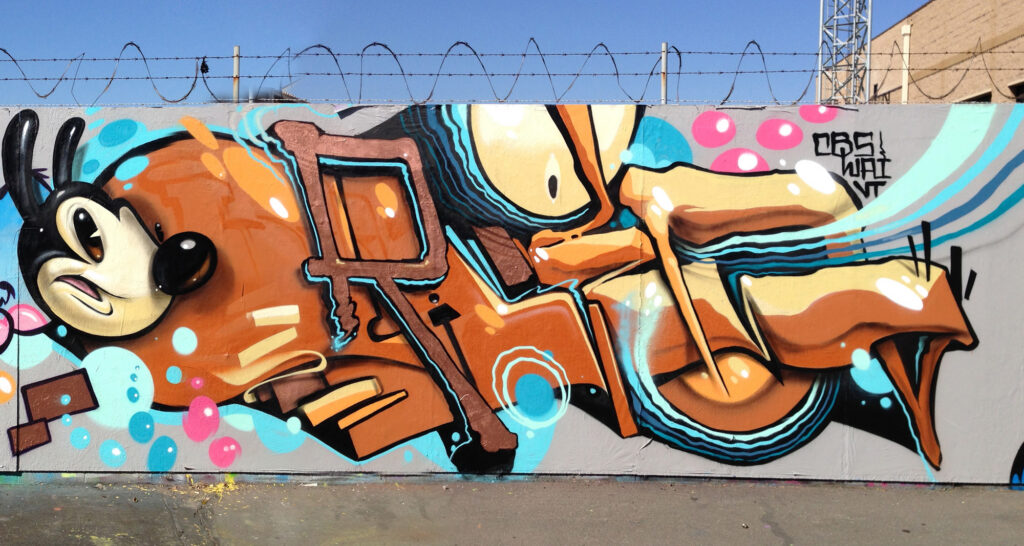
Soon, Simkins was running with various graffiti crews – CBS, WAI, LORDs, SCI – that were painting the overpasses and oil drums of the L.A. harbor area. They became his teachers, and Los Angeles became his canvas.
Graffiti, like skateboarding and punk rock, offered him friendships that would open the doors leading to the rest of his life. “Everybody in the South Bay, we all kind of mingled together, and there were all these people that kind of pushed me in different directions,” Simkins said. Through singing in a punk band, he met and made art for bands that would become fixtures of American punk. Among other gigs, he drew the cover of Time Is the Distance, Deviates’ beloved sophomore album, and designed Warped Tour merchandise for Pennywise.
After high school, while he was attending El Camino College, Simkins hung out daily at Torrance Beach with a motley crew of surfers, skateboarders, and punk rockers. It was there that he first laid eyes on a pretty girl named Jennifer. He was in a relationship and so was she; they made only a polite acquaintance.
Simkins later transferred to Cal State Long Beach to study studio art. The following year, Jenn went there too, to pursue a communications degree. Now both were single. Jenn and a mutual friend plotted that the friend would call Simkins to ask what he thought of Jenn, and she would be listening on the other line, unannounced. She thus on the sly discovered he was very much interested in her.
“I wanted to get his temperature. So embarrassing,” Jenn recalled, laughing.
Simkins approached her one day at The Nugget, the school’s food court, and asked her out.
“I said yes because, you know, I had the intel that he was interested,” she said. “Me not being a risk taker, I had the confidence to go, okay, yeah, he’s into it.”
The marketing major who did her due diligence before she said yes to a date was business-minded in a way that would later amplify and sustain Simkins’ art career. She would become the CEO of Greg CRAOLA Simkins Inc. and the mother of the artist’s children, whom Simkins describes as his most interesting collaboration yet.
“We’ve been inseparable ever since,” he said.
After college, Simkins waited tables at the Chili’s across the street from Del Amo Mall. He did the odd T-shirt design and thought a lot about how he could turn art into a living. A few writers from CBS, one of the graffiti crews he painted with, worked downtown at JNCO Jeans, the brand known for its super-wide-leg jeans. The company was looking for graphic designers. Simkins applied. He got the job.
That put him at an illustration table with some of the graffiti writers he admired most: Axis, Kofie, Epik, Yeloe, Pryer. It also taught him how to use software to design graphics. Later, when a friend left JNCO to work for Treyarch, Simkins begged him for an interview.
Treyarch – an El Segundo video game company that would later be purchased by Activision, publisher of the popular game Call of Duty – was advertising for artists to design graffiti-covered urbanscapes for Tony Hawk’s Pro Skater 2 for Xbox, then a brand-new game console.
“I’m like, I’m your guy,” Simkins said. At Treyarch, he built worlds for Kelly Slater’s Pro Surfer, the never-released Shaun Palmer’s Pro Snowboarder 2, and three Spider-Man games. He would work until ten or eleven at night and then paint canvases after that, until three or four in the morning. He’d take his paintings to work, where colleagues helped him photograph and advertise them on Friendster and Myspace. Soon he was selling paintings to customers as far away as Germany.
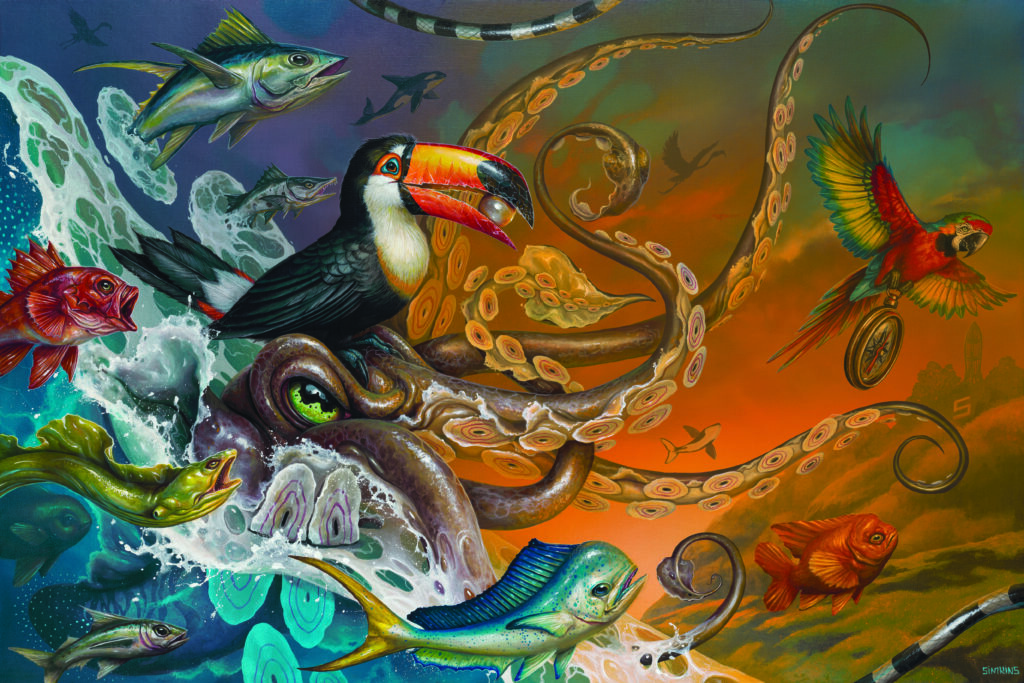
“Path Of The Sea” • 30”x20” • acrylic on canvas • BY CRAOLA
One day in 2005, Simkins got two emails that changed everything: one from Gallery 1988 in Los Angeles, one from Upper Playground in San Francisco. Both invited him to show some work. In later meetings, the gallerists who sent those emails asked why he wasn’t painting for a living.
“I’m like, I don’t know if you can do this for a living,” he said. “They’re like, of course you can. … Just try it. See what happens.”
By then, Simkins and Jenn lived in an apartment near the Redondo Beach Dog Park on 190th. She was climbing the corporate ladder, working as the national marketing manager for U.S. HealthWorks, a major network of healthcare centers. They decided Simkins would quit his job to focus on art.
“I would just paint all day, take a break, go to the dog park, watch the dogs, come back, and paint, paint, paint, paint,” he said. “And it just snowballed. And that’s just all I’ve done since.”
As requests for paintings rolled in, they decided she would quit her job, too, to focus on building the Greg CRAOLA Simkins Inc. brand.
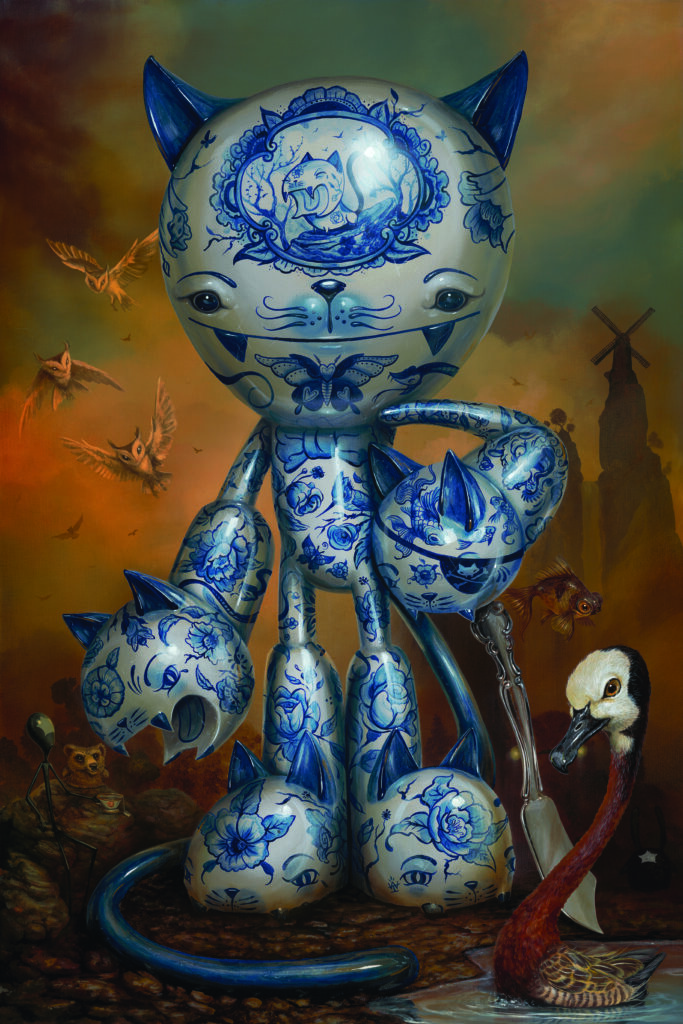
“Kitron” • 30”x20” • acrylic on canvas • BY CRAOLA
“We really had to make a big leap,” Jenn said. “It took so much faith.”
She became Simkins’ “filter,” she said. Anyone who wanted his work went through her.
“I feel like a lot of artists that I know, just because they enjoy doing [art], they don’t put a value on it,” Jenn said. “So I was always very protective of his time and his talents.”
She handled correspondence and contracts. She drove the diversification of the business: prints, merchandise, vinyl toys, art books. She managed licensing partnerships with Disney, Marvel, and Mattel.
With Jenn’s mentality, which her current employer described in a recent LinkedIn post as “strategic” and “growth-focused,” Simkins’ art business boomed.
“If it wasn’t for her and her beautiful mind,” he said, “I’d still be sitting behind a desk.”
Soon Simkins was selling out gallery shows, hanging work in museums, and landing commissions for art collectors all over the world. His paintings appeared on the covers of popular art magazines: Juxtapoz, Hi-Fructose and American Art Collector. Four of his five books sold out. More than 213,000 people subscribed to his YouTube channel to watch time-lapse videos of him painting.
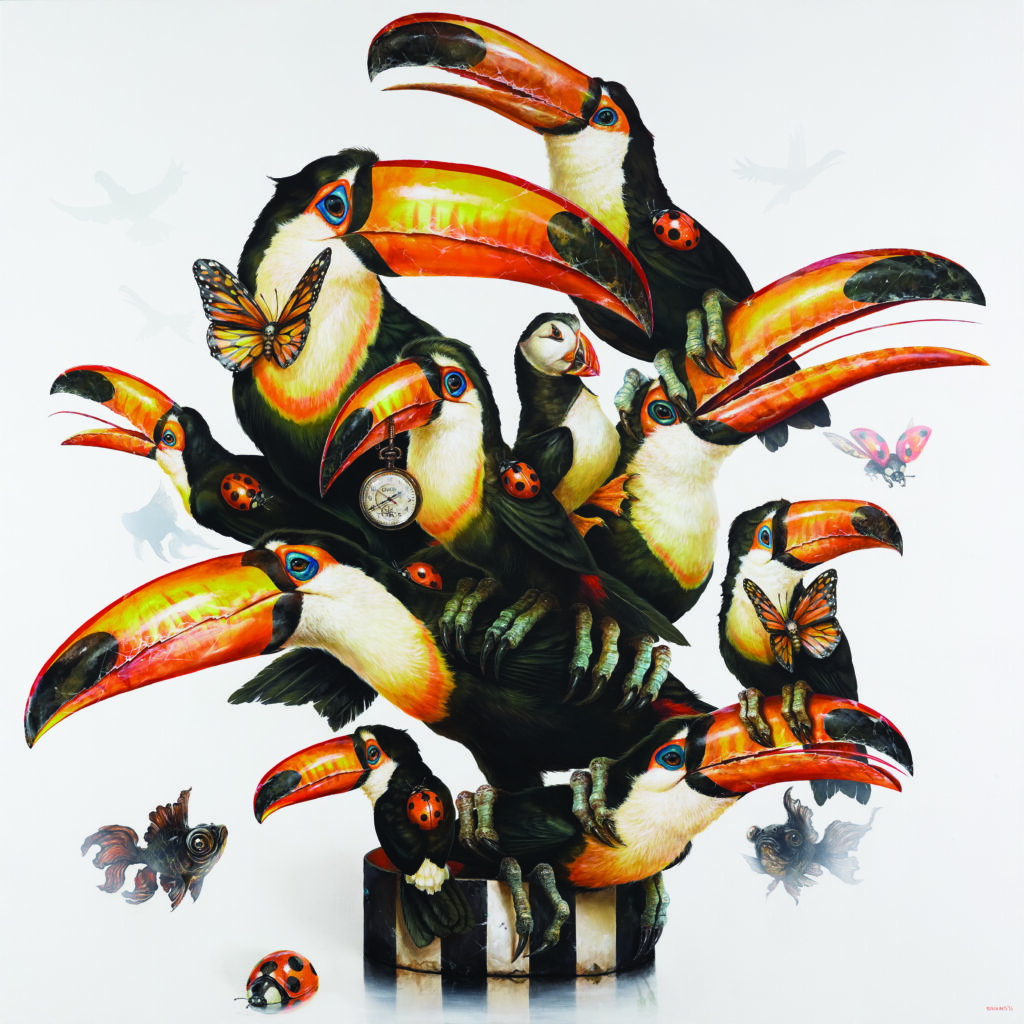
“Try To Fit In” • 72”x72” • acrylic on canvas • BY CRAOLA
The graffiti artist who spray-painted cartoons on concrete turned into a serious fine artist in the canon of pop surrealism, a genre that blends pop culture and the otherworldly imagery of surrealism.
“If there was ever a prototypical balance of highbrow and lowbrow art merging together with a seamless flow, Greg ‘Craola’ Simkins would be the quintessential example of that confluence,” explained a writer for Mindzai, an online marketplace for artists.
The genre was another natural destination for Simkins, who had always been drawn to the uncanny.
“From my first exposure to this world, I felt like I was always in it without even knowing it,” he told a writer at Spanish magazine Staf. As a child, he loved worlds that, like dreams, mimic reality but operate according to different rules: Narnia, where animals talk; Wonderland, where a vanishing cat leaves his grin behind; the Lands Beyond in The Phantom Tollbooth, where words, numbers, and sounds are things you can touch.
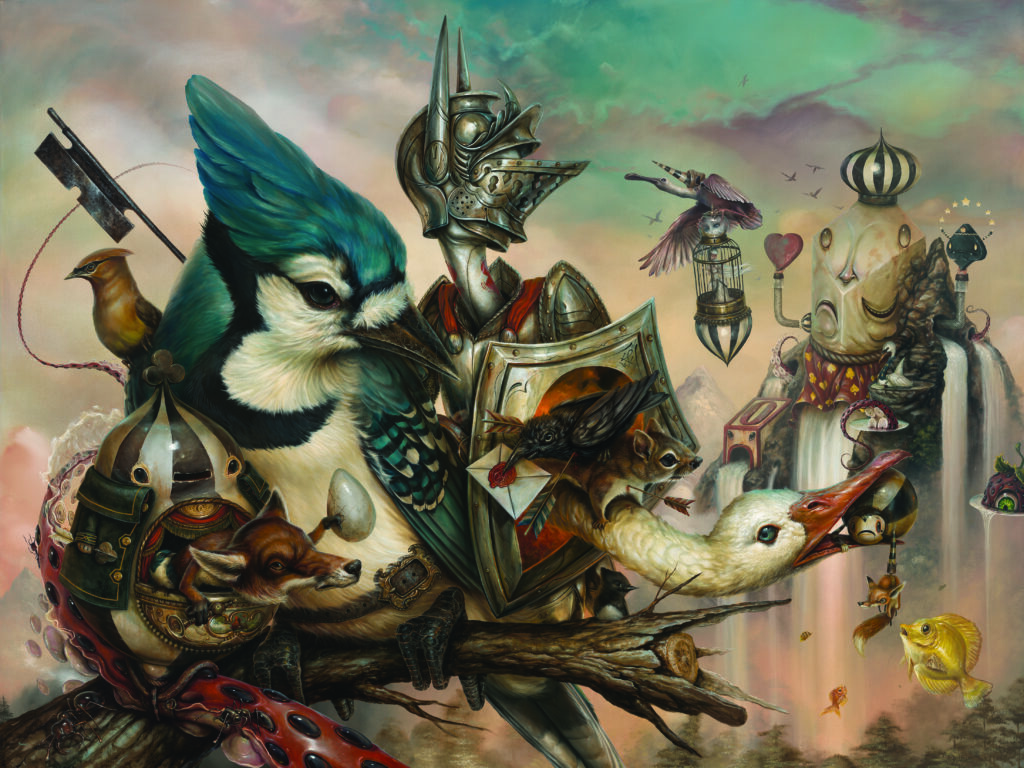
“Good Knight” • 72”x96” • acrylic on canvas • By CRAOLA
He found one of these weird, fantastical worlds at Redondo Fun Factory, the arcade tucked beneath the Redondo Beach Pier from 1972 until 2019. If you grew up in the South Bay in those years like I did, you probably went there to play arcade games and ride the tilt-a-whirl and study the kitsch: a piñata witch, a life-sized gold Buddha, clogs hanging from the ceiling, a taxidermized reindeer wearing a straw hat. In that dingy, seedy, carnivalesque atmosphere, familiar items were recast as strange, simply because their togetherness made no sense.
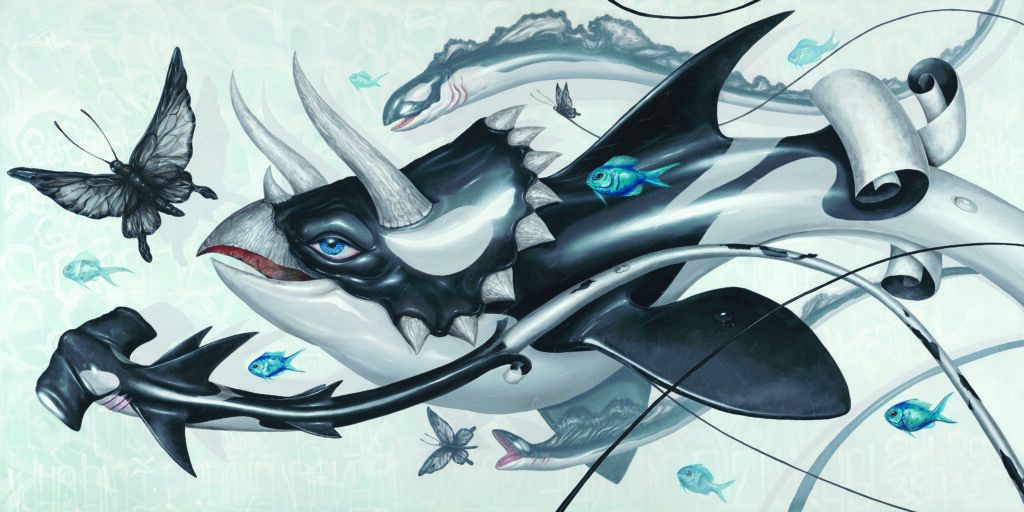
Orceratops by CRAOLA
“That was just like, whoa, what is this place?” Simkins recalled. “It’s kind of like Alice falling down the rabbit hole, and all the cool stuff she would see along the way to Wonderland. It’s how it felt, like you were going to another world when you went there.”
This is precisely the feeling he wants his paintings to evoke. Their subject matter is surreal: a piano walking on crab legs, a duck with the face of a flower, a bird sailing through the air in a teacup. In one painting, an octopus with a lime for a head clutches a beer. In another, a six-eyed rabbit poses with a lobster and a peeled orange. Every painting, full of competing details, is an experience, an invitation to look longer. Simkins described his style to a PBS reporter as “Dalí plus Disney plus Wild Kingdom plus antiques.”
All of this chaos is rendered with technical precision. Simkins’ paintings demonstrate a meticulousness and a mastery of light and shadow that reflect his careful study of realist painters such as Rembrandt and da Vinci.
“If you paint things realistically that are weird, people kind of go, oh, that makes sense now, instead of it just being super cartoony,” Simkins said. “I try to put some realism into it so that you feel like it’s living and breathing, like it was maybe, you know, a captured still life of something that actually happened or exists.”
He developed the characters he painted. He gave them narrative. He built them a world he named The Outside. Isaac, his 19-year-old son, remembers hearing stories about The Outside every day when he was a kid. Some of Simkins’ characters came to life in a 2016 stop-motion film called “I’m Scared,” directed by Pete Levin, produced by Dan Levy, and scored by Mark Hoppus of Blink-182. The short film features eight-year-old Ralf warning his younger brother to beware the weird and monstrous creatures that keep appearing in their bedroom at night. It showed in festivals all over the world, winning best animated film at two.
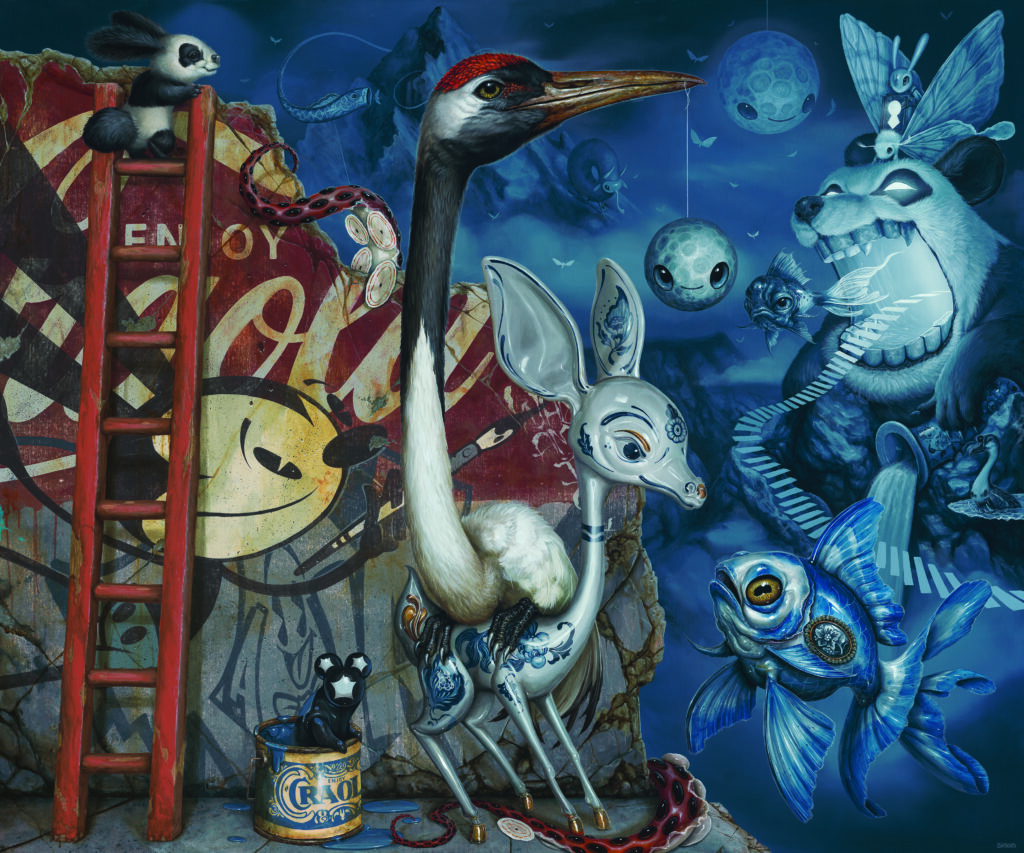
Sidewalk Ends by CRAOLA
“I’m Scared” is an ode to imagination inspired by and developed for Simkins’ two sons, Isaac and Everett, who were nine and four when it was released.
“This whole world, you know, is basically a gift or a love letter to them,” Simkins said. Their childlike imaginations encouraged his. Their astonishment as they discovered the marvels of being alive – trees, bird nests, water slides – kept him paying attention.
Attention like this is rewarded by a sense of awe at the wondrous unfolding of the world, which Simkins understands as the work of God.
“I think it’s just mind-blowing, just the beauty that’s out there in the world,” he said. “I’m working on a big landscape painting as a background for a bigger piece right now, and I’m just looking through photos of all of these beautiful sunsets and cloudscapes and I’m like, wow, it’s like, you get it. He paints this every single day.”
Simkins aligns with C.S. Lewis, one of the writers whose worldmaking (such as in “The Chronicles of Narnia”) inspires him, on this philosophy: that to imagine and create is to echo the original act of creation, and that this God-given capacity is both a gift and a responsibility.
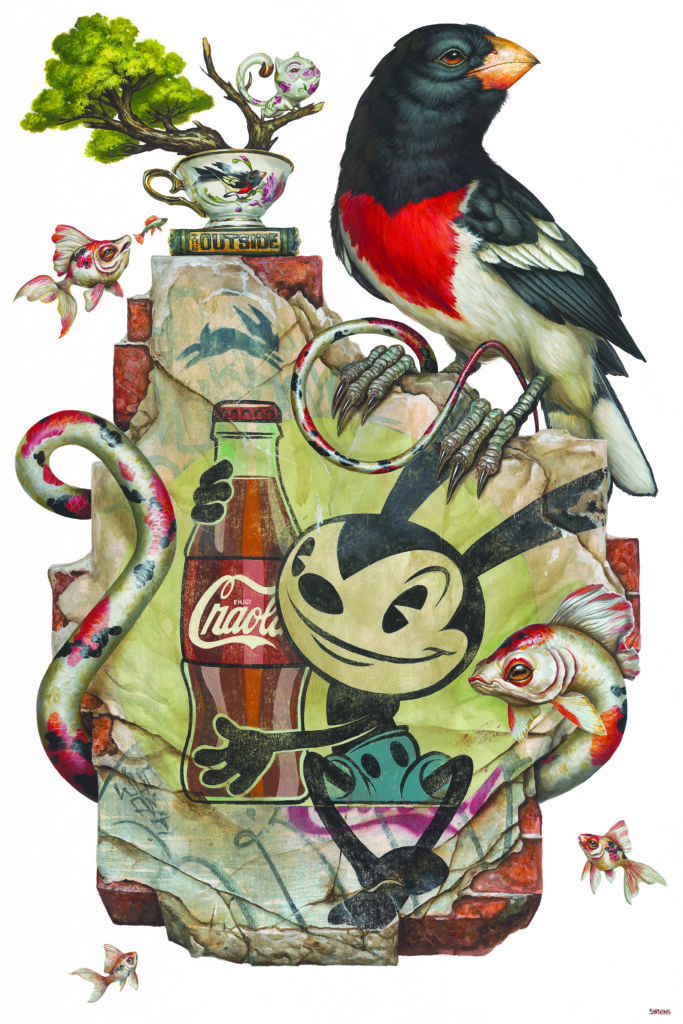
Soda Pop by CRAOLA
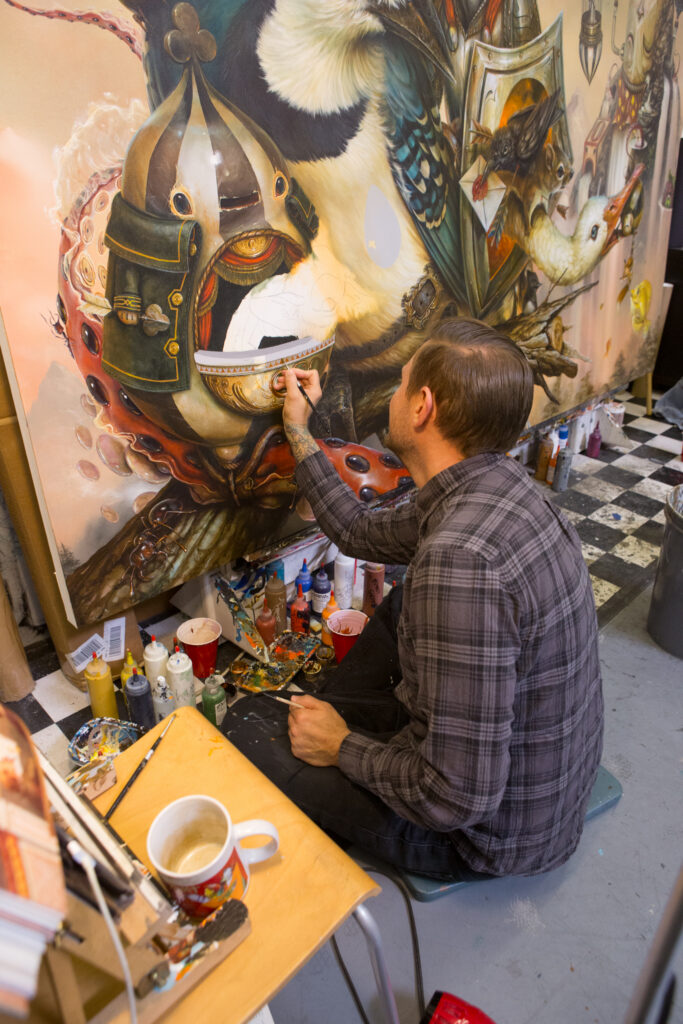
After more than two decades of painting for a living, the artist still does not experience art as labor. He fills up sketchbooks when he’s waiting for his kids at wrestling practice or the skate park. He’s in the studio from nine to six daily, painting to a soundtrack of punk rock, classical music, and songs from old cartoon movies. Recently he got so lost in a painting that when he looked at the clock, seven hours had passed.
Simkins paints in his backyard, a quarter of a mile from the house where cartoons taught him how to draw. He and Jenn walked into this backyard when their boys were little and discovered a zip line over a fire pit, an in-ground trampoline, and a ready-made art studio.
“I was like, oh my gosh,” Simkins said, “I guess we’re moving in here.”
A family with young kids lived behind the house. Daily, Isaac would climb the wall in the backyard and call out for his friend to come play with toys and watch cartoons. Later, neighbor kids built a quarter pipe and they’d all skate until sundown.
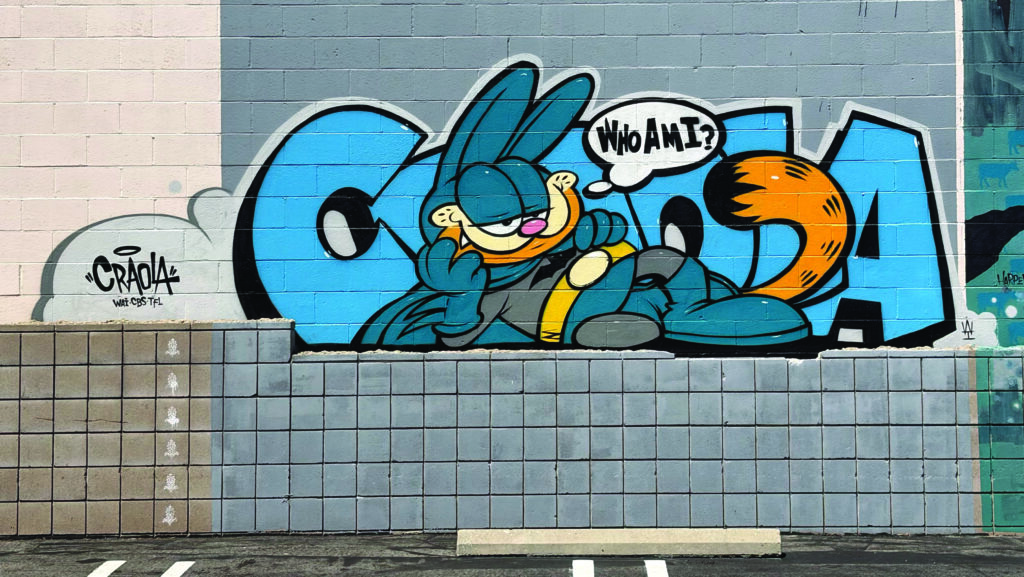
“Garfman” by CRAOLA behind Paul’s Photo in Torrance
Isaac and Everett went to the same schools their parents did: Seaside Elementary, Calle Mayor Middle School, South High. Isaac, who recently graduated from South, worked at Jack’s Pizza, where Simkins worked when he was in high school.
“The South Bay just became this neighborhood of, like, skateboarding and art and fun that it did for me growing up,” Simkins said. “It happened for them too.”
It happened because he was intentional about it happening. During the pandemic, when most people remained indoors, Simkins took his boys outside every day to play Frisbee or go skateboarding. He imparted to them what the South Bay had given him. In homage to local punk rock, Isaac has a Black Flag tattoo on his left thigh.
CRAOLA was already a South Bay legend when I was in high school at Redondo in the early 2000s. While I was thinking about this story, I called an old friend, Mirko Antich, an artist who’s now a creative director at Vans.
He told me Simkins was one of the few artists who changed the direction of his life. Antich discovered CRAOLA as a teenager, by way of Deviates’ album cover, and soon realized the artist had been all around him: in the worlds built into Tony Hawk’s Pro Skater 2 and spray-painted walls throughout L.A. Without words, Simkins taught him what was possible.
In high school, Antich reached out to Simkins, who invited him to the studio. During that visit, the gap between the legend and the person closed. Antich saw another South Bay kid who, like him, was into skateboarding and punk rock and graffiti and tattoos.
“CRAOLA is larger than life,” he said, “and Greg is just, like, a regular guy.”
With this characteristic humility, Simkins attributes his career as a full-time fine artist — extraordinary in its reach, fan loyalty, and longevity, particularly in a time when there are fewer people than ever making a living selling art — to a combination of imagination, work ethic, his wife’s willingness to support his dreams, and the people he connected with along the way.
“I wouldn’t have met all these people and had all these adventures,” he said, “if I hadn’t been here in the South Bay.”
Those adventures have by now achieved an epic reach. Art critics and his client list speak to just how wide a world he made. Simkins has painted for Disney, Converse, Vans, Pearl Jam, Linkin Park, The Used, and Blink-182. His paintings hung on the late Robin Williams’ wall. They hang in the homes of singer Fergie and actor Josh Duhamel, Nike’s CEO Mark Parker, and actor Jason Biggs and actress Jenny Mollen. Nick Cassavetes, who directed such popular films as “The Notebook” and “Alpha Dog,” wrote the foreword to “The Outside,” one of Simkins’ art books. Five hundred people lined up outside Merry Karnowsky Gallery to purchase the book when it was published in 2013.
Cassavetes wrote: “From the first time I ever saw his work, Greg Simkins’ paintings have always hit me on a gut level. You get drawn through the portal by the sheer beauty and delicate techniques of his work. But it’s the narrative, the complex and hallucinatory clarity of the defined worlds that he creates, the hybrid characters, each with their own detailed history, that hits you on an emotional level. It’s like taking a trip back to your childhood, only weirder and more dangerous. In this respect, I have the highest level of appreciation for Mr. Simkins. I find myself staring at his paintings for hours at a time. The characters become my friends, and the longer they live with me, the more understanding I have for them. All in all, he’s the stone cold nuts. Any time you’re lucky enough just to see one of Craola’s paintings, you are in for a truly transporting experience. One that is gorgeous, genuine and deeply personal, the artist presenting a pure experiential journey, with enough stories and mysteries swirling through the paint to make your head spin. The impact is invariably startling, but the success of these journeys is that they are always 100% authentic. And that’s because Greg Simkins doesn’t have a false bone in his body, and he delivers his dreams wrapped in candy and smoke.”
To purchase art or learn more about Simkins’ work, visit gregsimkinsart.com.