A three decade friendship between a surfer and a photographer in work and words
Words By
MIKE BALZER AND MARK McDERMOTT
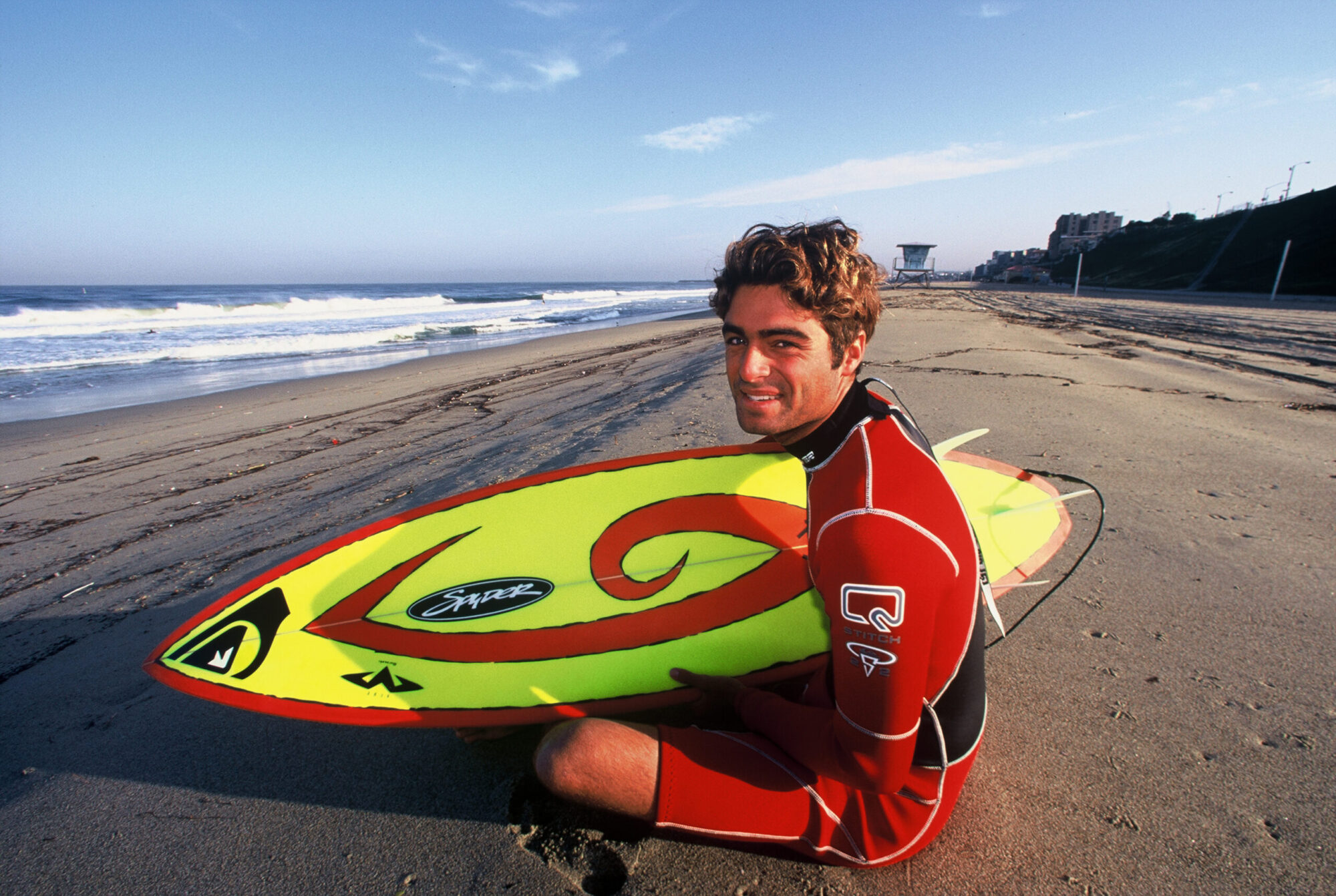
Mike Balzer met Greg Browning in 1988 when he was a 29-year-old up-and-coming photographer and Browning was a 14-year-old surfer whose fast and fearless style was turning heads on local beaches. Body Glove had given Browning a wetsuit sponsorship and Balzer, their in-house photographer, met Browning for the first time on the Avenues in Redondo Beach for a photo shoot.
What transpired from that meeting is now the stuff of surf legend, not only because a photo from the shoot made it into Surfing Magazine – which was in itself fairly unprecedented, a 14-year-year-old kid making the pages of one of the defining magazines of the sport – but because that photo session launched a prodigious partnership and an enduring friendship between one of the most gifted photographers the sport has known and an electric young surfer who would take his place among the Generation Momentum, a group of surfers who would play a role not only in revolutionizing surfing but also in how the sport was documented.
Balzer would play a key role in establishing this “New School” of surfing, not only with his photography, but by introducing some of those surfers to each other. He began introducing Browning to his surfer peers, such as Rob Machado, shortly after that first shoot on the Avenues. Later he’d introduce Browning to filmmaker Taylor Steele, whose influential 1992 surf film “Momentum” gave the group its name. Browning, in turn, introduced Steele to South Bay band Pennywise, whose music would form a key part of the soundtrack for the film.
But it all began with a skinny teenage kid outright astonishing Balzer on Avenue C.
“The gnarly thing about that photo shoot is it ended up in the Surfing magazine calendar,” Balzer said. “That was in what I am going to call the golden years of the magazine, when Larry ‘Flame’ Moore was photo editor. And if you got something in [the magazine], within the surf world – dude, it was a huge accomplishment, not only for him, but for me.”
Over the next three decades, Balzer and Browning would enter surf history, both for their individual work, and especially for what they did with each other.
“Our path, and what we did together … .We kind of rose together through the whole thing,” Balzer said.
They would share dozens of adventures all around the world, from epic North Shore days to Tahiti, Indonesia, South Africa, Mexico, Australia, many other countries and countless legendary surf breaks. But the South Bay remained home, and the place where Browning and Balzer produced much of their best work together. Not incidentally, their partnership would help put the South Bay back on the map of the larger world of surfing.
Early on, when Browning was still a teenager, Balzer utilized him as a “test pilot” on countless days, finding ways to get great photographs in locations and even waves that many surfers and photographers wouldn’t think of as prime. This working relationship would last decades. They stayed in contact constantly, fanning out across the South Bay in search of the right light and the right wave.
“If we didn’t talk to one another for some reason in the day, we’d always check in in the evening and go, ‘What’s going on? Can we do anything tomorrow? Where can we go? Who can we shoot with?” Balzer recalled. “And we would decide what we are going to do the next day.”
The two shared a fervent quality: each was always up for anything. And though Browning became a professional surfer, competitions were not what he loved most, nor where he thrived. He had a preternatural gift from the get-go, an instinct for how to create a striking moment, and image, through surfing. He would later go on to become a filmmaker himself, best known for his groundbreaking DriveThru series surf documentaries. But even as a teenager, Browning had a vision that not only encompassed waveriding itself but how to do it with a style and casual verve that was eminently photographable.
“Man, he had his turn,” Balzer said. “He was a regular footer, and if he went right and he got the right wave, he had this turn he could do off the top, and he would blow the tail out. It was kind of ahead of its time, and wherever you were – from the beach, from a side angle, whatever – dude, you could get an insane photo. That was kind of the Ace of Spades in his pocket.”
“He was fast. He was on the cutting edge of what was being done at that time. And he was fearless.”
In a sense, the kinship between Browning and Balzer was that they both were artists. Neither would ever use that word – they just wanted to do cool things, and create radical images that documented those cool things – but the end result was pure art.
One day, they made an unexpected discovery.
“We were trying to get a shot, and everywhere was shitty,” Balzer said. “But the lighting was really good, and there were some waves. It was good weather, it was offshore, it was winter, and I go, ‘What if you go right on the north side of the Manhattan Pier?’ So we just tried it, with a long lens. And that’s how that whole thing started. I mean, I got like nearly 20 covers from there, but Greg was the test pilot for all that. He went out, and the way he surfed, all of a sudden, the first session we saw it. This is back in the film days…And once we saw it, we’re like, ‘Oh my god, there’s something here. We can do something. Let’s keep an eye on it.”
Pretty soon Balzer was convincing some of the best surfers from around Southern California to come surf at the pier, much to their reluctance.
“It was Benji Weatherly from San Diego, Keoni Cuccia from Ventura, the Malloys,” he said. “They’d all go, man, it’s so fucking shitty, Balzer, let’s go surfing somewhere else.’ And I go, ‘No, you won’t believe it, the photos from here are insane. Let’s just chill. Let’s see the photos. And almost everyone would get something big.”
Browning got his first Surfer Magazine cover at the Manhattan Pier. Balzer didn’t tell him, but instead invited him over to his house, where a bunch of friends were waiting and a foamboard mockup of the cover was sitting on top of the fireplace. Browning was just happy to see everyone and didn’t notice it at first, and when he did, didn’t think it was real.
“Whoa,” Browning said. “What’s that? You just made that up. That isn’t the real thing.” “You got the cover,” Balzer said.
“It was such a cool moment between us,” Balzer said. “I was determined, I wanted to get him something bigger. Because he worked his ass off. And he was just awesome at getting photos, just phenomenal.”
It got to the point that rival surf magazines would send photographers to the South Bay to try and find Balzer and whatever crew of surfers he was shooting in order to poach the shots. It was the ultimate sign of respect, if annoying, after all the derision directed at the local surf.
“They’d try to find us, try to shoot, try to give those photos to our competitors,” Balzer said. “But if you go other places, it’s way easier to figure out. In the South Bay, if you don’t know where to go on certain days, you could be a mile off of a spot that’s the best day of the year, and you didn’t see it that day because you didn’t know where to go. The South Bay is kind of a unique location. Whereas if you go to Huntington, you are like, ‘Oh, let me go to the Huntington Pier.’ Well, that’s pretty easy…But the South Bay, you’ve got to know where and when to go to these spots.”
The Manhattan Beach pier showed up in so many Surfing Magazine covers and spreads that Larry “Flame” Moore, despite loving the results, finally had to tell Balzer to focus elsewhere.
“I think I had five Surfing covers pretty close together, and they’re like, ‘Okay, shoot somewhere else,’” Balzer said. “It just became like a studio. Greg was a big part of starting that. Good, good times.”
By that time, Browning, Balzer, and this group of young surfers who’d coalesced around a new way of doing things had already gone global. Generation Momentum had arrived.
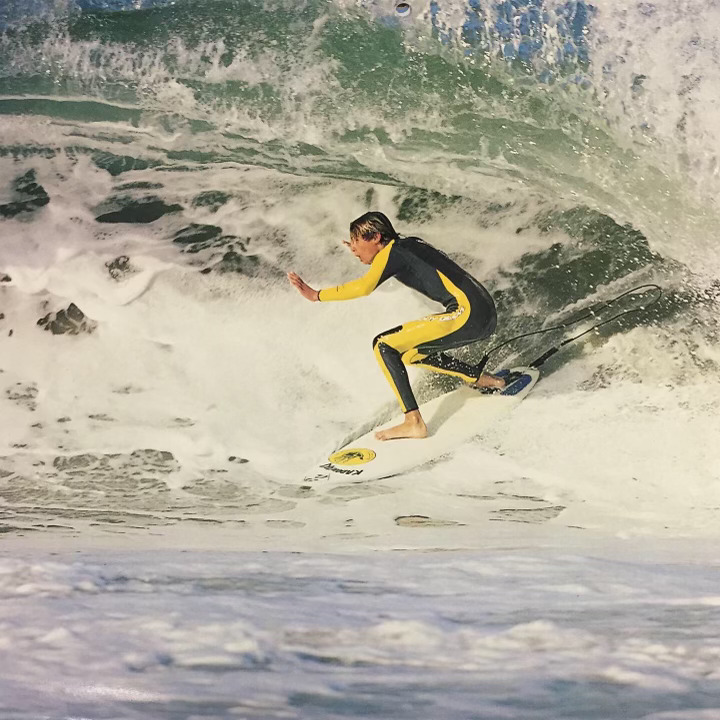
1 Avenue C, Redondo Beach, 1988
“That’s the very first time I ever shot Greg. It’s at Avenue C. It was just so surprising. He wasn’t afraid of anything. And when you look at that kind of wave, you look at the lip and what everything is doing, and he was still able to pull in and look really stylish and kind of be on that face long enough that I could get a good shot….You never know when you shoot with people for the first time, but that photo is kind of what really launched him and me together. That started our relationship and road to shooting together for decades.
I was introduced to Rob Machado and Pat O’Connell in a similar way around that time. They were on the NSA national team, and Body Glove sponsored that team at the time. Greg, at 14, was kind of not yet on the radar of the surf industry. So when I first met him….Okay, something really unique about Greg was his high-pitched voice, right? At that age, he had a really, really high-pitched voice. When you’d first meet him, everyone would kind of laugh. But Greg was so cool and just so nice that that would always just fall to the wayside. You hear it, and you’re like, okay, he’s not taking your bait. And he’s a really cool person. We are not going to make fun of him. And also, he was super skinny.
So I just thought, let’s go to Avenue C today. We’ll have a good chance to get something for a photo because of the swell direction and lighting. And it was a good day to shoot. I’d never really seen him surf before that, so I didn’t know what he could do. And I was kind of blown away. He looked like someone that should have been surfing for a lot longer than he had. He just knew how to draw the right lines. He knew what to do. He just had that in him from day one. And so for me, I kind of immediately recognized, ‘Oh, wow, this kid’s got something.’
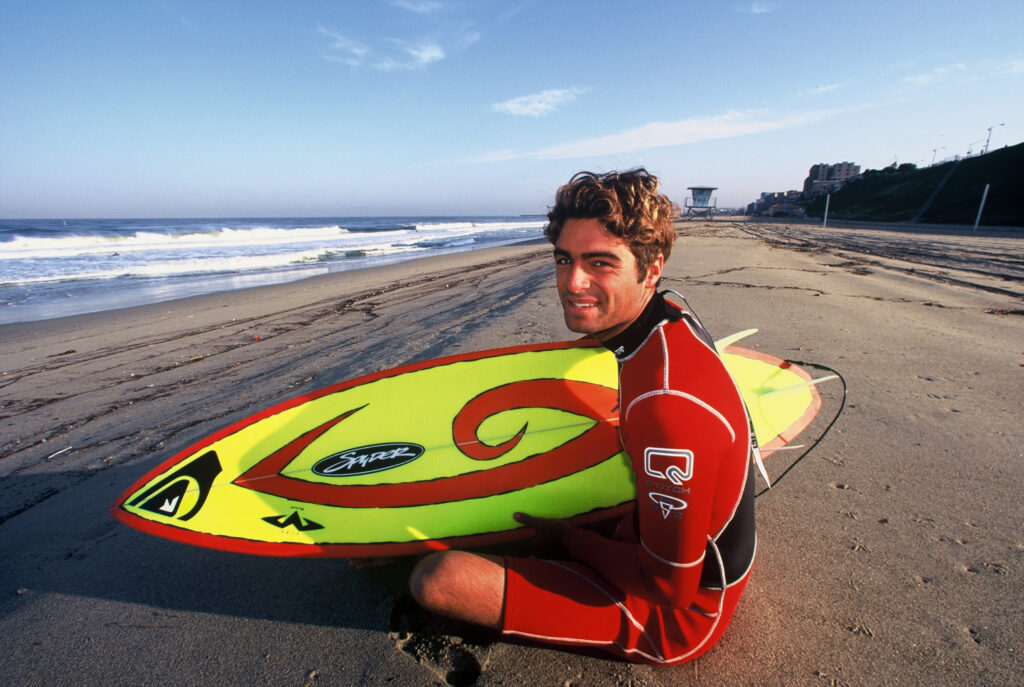
Avenue C, Redondo Beach, 1996
“Ironically, that is the same location pretty much as that first shot, when he was 14. He’s about 22 here. It’s probably one of the best portraits I ever got of him, because it kind of shows who he is. Another cool thing about Greg is he understood – that board, that’s all his idea.
There’s a stylized G on the whole board on the top, and that’s G for Greg. But it’s the color, it’s insane, and he did that to be unique and different from everyone else and have color on his boards.
Color would always help when you’re shooting to get something. There’d be reflections, and that upped his chances of getting something in the magazines over his competitors. All the time, I’d be like, what are you going to get on the board? And he goes, ‘Don’t worry. I got this.’ Other guys would roll up and they’re all in a black wet suit and all their boards are clear, like, ‘Oh man, you guys are just all going to look the same.’ Greg took a different approach and it really served him well all through his career…We’d see other guys show up, other pros, and they’d show up with dirty, older wax [on their boards] kind of like blackish. We’d be like, ‘Dude, you got to take that wax off, rewax your board.’ And they’re like, ‘Why?’ ‘You want it to look clean.’ Greg understood all that without even having to explain much of it. And it was just, you know, I just think of all the things we did like that that really benefited both of us.
It sums, sums up where we kind of shot a ton, and everything, the color on the board, even his wetsuit, it just kind of sums up, in a sense, what we were both trying to do together.”
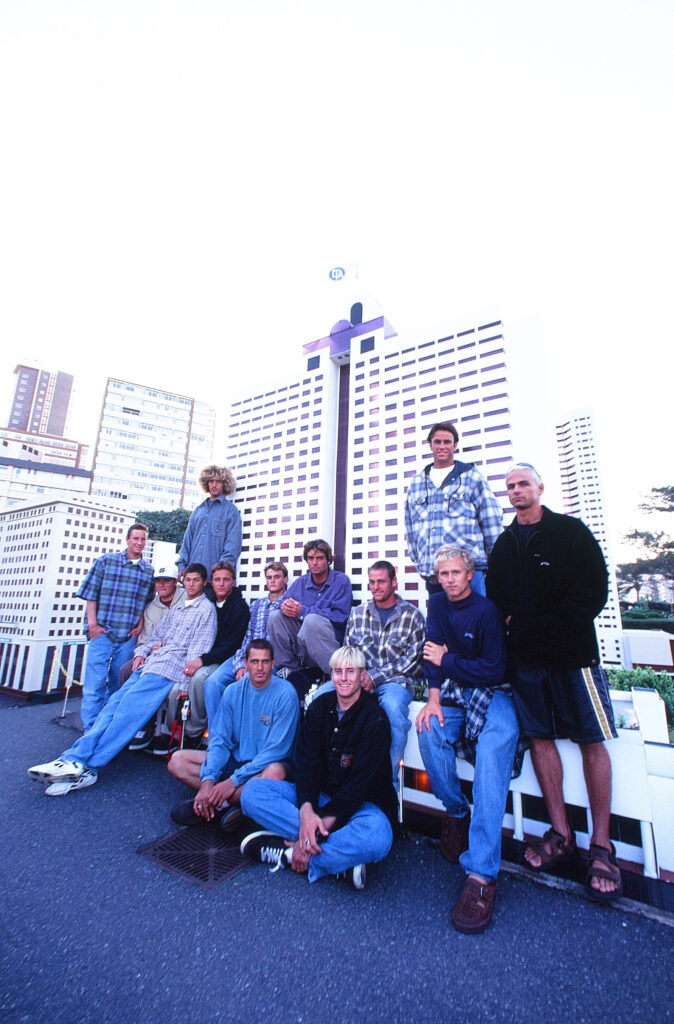
1995 South Africa Momentum
Generation Momentum: “Todd Chesser in black jacket, Pat O’Connell blond hair, above him standing is Shane Dorian, sitting on ground Ross Williams. blond hair, above him Taylor Knox, sitting on ground in blue shirt is Kelly Slater, above him Greg Browning, Todd Prestage, Joe Curren in black shirt, Kalani Robb in front of Joe, Rob Machado with big hair standing, Benji Weatherly in white hat and Timmy Curran standing…”
3 Durban, South Africa, 1995
As Generation Momentum was both coalescing into a hugely influential group of young surfers, and being recognized as, Balzer managed to get almost all the surfers together – 14 of them – on the North Shore in Hawaii in 1993 for the defining ‘New School’ shot . Browning, however, as was his happily non-conforming wont and his dedication to friendship, missed the shoot in order to go pick up a friend at the airport. So two years later, Balzer was able to gather the group again, this time with Browning.
“So we all went to Durban, South Africa. Just a hell flight to get there. LAX to JFK, long layover, JFK to Johannesburg, 18 hours in a plane. Brutal. I didn’t know they could stay airborne that long. When we got to Johannesburg, we were told, ‘Don’t leave the airport. It’s gnarly.’ Layover there, and then to Durban. Which is kind of like, it’s a beautiful area, but it would be kind of like their Huntington Beach. And at the time, there was the Gunston 500 contest. Greg hadn’t entered, but he wanted to go, because we had an insane crew. Taylor Steele was going to shoot, and obviously Kelly [Slater] and everyone else was going to be there. We’re all staying right above the Gunston, because half the guys had to do the contest, and half of us didn’t. But we kind of stuck together, and then we’d all go shoot on off days. and then so on that. On that day, we all kind of walked across to this, to this little it’s like it was like, not quite an amusement park, but something called Small World. It looks like a miniaturized world. And so we were all there, and we’re like, ‘Oh, let’s get a group photo.’
And so we gathered. And it’s just wild, because you look back in life…You know, Todd Chesser is in that photo. You just don’t know, people are going to pass away, and so that becomes a treasured photo to everyone. But also, that photo also defined and kind of narrowed down the Momentum Generation. And Greg’s in that shot, center, right above Kelly Slater.
It’s funny, when you’re that close to everyone, you’re not looking at things historically. It was more like, ‘Oh, let’s just document, hey, we’re all a group, and we went here.’
It was insane. Greg, on that trip, was only there for two weeks. We shot at a place called Ballito. A really good wave. I shot a ton of stuff, but there were other photographers there too. One guy I was real good friends with, Chris van Lennep, was one of the top water photographers in the world. He shot the Surfing Magazine cover that Greg got on that trip…Yeah, Greg gets the cover, once again. Here’s the guy not there for the contest, and he gets the cover. I was stoked for him. That was Greg’s first really big thing.”
Hammerland, El Segundo, 1996
“That is Greg once more being a test pilot with me. ‘Greg, let’s go try to get something here at this left at Hammerland.’ He was fully game for anything. And that’s a brand new board. He was with Spyder then, and it’s a pretty big board, but just the way he pulled in, and his style – how he would stand, everything, his hands, his arms. His style a lot of times, would just make the photo, because he looks so nonchalant in his stance. It’s like, ‘Oh, this is nothing, I can do this all day, any day. That wave, Ted Robinson is one of the main guys that named it. It is called Hammerland because it would break so hard they said it would hammer you, and it would just beat the living shit out of you. And of course, Greg keeps going, going, going. And of course, Greg breaks his board. He broke so many boards. I would not want to be who was paying for his boards. He broke that board that day, but we did get that photo. That photo ran in Surfing Magazine.”
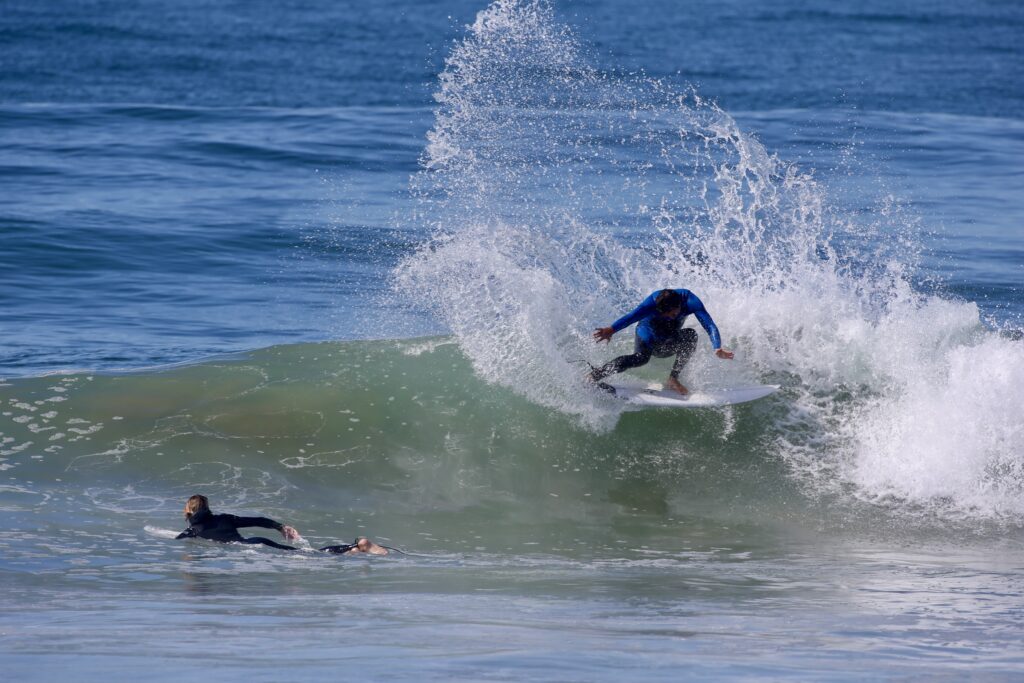
16th Street, Hermosa Beach, 2013
“Greg was the instrumental guy that was able to drum up everyone to come and surf bareback in the middle of winter, when it’s 55 degrees, and do surf heats to win the Bareback Cup. It was just a local thing, all locals at 16th Street, Hermosa, and I always shot it…..Greg does that turn, kind of his trademark turn. And paddling out is his son, Parker.
That turn just shows everything that was so good about Greg’s style, and it’s right in front of Parker, like, ‘Hey grom, screw you, look what I can still do as your dad.’ I just love the photo for that. It’s probably one of my favorite photos because of what Greg is doing right in front of his son, and Parker has gone on to be a really good surfer, also.
I think it was a day when the waves were good because Greg is wearing a wetsuit, so it was probably after they surfed their heats bareback.”
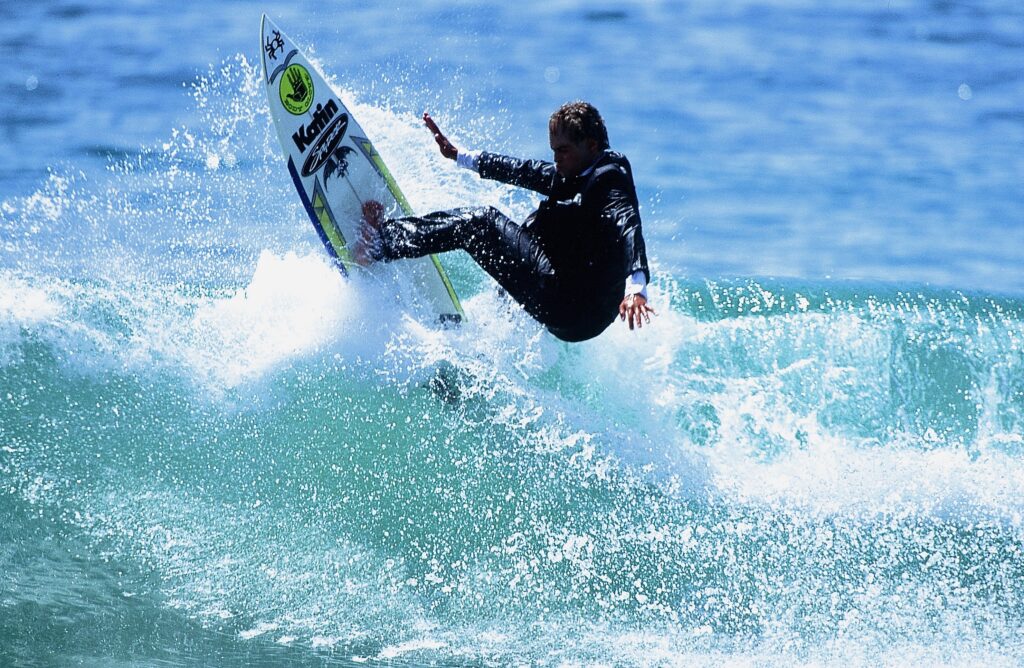
Jeff Deffenbaugh, David Letterman, Greg Browning Zuma Beach, 1994
In May, 1994, Balzer caught wind that Late Night with David Letterman was shooting a week in Los Angeles and intended to do a surf skit on the final night. They needed two surfers to impersonate Letterman and his sidekick, bandleader Paul Shaffer, on the water. They also needed a surf photographer to help organize the shoot. Surfing Magazine’s Larry “Flame” Moore turned down the gig but asked Balzer if he wanted it. Balzer immediately thought of using Browning as Letterman surfing body double and Huntington Beach pro surfer Jeff Dellenbaugh as Shaffer’s. The rest is history.
“When I first contacted them, they were saying, ‘We want really good surfers.’ And I go, ‘Well, who do you have?’ And they rattled off names that I’d never heard of. I’m like, ‘Really?’ And I go, ‘Where did you find them?’ And it was like a casting call, to it would have been want-to-be surfers trying to act or whatever. So I go, ‘I got two guys that are pro surfers, really good surfers, and they kind of look like Dave and Paul a little bit.’ I just wanted to do it, not sit there and go, ‘Pay me, I’m your agent.’
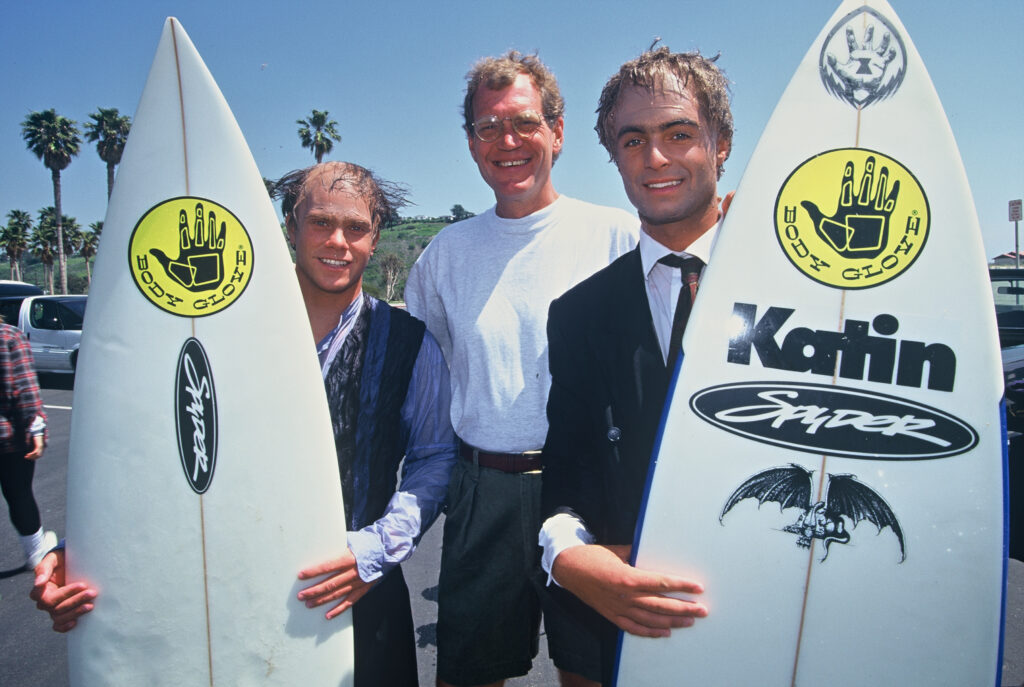
This was such a trip. The budgets on this stuff, I couldn’t believe. They told us they were going to shoot at Zuma Beach on this date, at this time, we say ‘Okay.’ So we show up, and they had three full sets of clothing for each of them, all identical, and real human hair wigs. Now keep in mind, Paul Schaefer was bald, and Deffenbaugh was not, so they had to do a bald cap on Deffenbaugh, then do all that makeup. It took like two hours. Letterman had his male-pattern-balding, curly, funny hair. They put that on Greg, then they put the clothing on him and the whole bit. And the directors tell him, ‘Okay, we’re gonna do this. Go out and surf.’”
The segment ran on May 13. In it, Letterman is bemoaning that there was one thing he didn’t get to do in California, and Shaffer says, ‘Well, there is still time,’ and they run out of the studio, and are shown jumping in a convertible, parking at the beach, and jogging with surfboards into the water, wearing their full suits.
“And then, the next shot is Greg, like, boom, boom, boom, in the suit and the hair, and you’re like, ‘Oh my God,’ and Deffenbaugh…. Look at how much he’s got on, and he’s wearing wetsuit under there. It’s a full-on tailored suit, and like I said, a real human hair wig and kind of bald cap thing. The lengths they went to get this, it was no ends. Unreal.
It was so fun, just so cool to do that. Greg was the perfect guy, kind of looks like Letterman, and who would I rather do it with? Greg more than anyone. It just worked out for both of us, again.”
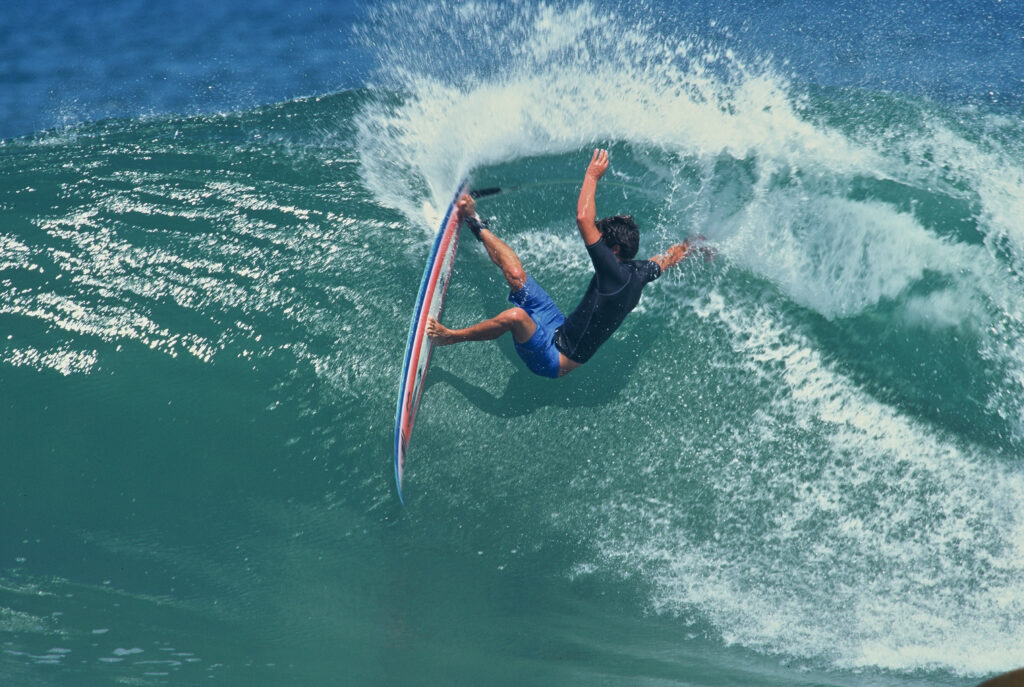
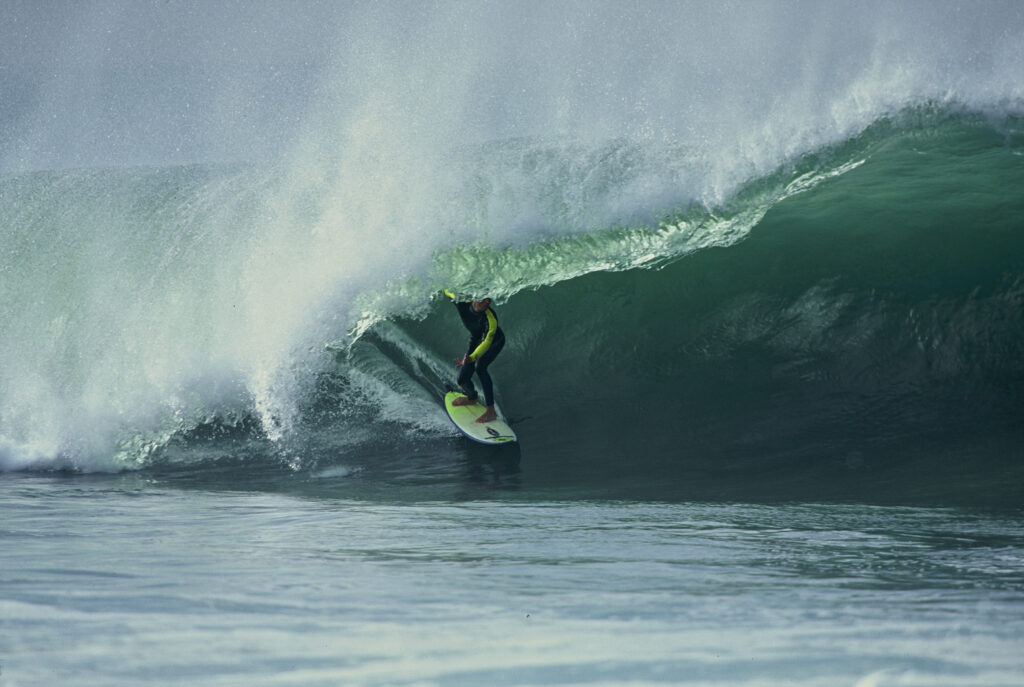
Puerto Escondido, Mexico, 1990
“That ended up being kind of an infamous trip to Puerto Escondido. All of a sudden, these things just would take off. Like, ‘Hey, what are we doing? Oh, let’s all go to Puerto Escondido.’ And it would be this group of us, gnarly, like you hear the names of the surfers now, and you’re like, ‘Oh, shit. How’d you get all those guys?’ Kelly Slater, he’s already on his super high trajectory rise of who he is, Pat O’Connell, Shane Dorian, Keith Malloy….So we go down there, and I have never been there. Greg has never been there. The wave is one of the most powerful waves in the world. It’s just so strong, it’s sand bottom, a beach break, but it just comes out of super deep water, and it breaks so hard.
That specific photo, what’s so rare about it – on that trip, Greg put his brand of what he could do, especially in front of a camera, on waves there. No one was doing turns like that. You just didn’t do turns like that at Puerto, and he did that turn. Obviously, if you look at the board, he’s got color all over it again, so he’s going with the same formula we do together. And that trip ended up running in Surfer Magazine, like 12 pages, just the crew that I was with and what I shot. Greg had a ton of photos from that trip. The turn he’s doing is just so high performance, and it’s something very few guys would do at Puerto Escondido. And of course, he went on to break that board. He didn’t have many baggage fees coming home from that trip. He’s 17 years old here, but his level of surfing was just phenomenal. The strength of the wave, it didn’t hold him back. He would get results. He’d get the goods.”
8 2008 Bruce reaction says it all by Balzer copy
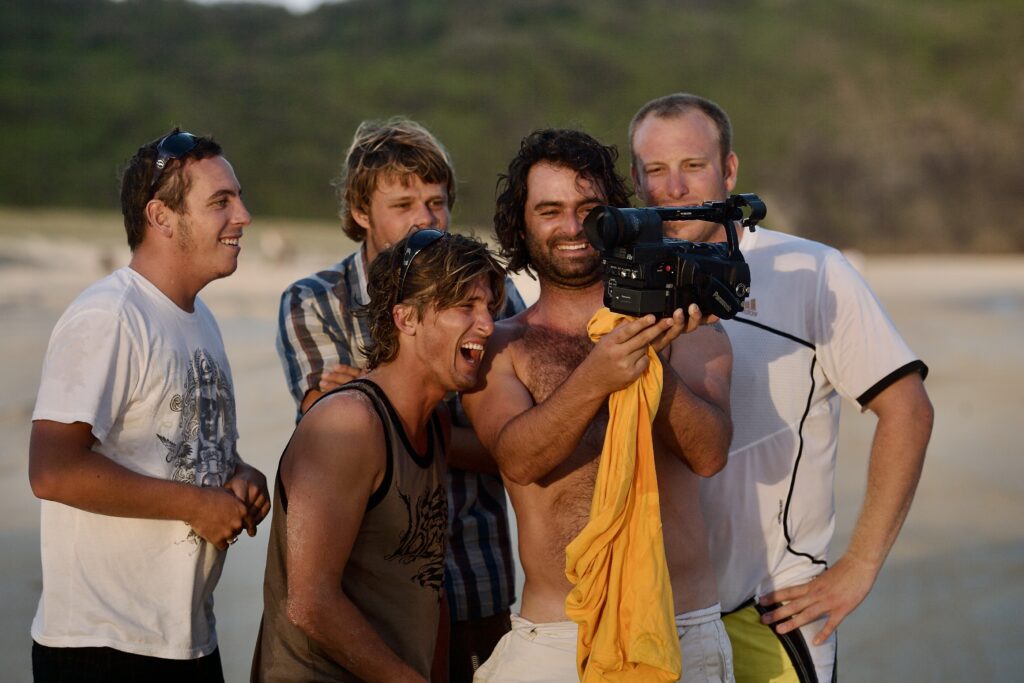
Treachery, New South Wales, Australia, 2008
“That beach, it’s so perfect, the name of it – I’m not making it up, Treachery, that was the name of the beach. I’m like, ‘Holy crap.’ Greg and a bunch of the surfers would ride in this van, and then this other photographer and myself would be in this brand new Nissan four door truck. They are both rentals. So we’re there all day, and it was really small, but it was beautiful. The water color was turquoise. It was just unreal. So the guys, they all went out and surfed, but it wasn’t the kind of surf you would go all the way to Australia for. It was just too small. And so they ended up surfing for maybe about two hours. And the funny thing is, I’m like, ‘Okay, I’m not going to miss anything. It’s Bruce Irons and Dane Reynolds, and Greg shooting video. I’m shooting from land, with a long lens. And Bruce Irons does this this backside air, and I ended up getting this photo of Bruce, probably one of the best photos ever of Bruce on this really shitty day. It was a killer photo. But then after that, they’re on the beach, and we had brought food there, and, of course, the cooler of beers. The beers are to persuade Bruce and the guys like, ‘Hey, will you help us do this?’ In the afternoon, they had put cameras on the hood of the truck to film them driving on the beach, to have B-roll and filler for the movie.
Bruce had had a few beers. And they go, ‘Hey, we want you to drive up and down the beach, you know,, driving kind of wild.’ And I’ll never forget, Bruce looks at me and he’s drinking a beer, and he goes, ‘Man, I drink another one of these beers. I’m gonna fucking roll this truck.’ I didn’t say anything. And sure enough, he rolled it.
Greg was in the truck with Dane Reynolds and Mike Craig. So there’s four guys in the truck, and Bruce, he was going about 50 or 60 [mph] on the beach, and he started kind of fishtailing it and he over-corrected, and he had to go towards the water, and he gets in the water, and then he over-corrected that turn, and it literally grabbed the wet sand and grabbed the right front passenger tire, ripped it off the rim, and the truck rolled. And it stopped, upside down. Windows are all down, and I shot the whole thing. I have the whole sequence, going over, then into the water, then it’s on its roof, and, I kid you not, the windows are down and there’s waves going through the whole truck, from driver’s side out the passenger side. I’m just going, ‘No way.’ That was a brand new truck. And Greg was shooting, and he didn’t stop. , I’m kind of far from Greg. Greg shoot. Greg doesn’t stop. So he got the whole thing too. And then the crew ran down to flip it over. The truck was destroyed. So destroyed.
They get out, and they get the truck out of the water. It took another vehicle. And then what you’re seeing in that photo, Greg’s s playing back the video of it, and you look at Bruce Irons’ face there. It just sums up the whole thing. And look at the joy on Greg’s face. He’s so stoked to show that to Bruce. That’s why I love that photo.
No one got hurt. The funniest thing about it is when the sponsor heard what Bruce did, they ended up making him pay for the truck. Bruce had to pay like 25 grand for it. Oh, man. Then, for the rest of the trip, the other photographer and I had to use that truck. The front windshield was broken, so we had to duct tape the window to drive it in. There’d be little shards of glass hitting us the whole time, we’re like, ‘Bruce, you suck, dude. Look what you did.’ But it was so fun. That was probably one of the best trips ever.”
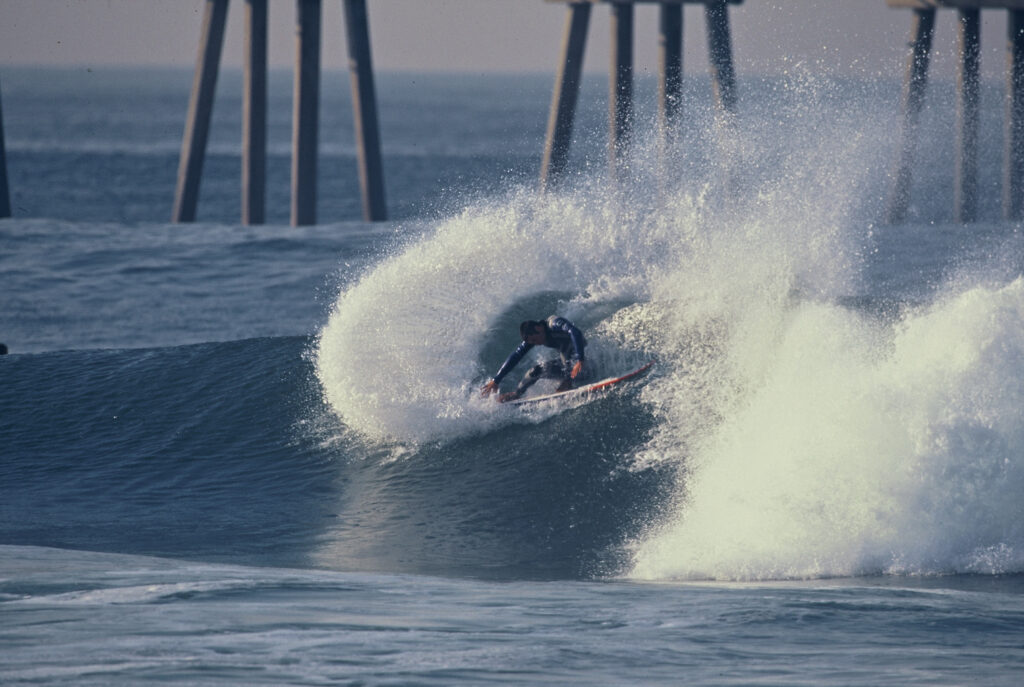
Hermosa Beach Pier, 1995
“What I love about that photo is that it just shows how good Greg is at that time, how good he was at surfing, and how good he was at that front side turn that he did. This was such a money shot, and on top of it, the pilings show it’s Hermosa, his hometown. That’s why I love it so much. It’s him and his high performance surfing, and the Hermosa pilings. To me, it just sums up a really awesome period of time for him and me both. We were so productive. That ran in a two page spread in Surfing magazine as well.
“I also always loved this shot because in the surfing world, unless you’re from the South Bay, no one says anything good about the South Bay. ‘It sucks. ‘It’s horrible.’ ‘It’s always closed down.’ ‘It sucks you guys live there.’ I’m like, ‘Okay, well, we’re not really going to call you all the time when it’s going off.’ But look at this shot of Greg. That’s a good wave.’”
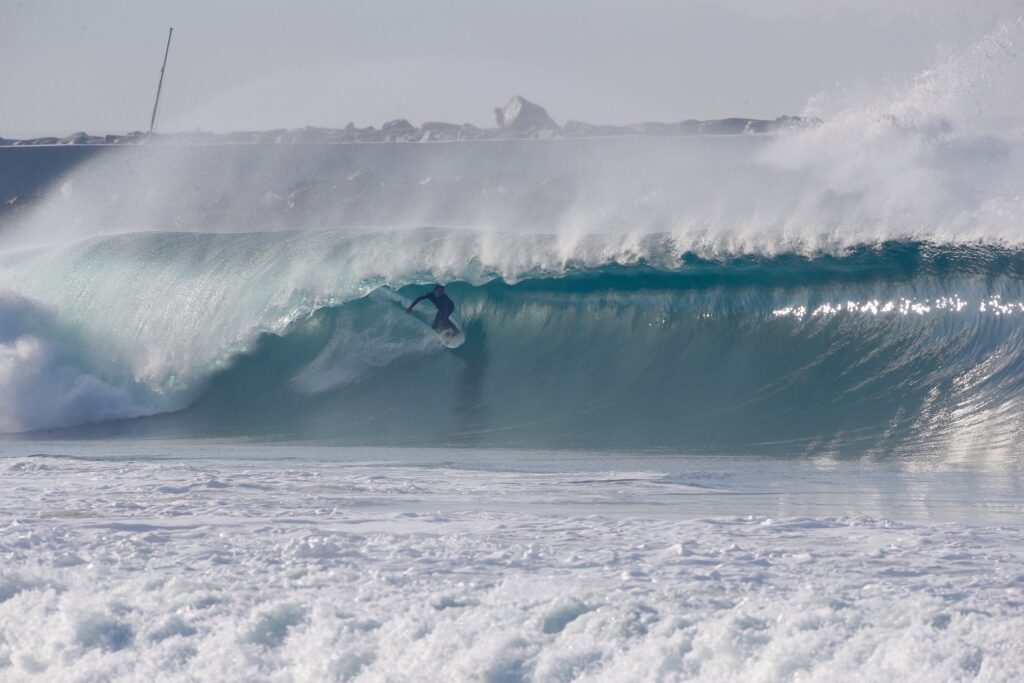
Redondo Beach Breakwall, 2019
“Look at his nonchalant stance. He looks like he’s just standing, somewhat casually. It’s like, ‘Oh, I’m not threatened by this at all.’ And that was Greg. And look at the wave he’s on. That wave is beautiful. And he knew just what to do to end up getting an A-plus photo. You are like, ‘This guy knows this. He’s got it down.’ And I was so happy. If Greg was out on a day like that, I am going to get something good. It’s Greg. There’s no problem there. And that kind of sums him up. Mainly, it’s mainly how deep he is on the wave and his nonchalance, ‘Yeah, I can do this. No worries.’”
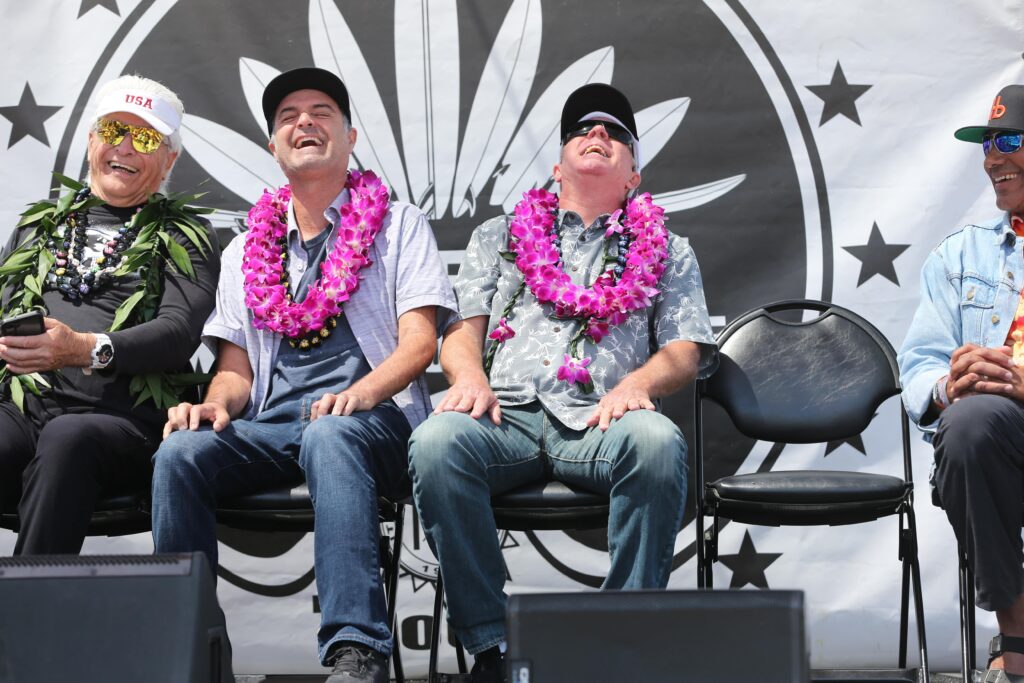
Photo by Malia Balzer
Surfers Walk of Fame, Hermosa Beach, 2023
In early 2023, Greg Browning was diagnosed with ALS. Over the next two years, the disease steadily stole his physical grace, and finally his life. He died at the age of 50 on April 11, 2025. But as Balzer and others who were close to Browning would learn, ALS could not steal his larger grace – his kindness, humor, and fearlessness. It wasn’t quite the cool nonchalance he displayed when riding even the most impossible waves, but a clear-eyed acceptance, leavened with his indefatigable sense of fun and his love of life and those he shared it with. He kept his stoke.
“It was so rotten and horrible and unfair, right? Torturous,” Balzer said. “It’d be so easy to just dwell on the negativity of that, but he was gnarly. He was like, ‘Okay, I’m going to Disneyland today.’ His favorite thing was going to Disneyland, that Star Wars [ride]. He kept going, even when he was in a wheelchair. He goes, “Dude, I’m stuck in a wheelchair. That way, I don’t get tired, and I go right to the front of the line.’ He’s not even fazed about how he’s feeling. He’s just stoked to go.
The kind of person he was is so rare on so many levels – his surfing ability, how nice he was to everyone, how talented he was, not just in surfing, but then at video and filmmaking, and then just how good he was to people..”
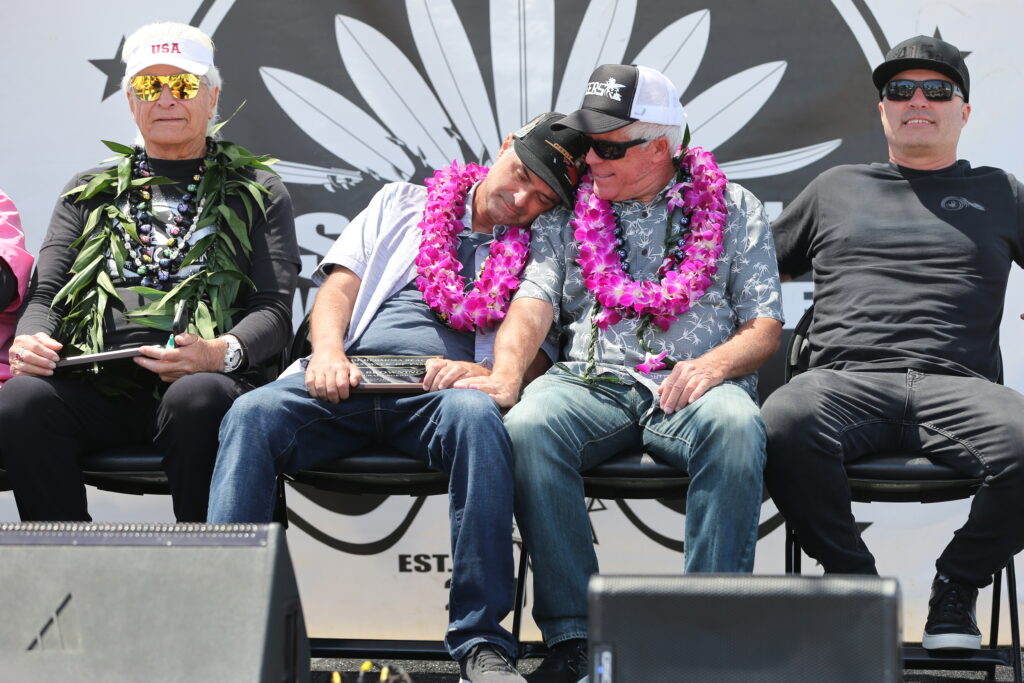
On April 27, 2024, Browning and Balzer were each inducted into the Surfers Walk of Fame in Hermosa Beach. It was a beautiful grace note, both for the final chapter of Browning’s life, but also for the epic times the surfer and photographer had shared. They were inducted alongside David Nuuhiwa, a legendary Hawaiian surfer many consider the greatest longboard of all time whose style influenced surfers across the Pacific. Browning’s physical decline was evident, but his joy, and his gratitude, outshined anything ALS could do. In his induction ceremony speech, he somehow managed to turn a long list of thank yous into an elegant and often funny expression of enormous gratitude for the people who helped make his life the great adventure it was. It was the equivalent to his signature turn on a wave, electric and mystifying and absolutely rousing. Balzer was among those he singled out.
“Mike Balzer. Your fearless approach to life was so infectious and undeniable, from the minute I met you,” Browning said. “You gave me the best opportunities every single day we spent together. To share this day with you, up on this stage, just makes sense on so many levels.”
As Kevin Cody would write in the Easy Reader that week, Browning “said barely a word about his illness. He barely said a word about himself and his career as a pro surfer, filmmaker of the Drive Thru surf movies for Fox Cable and Fuel TV, and personal videographer for surf celebrity Jamie O’Brien, and surfing world champions Marissa Moore, and Tatiana Weston-Webb. Instead, he thanked people, not in the dutiful manner of Academy Award winners, but as though he was speaking privately to the person, unconscious of the 500 people listening in.”
It was a sweet day that went long into the night as Browning, Balzer, and a crew that had come from all corners of the world – including Generation Momentum surfers Benji Weatherly, Kalani Robb, Chris Malloy, as well as O’Brien and Weston-Webb – held court on Pier Avenue late into the evening.
“It was so cool how many people were there, and kind of wild,” Balzer said. “It kind of bookended something for me, with him. There’s no way you could have planned it or predicted it, that that would happen this way, and the timing of it all. We were just so happy to be inducted together. And then what made it even more special was my daughter just grabbed my camera gear, and she can shoot. And her photos are what Kevin Cody used on the cover that week for the story. We’re sitting up on the stage and someone’s talking, and it’s me, Greg’s on my right, and then Nuuhiwa is next to Greg. And at one point, I look out at the crowd and I go, ‘Greg, can you imagine when we just started shooting photos at 16th Street, Hermosa? We never knew what would happen. And look at us. We’re sitting here and we’re going to be inducted in our hometown, and you’re sitting next to David Nuuhiwa, who probably has no idea who we are…This is insane.’ And he just looks at me with a huge smile.”