
Words By
JEFF VINCENT
Photos By
JESSIE LEE CEDERBLOM
The entrepreneur’s path is scary. Look over one shoulder, and it’s seemingly clear cut: interviews, positions, ladders. Over the other shoulder, and it appears to be smooth sailing: a paycheck that already exists, just waiting to be clocked in for. In reality, there’s no easy way through, and we’re all bound to tend the farm—to spend grueling hours tilling the earth, with hammer in hand, or spatula spanking the grill on rapid fire; in collars compressing Adam’s apples, or stilettos biting heels. Supporting one’s self in any fashion is an utter triumph. But there’s a Wild West sense of freedom in doing it your way, and some of us are compelled to do it no other way.
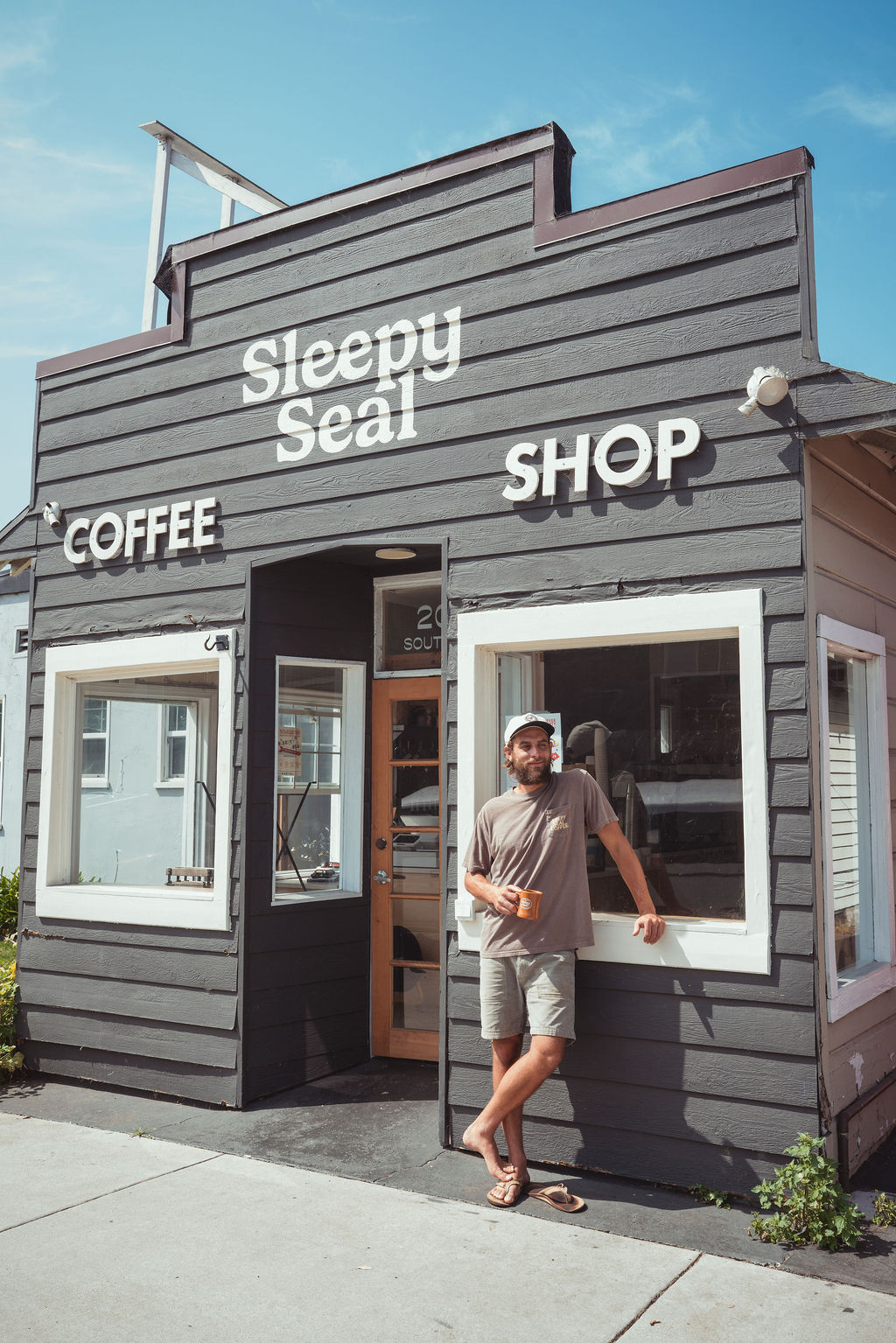
Dave Israel looked out upon the field of uncertainty, where any trails would need be blazed by your own hands, with tempests to tame and tornadoes to wrangle, where every thin dime will be squeezed from the sweat of your brow. He peered into that unknown with a vision of both where he wanted to be and where he didn’t want to end up; and, with a bit of that South Bay “fuck-it” energy, he embraced the storm.
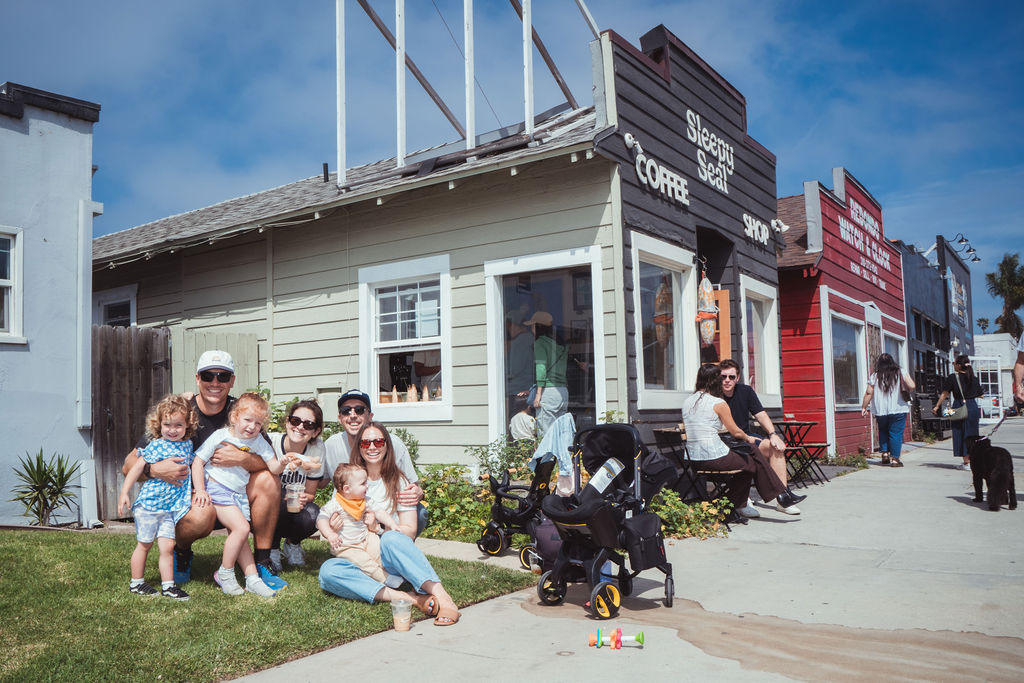
Which ultimately takes us to a quaint little coffee shop called Sleepy Seal, nestled into an historic building at 205 S. Pacific Coast Highway in South Redondo Beach. A neighborhood spot, run by one of our neighbors.
One glance at Dave Israel, and you might just think you’ve encountered the California dream encapsulated in a pillar of tall, dark, and handsome stoicism. A surfer and part-time/recurrent lifeguard you might’ve caught ripping past you along the sidewalk on a skateboard being towed by his best furry four-legged friend. Somewhat reticent by nature, yet readily available to engage with natural charm. He’s a total dude, and a deeply rooted man of Redondo.
Born-and-raised Redondo, Dave grew up a few blocks from his eventual shop in town. He graduated RUHS in 2008, and worked a number of youthful odd jobs throughout his teens, including a stint at the Vons off of Beryl, where he collectively gained enough work experience in learning what he didn’t want to do. And if he could really help it, he saw how he didn’t want to do it.
“I’ve always had this, um… Like, I’ll be driving in the car, and I’ll look at the dude next to me and it’s like this 65-year-old guy wearing a tie going to work, and I’m like, ‘That guy looks friggin’ miserable.’ I don’t want to be doing that,” he says. “Like, honestly, I’ve thought about that so much. So I think it really all starts there.”
A stint in the beer industry followed. After a moment providing the revered community service of slanging pours at Naja’s Place down at the boardwalk, and some grunt work with (the now defunct) The Dudes’ Brewing Co. in Torrance, he was brought on as assistant brewer at (the now defunct) Phantom Carriage Brewery in Gardena by then head brewer Brenden Lake (current owner/brewer of Burnin’ Daylight Brewing Company in Lomita). Which led Dave and his best friend—Hermosa/Redondo Beach born and raised fellow 2008 RUHS graduate, Robby Horn—toward the sudsy daydream of opening a brewery together. One problem, they didn’t have millions.
However, a burgeoning cold brew coffee scene was popping at this time, and they saw room for themselves to shine within what they thought could be a more obtainable endeavor.
“Around that time, me and Robby were thinking about doing something for ourselves,” Dave recalls.
“Robby had worked in the action sports industry—outside sales for surf brands… And we’d both been like, let’s do something of our own. We wanted to do beer. But didn’t have any money, didn’t have any experience raising money, didn’t know the first thing about being entrepreneurs. We were so naive. Later Days—and probably Sleepy Seal, actually—would have never existed if it wasn’t for that naivety.”
“Cold brew [coffee] was on the rise. So we’re like, ‘What about coffee?’ We thought we could make a better brand than what was out there, and hopefully a better product. Like, these other companies that are lame are doing it—Chameleon Cold Brew sold for $500 million… I just started making cold brew. With that sort of South Bay mentality of, like, fuck it—we’re just gonna do this. And that’s sort of where Later Days came from.”
And so Later Days Coffee Co. was born in 2015. A simple, high quality, health-conscious cold brew coffee, using a bare minimum of ingredients—just coffee and water—blooming from humble beginnings.
“We started with Mason jars and hand-stamped tags. And people loved it!” Dave reflects, in reverie, with a mixture of tickled surprise and fledgling accomplishment.
But they didn’t remain in jars, crafting and slanging cold brew out of the house like it was moonshine, giving it away to friends and family. In fact, they secured investment capital and really went for it. They dreamed it big, and, hustling their asses off, they made it happen. Or so it would seem.
From the outside, Later Days looked to be an impressive success. With an eventual storefront office established at (yep, you guessed it) an historic building on Pacific Coast Highway in South Redondo Beach, where you could occasionally pop in to say what up to the fellas and grab a bag of beans or some swag.
And with their signature stubby bottles of cold brew (as well as cans) lining shelves alongside all the other players in major stores such as Whole Foods, Erewhon, Lazy Acres, and Bristol Farms—not to mention a more personable support from local shops like Granny’s Grocery, Mickey’s Deli, Brother’s Burritos, Homie, Rock & Brews, Malaga Ranch Market, HopSaint Brewing Company, and Select Beer Store—it was easy to think they’d actually made it.
And perhaps the penultimate feat of the entrepreneur is to always present calm seas upon a shiny surface, no matter how the undercurrents push you around or threaten to drag you beneath. Remain calm, and always professional, even while you’re freaking out. Hold fast and steer the ship straight, while you’re dodging cannon balls and unfurling sails from all sides. And fight with fierce determination to stay afloat, to maintain course for that sweet terra firma of land-ho.
Alas, stable ground proved an increasing challenge for Later Days to maintain. At some point, with his first baby on the way, it was agreed that Robby needed to secure a job rather than run the business. Dave hung on and hustled as best he could for sometime thereafter, but by 2022-23ish, he also had to unfortunately let it go.
But he still had this building. This bitchin’ building.
There’s a little strip of about a handful of historic buildings along PCH on either side of Garnet St. in South Redondo, just around the corner from the pier. They stand out so starkly that they almost appear contrived, like a factitious throwback. But, to be sure, they’re genuine remnants of a young South Bay, dating back to the early 1920s.
From the ashes of Later Days Coffee Co., standing at the crossroads of conundrum, upon the precipice of pondering the plunge back into the employment pool, Dave looked at this building, this old house-store hybrid of a structure, and still smelled coffee in the smoldering embers of his entrepreneurial dreams. He couldn’t stomach the idea of walking away to see it stripped of its soul and watch it turned into something hollow.
“It was a fork in the road. Later Days was done and I still had the lease on the place. I’m like, ‘Alright, I’ve been suffering trying to be an entrepreneur for seven years.’ I was burned out. I was ready to go get a job. I was like, ‘Dude, I can’t support myself.’ But I had a tough time letting that place go, because I knew how money. And I realized, ‘If I give this up, I’m not going to be able to open a coffee shop. You’re just not going to have the opportunity again.’ And I would have been pissed if I let the lease go and something whack moved in there.”
“I think that was the turning point. You can’t be in the middle. Either you’re doing this or you’re not. And at that point I was like, ‘Fuck it, I’m gonna open a coffee shop.’”
And so, with the invaluable financial support of family and friends who believed in him, the glutton for punishment dove in hard again.
“I didn’t have any money,” Dave recounts. “I had to go borrow money from friends and family. I hired an architect who probably hated me. Eventually submitted plans to the health department—that took forever, back and forth with the city. The city would say you can do this but you can’t do that, and I’d have to go back to the health department. It was a bouncy ball.”
“Eventually got the plans approved, hired a contractor, told the landlord what I was planning—ripping up floors, all new plumbing—and they gave me the approval. First couple weeks, they jackhammered the front room. I walked in and I’m like, ‘What the fuck am I doing? I don’t even have enough money to get this place open, the floors are torn up, I don’t own this building…’”
“But I was like, ‘Alright, I’m really in it. What’s the worst thing that can happen? I can’t pay rent and I gotta vacate. My dreams are crushed.’ But that was really the thing—the floors are fucking torn up, we’re not turning back!”
Best bud and former Later Days co-owner, Robby Horn says:
“I can’t tell you how tirelessly he [Dave] worked to get that place open. His back was up against the wall from day one, and truly on a shoestring budget. He sacrificed a lot, but, with a hell of a lot of determination, he was able to beat the odds.”
“He’s about as loyal as they come, and as hardworking as anyone you will meet. He’s not afraid to get his hands dirty and figure things out himself. When creating and building something, there are a ton of obstacles that happen throughout the course of a day, a week, a year—what makes Dave different is that he doesn’t let that stop him, he always finds a way to make it happen.”
“On top of all of that, he is very humble and (like Sleepy Seal) authentic. I think that’s a big reason why it’s been so successful and why everyone wants to come support. They feel that on him and naturally gravitate towards it. Nothing is forced.”
With minimal resources, and a minimalist eye for aesthetic and style, Dave’s instinct was to transform the good old bones of his homey domicile into a warm and welcoming community harbor for connectivity, interactivity, and a solid craft coffee.
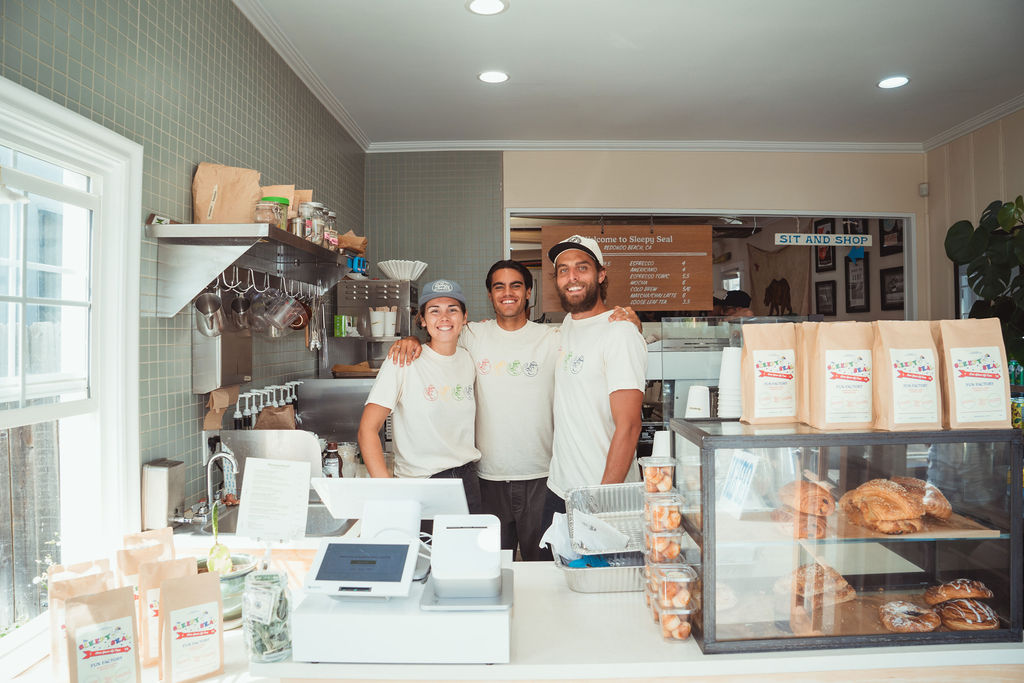
Before you even step foot into Sleepy Seal Coffee Shop, the cuteness of its historical essence begins to hit you. Today’s hospitality slaps you with a smile while already knowing your order, as a weighted and fuzzy funk left behind from yesterday’s lives invites you in to peer further.
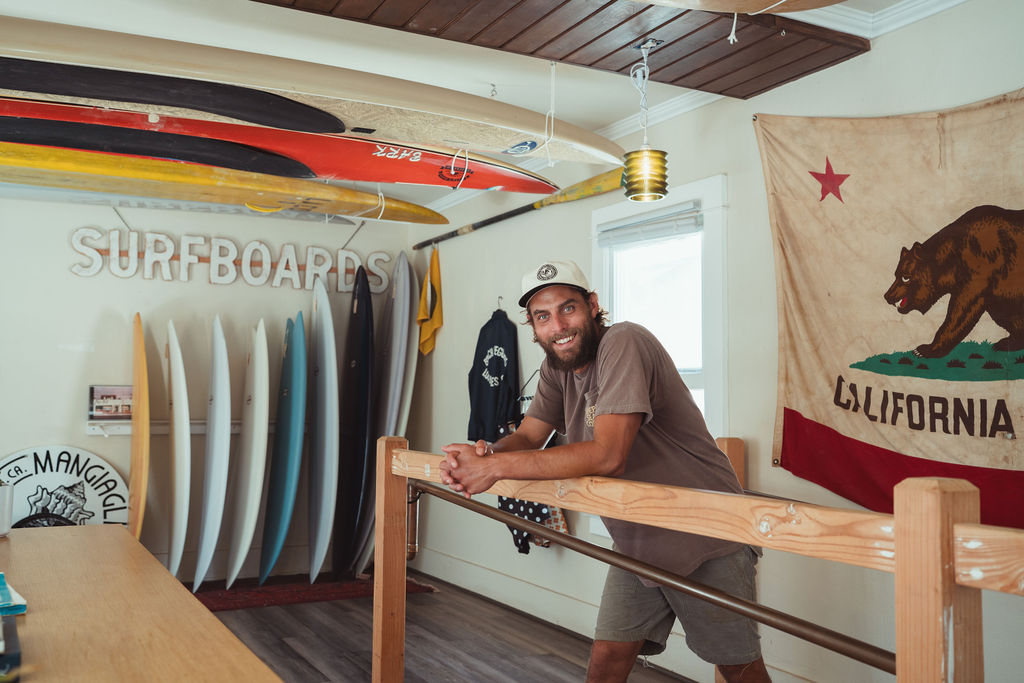
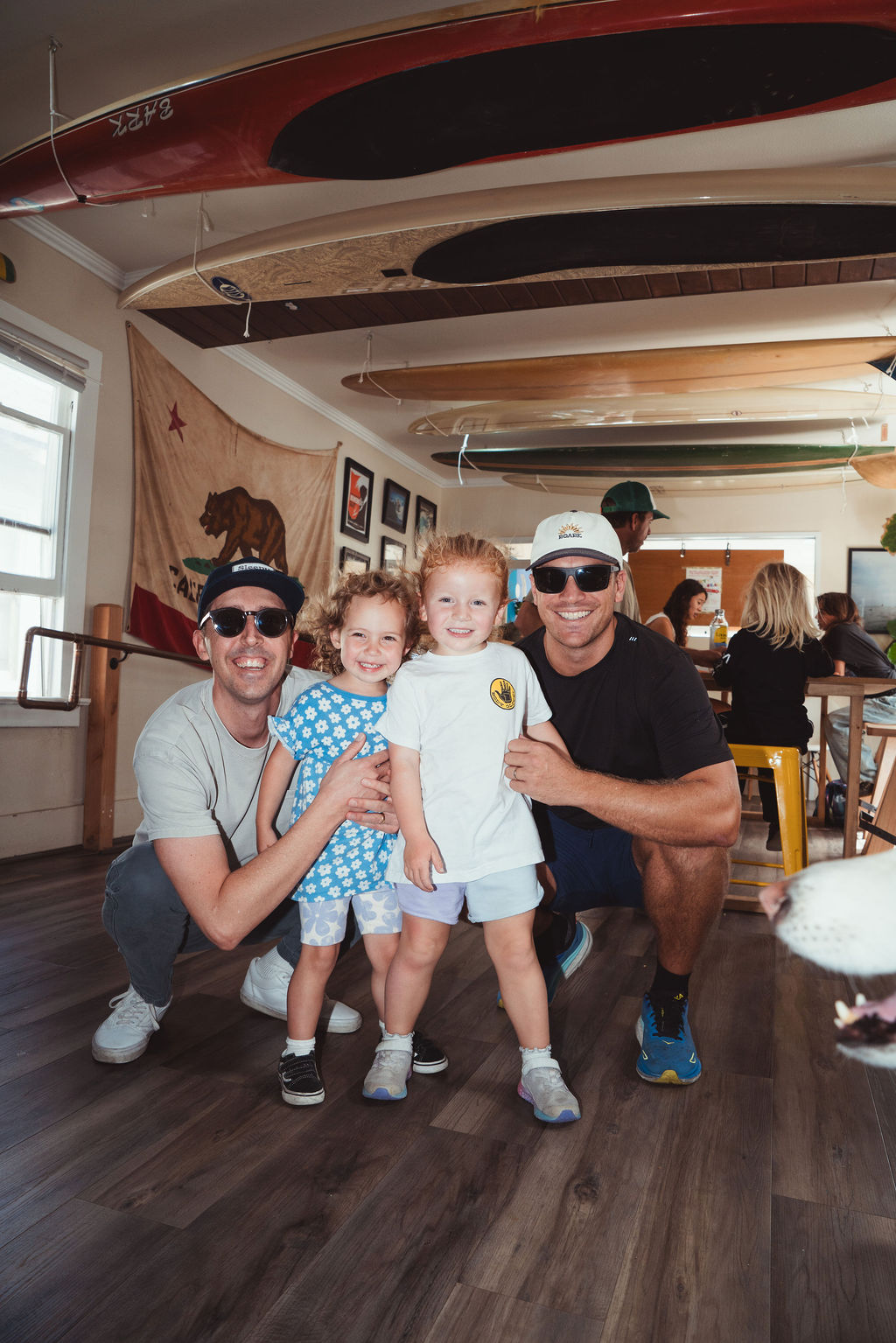
The greenery of plants and cacti color in nooks and crannies, and a sense of micro-museum anchored in local surf and beach culture grasps at your gaze. But not in a cheesy or forced way—there’s no “live, laugh, love” beach life energy. It speaks it without saying it.
Vintage surf and paddle boards hang from the ceiling. Signed LeRoy Grannis photography adorns the walls. An old school black and yellow Body Glove sticker has its hand slapped atop a genuine, tattered green lifeguard tower tide chart. A well-worn California Republic flag announces itself loudly and proudly while looking like it survived Woodstock 1969 on the back of some hippie, mud stains and all.
Yet, it’s all really clean; even spare. But not sterile. To the contrary, it all hums with the soft candlelight feel of home. (And to be honest, the vibe is really none too different from Dave’s actual home.)
Dave himself is a craftsman, to be sure. Even down to the detail of which bottled sparkly water he stocks in the refrigerated section, or the Zacatecan-style burritos by Burritos La Palma he serves, every morsel of Sleepy Seal bears the fingerprint of a craft curator.
A large part of his goal was informed by envisioning a place where he himself would want to go for a cup of coffee. In an environment where you don’t have to raise your pinky to drink it.
“I didn’t want to open a place that’s going to be a cookie-cutter coffee shop,” Dave acknowledges.
“I don’t want to have a pretentious coffee shop… a precious coffee shop. There’s a customer for that, I just don’t really want to be on that level. I thought, ‘How do I create this space for the community…?’ I thought that was important, especially these days.”
“We’re living in a crazy fucking world. You can go to a spot where a robot makes your coffee! ‘How do I create something where somebody could walk in and feel something?’ You walk in, maybe expecting to get an Americano, but then you look at something, or you talk to somebody, and you’re like, ‘Yeah, that was cool—my day is a little bit better from that, I learned something I didn’t know.’”
“Whether you’re from Redondo or you’re stopping by, I just didn’t want it to be like a dental office coffee shop.”
Local customer Ricki Jones says:
“Sleepy Seal, with its warmth and uncomplicated coolness, is a marker for grit and good coffee. It’s a hallmark of the South Bay spirit. And an homage to Redondo’s yesteryears.”
“The space itself is a literal coffeehouse. And, Dave, with his penchant for a good ole clean design scape and taste for a vibrant roast, is the humble genius behind it all. He’s created a space for community, for connection, for quiet, for contemplative thought, for exploration, and for history.”
For Robby Horn, the key element is authenticity.
“It’s not trying to be something it’s not,” he says. “From it just gives the vibe that you’re somehow on the local ‘in’ and makes you want to support.”
“Most of the memorabilia, boards, and wall hangings in there came from local legends who don’t care to be named or want the adoration; they just wanted to help out a local entrepreneur.”
“Lots of old lifeguard and watermen stuff collected from guys like [Jon] Mangiagli, Derek Levy, Jeff Horn, Mike Murphy and more… The old [Rick] lifeguard board on the ceiling is from Andre [Klaser] of Granny’s Grocery… The list goes on!”
If you poke around, you’ll also notice a seamless touch of the new that’s still beating to the same pulse, in the form of sales goods from fellow local craftsmen.
Crap Eyewear sunglasses. Stylish spring suit wetsuits for the ladies (by Our Ripples). Artisanal surfboards (from Jon Mangiagli). Artworks centered around real surf fins (by designer John Hudson), coastal themed watercolors (by VattArtt, aka Maddy Livingston), and surf photography (from Sarah Plenge), among occasional others.
Dave says he also wants to use the shop as a canvas to bring the community together by making it available even when it’s closed; which has already seen Entropy Creatives Craft Club holding art class events, and he’s scheming about the possibility of open mics.
But in a 103-year-old edifice, it’s those creaky bones that frame it all together. And Dave, who’s a self-proclaimed geek for local history, claims that his shop has Redondo in it without even trying.
In fact, so much so, that during the interior remodel he actually found an antique whiskey bottle inside the walls, dating back to the early 1900s and having originated from The Stag Bar, with the bottle label clearly denoting Redondo, Cal.
“The proprietor’s name is on the bottle: J. S. Schindler,” says Dave.
“I was poking around the Redondo Historical Society website and I found access to old city directories from the early 1900s. There was a different downtown of Redondo back then.”
“I found J. S. Schindler; it said proprietor, Stag Bar, and it had his home address. The only image I could find was a postcard, and it had a photograph or drawing of The Stag Bar, which looked like this elegant steakhouse, with a beautiful wood bar. This shit blows my mind.”
The Stag Bar wasn’t seated where Sleepy Seal now resides (perhaps it was where Antique Corral has been since 1973, just across Garnet St.), but a customer recently popped by with a heck of a story, revealing to Dave that she had actually lived in his very building from 1948-1963.
“My parents Edward and Mary Crowley were the owners of Redondo Watch & Clock Repair Shop from 1948-1974 at 205 and 207 S. Pacific Coast Highway,” says Dr. Colleen Crowley.
Perhaps that Stag Bar whiskey bottle was part of Edward’s stash.
Colleen says that her family of eight—her parents along with their six children (who all attended RUHS)—lived behind the clock shop storefront, in what is now Sleepy Seal’s main seating area with its long table.
They then moved directly next door, where Redondo Watch & Clock Repair still stands to this day after Colleen sold it in 1974 following her father’s passing. She says that the back shed is still behind “the red clock shop.”
It means a lot to her to still be able to drive past the buildings and be transported straight back to 1962 with every passing glance, let alone to be able to walk into her former childhood home and admire what Dave has done with it.
She says that he now represents old historic Redondo.
And she told Dave, “I love the changes you created in our home. Sleepy Seal is the best coffee shop in Redondo!”
Sleepy Seal has Redondo in it. And so does its name.
“Redondo has always been this sleepy beach town to me,” Dave says.
“As close as we are to Hermosa and Manhattan, they’re all very different, and Redondo has always been this last sort of sleepy beach town. Growing up here, I had a west window in my bedroom, and I heard seals all the time. I don’t know why I thought about a sleepy seal… That felt good to me.”
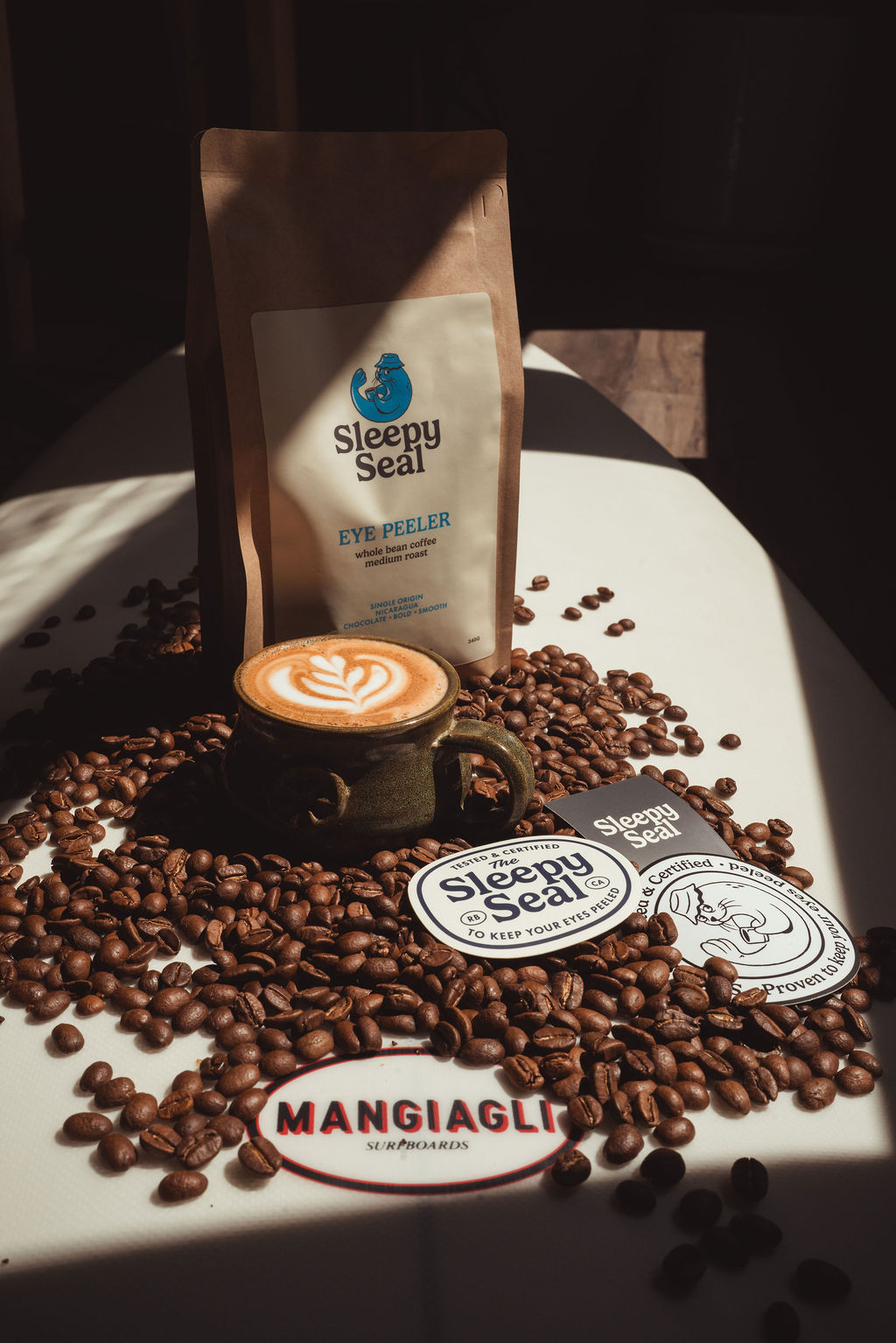
And with the help of his branding maestro Mike Pargus, the adorable signature Sleepy Seal logo of a seal wearing a sailor hat and holding a cup of Joe brought the visual to life.
Dave and the crew just celebrated their one year anniversary on March 28, commemorating the occasion with a special bag of beans which paid homage to The Fun Factory, both in name and graphic style, using the same zany, off-kilter, colorful font as the Redondo relic itself. And shop t-shirts to match.
Standard Sleepy Seal fare is a medium roast of single-origin Nicaraguan green beans that Dave sources and then has a contract roaster perfect to the profile he wanted for the shop, preferring something that could be drank black without requiring a bunch of milk and sugar.
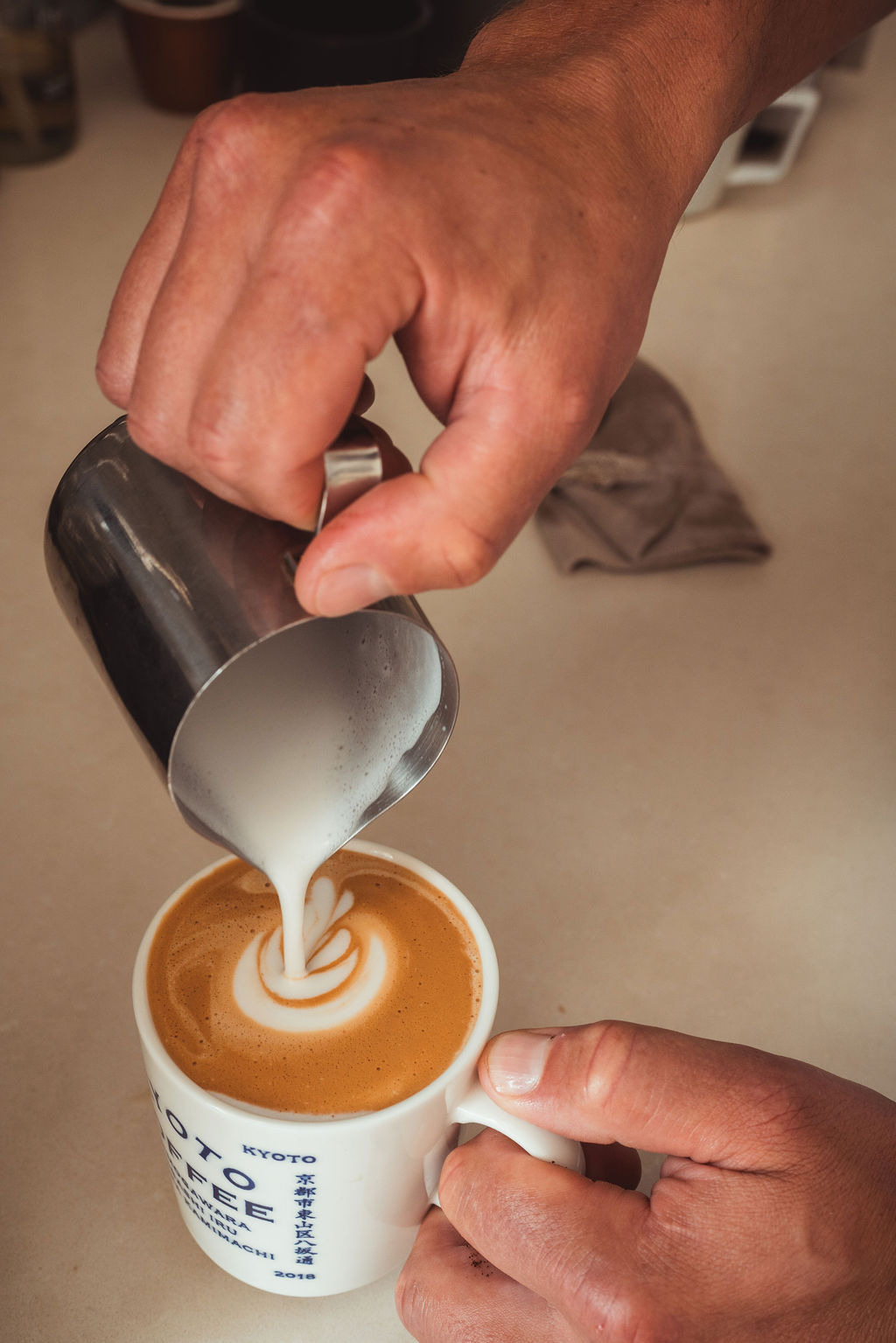
And they do it all, from hot or iced lattes to half-caf Americanos and cortados to just a cup of Joe.
Dave says:
“We’ve become known for our Flat White, with a lot of good feedback from Australians. People love our cold brew. The espresso tonic has been quite popular—a sort of bitter, citrusy espresso drink.”
“And we just rolled out our spring menu, which has some fun stuff. One of my favorites is a sparkling coconut water Americano. Another one is a raspberry iced mocha, people have been digging that a lot.”
In an ocean of coffee shops crowding South Redondo like the swarms hitting Haggerty’s when winter swell is pumping, it’s a joy to see one of our own plant a seed (or a bean) in the very soil he sprouted from and make it.
“There’s no secret to it,” Dave says.
“It’s just good experience, good coffee, and the rich history of where we live and the building you’re walking into. I feel really humbled to be in there.”
“And it’s been really cool to start something and see it blossom organically. You start a brick and mortar… You have this concept and this essence of what you’re trying to create, and why you think people will resonate with it. But you don’t know, you just don’t know.”
“How many people can leverage a year of their lives to not fucking know? Since I opened the shop, having had this concept that was only in my mind, and then seeing somebody who I don’t know, who has no idea I started the shop, come in there and be stoked on it; it’s sort of this full-circle moment.”
“Even if it ended now, I’d be like, ‘Ya know, I did something cool. People liked it. It was a good chapter.’”
“I don’t know if there’s another coffee shop in the South Bay that was started by somebody born from here, but I really felt like with the history of this building and with me growing up here, people would be stoked on it.”
“The concept of it was rooted in local history… Redondo is the forefront. This is in my blood right here—a love of Redondo, and a love of growing up here.”