
Words By
MARK McDERMOTT
It began with a thirsty and inquisitive man, grew to include his thirsty and increasingly friendly neighbors, and eventually grew into a homegrown institution. Because Smog City Brewing achieved that elusive thing that can’t quite be planned but can only be cultivated, then hopefully grown. It became a community.
In 2002, Jonathan Porter started brewing beer at home. “I fell in love with the process, with this blend of art and science,” he recalled. At the time, he and his wife Laurie lived in Venice, and his first taste testers were friends and neighbors. But then the Porters began noticing something: with every fresh brew, a congregation grew.
“We had a community of people that would come and drink the beer,” he said. “So my little kegerator with two faucets became like this homebrew tap room?”
“It was like a community hub,” Laurie said. “The door was always open and people were showing up and they’d have a beer, and they’d hang out and chat.”
Jonathan began brewing 30 to 40 times a year. “I was making lots of beer and lots of friends,” he later told the Food GPS blog.
In 2006, Jonathan graduated from the American Brewers Guild. He began with a job washing kegs at BJs Brewhouse in Brea, where he quickly rose to assistant brewer. He eventually became Tustin Brewing Company’s brewmaster. But he also began brewing his own beer, using Tustin’s facilities, and distributing it regionally. Thus in 2011 Smog City was officially born, albeit as a semi-homeless brewery.
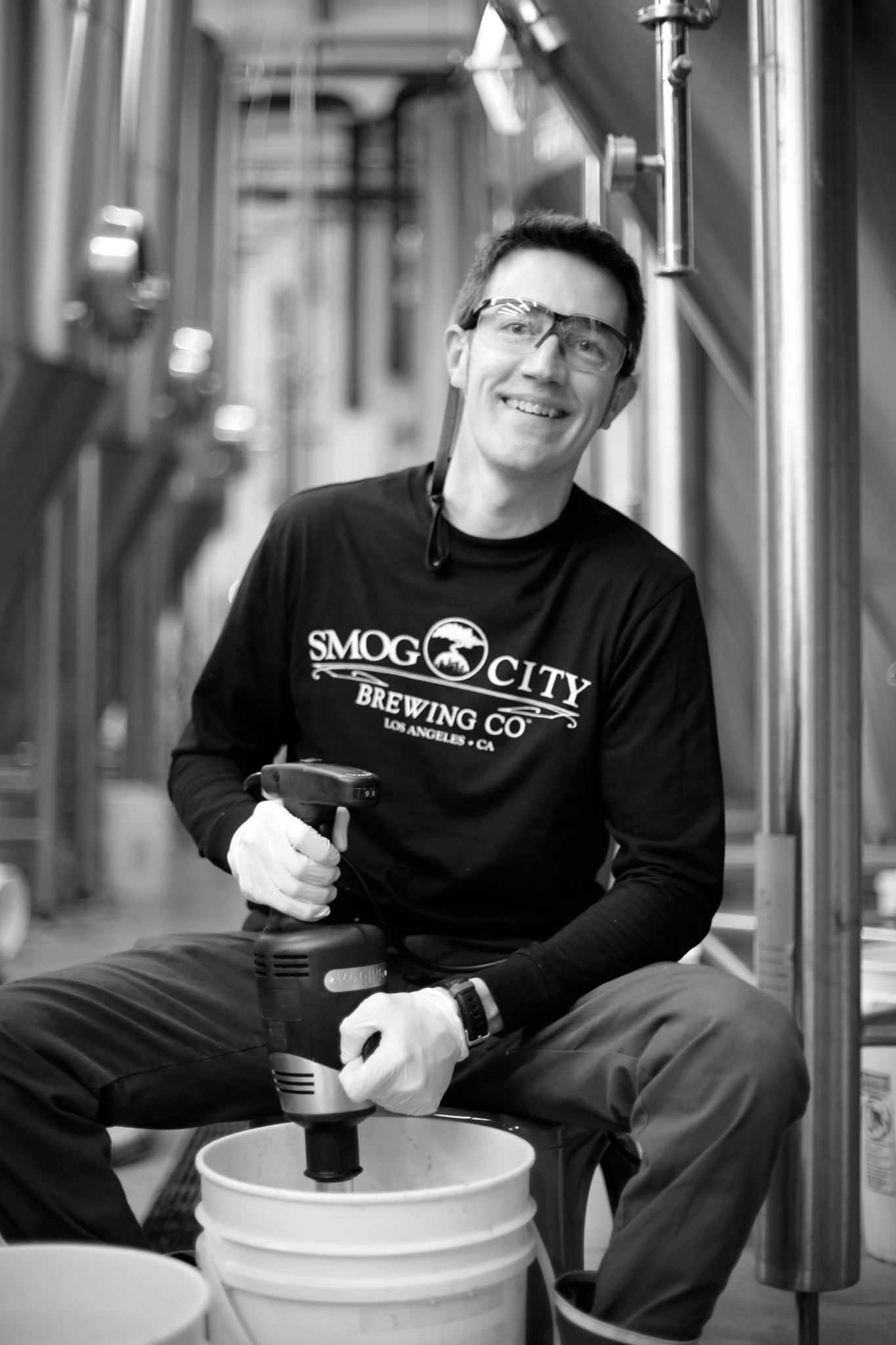
The name itself sort of descended upon the Porters, and they kept rejecting it.
“We wanted regional identity without being the Los Angeles Brewing Company or the California Brewing Company,” Laurie said. “…When we first talked about Smog City, of course it had a negative connotation, so we kept putting it aside. And eventually we said: it’s up to us to flip the script. People know it’s Los Angeles, and then it sinks its teeth in you.”
As the beer found a market, the Porters knew it was time to plant roots. Elsewhere in California, breweries such as Sierra Nevada and Stone Brewing had decades earlier fired the first shots in what would become a revolution, a rag-tag network of largely self-taught brewers launching little breweries taking on the behemoth-dominated big corporate beer industry. The revolution was finally coming to LA.
The Porters had a sense that their Smog City tribe could best be found in the South Bay. At the time, there were only three breweries locally — Monkish, Red Car, and Strand — and 13 in all of LA County. Jonathan had spent years commuting to his brewing gigs. They had a toddler, their son Emmett, and Laurie was running the business side herself, driving around LA in her car delivering invoices and keg handles while Jonathan made the beer and shuttled it back. They looked at properties in Venice, El Segundo, Santa Monica. Then Laurie walked into Strand Brewing and met Rich Marcello, who with brewer Joel Elliott was one of the South Bay’s early craft beer pioneers. He told her to stop looking.
“Don’t go any further,” he said. “Torrance is business friendly. The weather can’t be beat. The people are awesome.”
Smog City found a home in Torrance. Marcello’s warm welcome was indicative of the fledgling local craft beer scene.
“I think that’s also the benefit of being a rebel young industry rising up against big beer,” Jonathan said. “You know, we’ve got to link arms. We’re not fighting each other. We’re fighting the big guys who are taking our handles, who are dominating all the bars. And we still are…They’re losing market share, so they’re fighting harder. I think they kind of took us for granted for a while. ‘Oh, look at that little, cute little industry happening.’”
Fifteen years in the craft beer industry is a genuine landmark. Jonathan still does a double take when customers call Smog City the old guard. Then he sees people who used to come in as little kids with their parents who are now 22 and sitting at the bar on their own. “You’re like, oh, okay,” he said. “We have been here a while.”
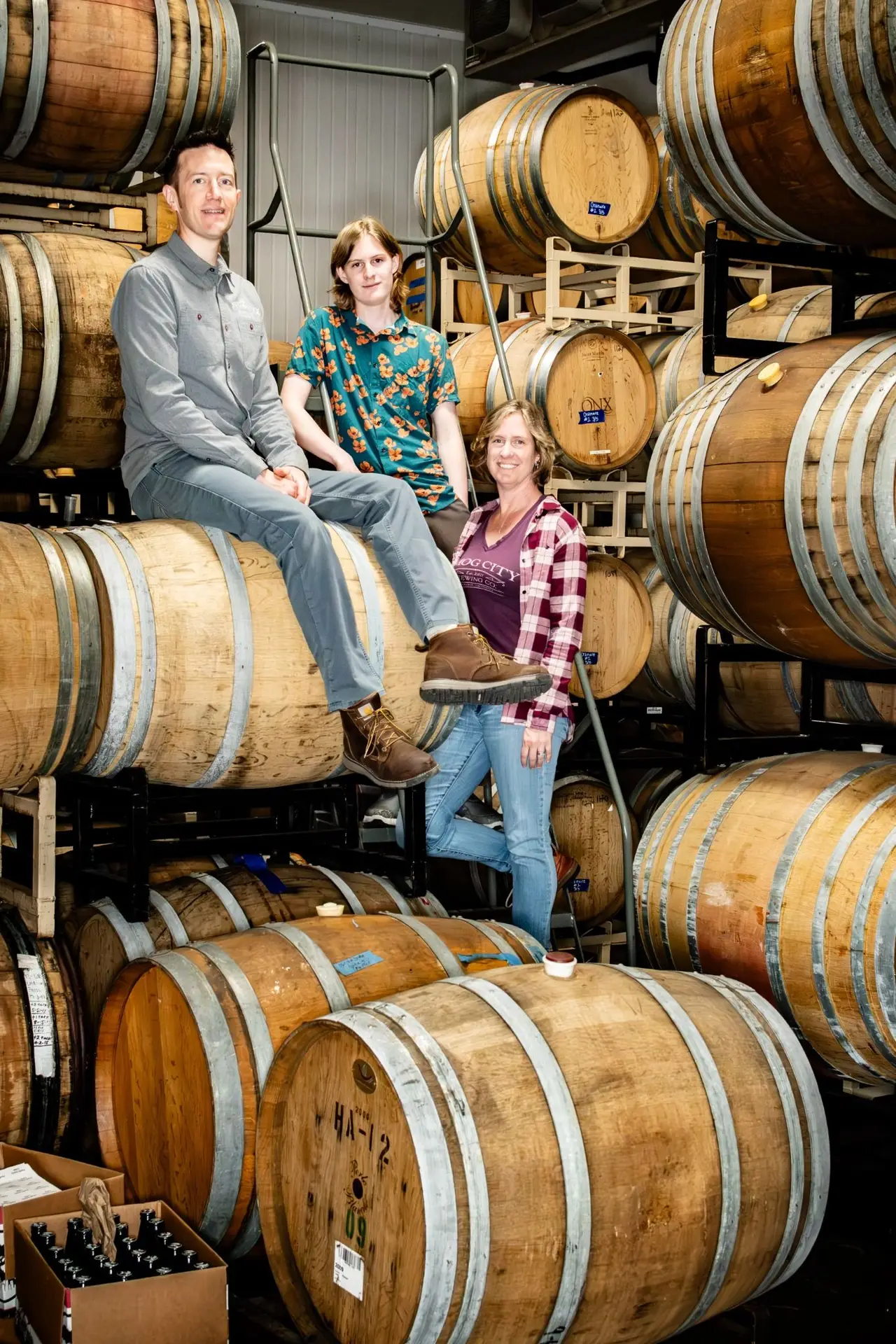
Brewers have come up inside Smog City’s production facility and gone on to run breweries of their own. Customers evolved into employees, and employees into managers. Todd Worley was a regular; he now manages Smog City Heights, the brewery’s ambitious first full restaurant concept. Marcello Cavallo was a devoted fan and now works across all of the South Bay locations.
“Fifteen years is a real point of pride for me,” Jonathan said. “How far we’ve come, and how many careers we’ve nurtured….And we really wouldn’t be here without the fans — without people somehow making us their beer.”
Laurie experienced another measure of Smog City’s OG stature when she stopped into the Vons in Hermosa. She asked a young cashier, maybe 16 or 18, if he knew about Smog City beer. He said he didn’t drink. “But Smog City is my dad’s favorite beer,” the kid said. She laughed retelling it. “We have made it to Dad’s favorite beer.”
Their own son Emmett is 16 himself now. They think he is somewhat proud of Smog City. But they stop short of believing they’ve achieved cool parent status.
“I think we’re cooler than the average,” Laurie said.
“I don’t know that he would go that far,” Jonathan said.
Craft beer is about beer, but it is also about more than beer, kind of like how Moby-Dick isn’t really a book about a whale. Craft denotes a deeper level of attention, on a more human scale. What it is really about is independence, and the quiet insistence of a community providing for itself.
“I think a lot of people resonate with that,” Laurie said, “because we live in a world where Amazon will deliver you anything, and you don’t know who made it, where it came from, or where the money’s going. Craft beer gives you this holistic experience where you see the brewers, the owners live in your area, your friends are drinking the same thing you are. You find your tribe, the space where you feel most comfortable. It’s bigger than beer. And I think that’s why craft beer sustains.”
The congregation of a taproom works the way it does, Jonathan says, because beer is a remarkably calibrated social instrument — its moderate alcohol content lowers the guard just enough, facilitates connection in a way that harder substances don’t. The taproom gives that something to organize around.
“Every person in there shares one singular thing,” Laurie said. “They came to drink Smog beer. And then all you have to do is say, ‘What are you drinking? Is this your first time?’ And now you’re in conversation with a perfect stranger you might never have crossed paths with.”
She thinks of it in terms of algorithms — social media narrows, funnels, repeats. The taproom gives you one seed and opens in every direction. Politicians, electricians, retirees, students, tourists from Germany. “You just don’t know,” she said. “And I think that’s super cool.”
The beers themselves anchor all of this. Little Bo Pils, a crisp Bohemian pilsner that features Czech Saaz hops, remains one of the most recognizable beers in the lineup — restrained, precise, built to be lived with. The Amarilla Gorilla IPA is a longstanding favorite among a certain tribe of hopheads. The Coffee Porter, brewed with locally roasted beans, has changed the least of any beer in 15 years. When a malt supplier was recently lost and a switch became necessary, the instinct wasn’t to take the opportunity to modernize it. The instinct was to make it the same.
But the flagship beers are only half of the Smog City story. The other half is innovation, and at 15 years the Porters are leaning into it harder than ever. The taprooms now carry 27 beers at a time, all made in house, spanning farmers market fruit sours, bourbon barrel-aged darks, and everything in between. A new five-barrel pilot system, just installed alongside the 15-barrel, gives them room to experiment at a smaller scale with less risk and more creative freedom.
“We can be even more experimental, more irresponsible with ingredients, because we don’t need to buy them at such scale,” Jonathan said. “We can teach people about flavor in ways you don’t get with three or four core brands. That’s what makes a taproom special. The freshness, the variety, and getting people excited about that again. I feel like some of that excitement is lost. ‘Oh, it’s craft beer. Craft beer is everywhere.’ No — it’s different. Every brewery is different.”
As a descriptor, the words “craft beer” don’t quite convey the full wonder of what is possible when a brewer as skilled, experienced, and communally conversive as Jonathan Porter gets a wild hair.
Consider the beer he hasn’t brewed yet.
A British chef friend came to Jonathan with an idea: an English bitter. Jonathan liked it, with conditions. You can’t call it a bitter, for starters. Too scary a name for American drinkers. And let’s talk about the sweetener. English beers use invert syrup for dryness, for bitterness, to lighten the body. But this chef sources an avocado honey from a specific farm, uses it as the only sweetener in his kitchen, for everything. Porter said: bring me that honey. And then — because fennel grows wild on roadsides all over Southern California, and Smog City has foraged it before — he suggested they go out and harvest the flowers together.
“Now we’re tying the story of the way he sources his products to this beer,” Jonathan says. “We can talk about the apiary, the flowers, the restaurant. And the restaurant gets to talk about us. We’re weaving together people from all these different walks, and we’ve built a larger and more interwoven community. That’s more interesting to me than what ends up in the glass. It’s just my job to make it delicious.”
That’s how he approaches brewing. That’s how Smog City has lasted 15 years when so many around it have not. Not by scaling past the point of feeling, but by understanding that what they were really brewing was something harder to name and longer lasting than any beer.
They were brewing a conversation. They were brewing a community.
Long Live Smog City!